
Disaster Preparedness Bush Fire Legal Assistance – South Australia
March 2026
The South Australian Bushfire Legal Services project supported people and communities impacted by devastating bushfires in late 2019. The Attorney-General’s Department (SA) commissioned the Climate and Sustainability Policy Research group to undertake an evaluation of the project.
The project is a great example of best practice work from our sector. As natural disasters increase in frequency and severity, community legal centres need to be properly resourced to provide the help communities need.
Here we share just some of the features that made this project so effective, and some of the report’s recommendations. Read the report here.
Key features of success
Community engagement
The project team’s ‘boost on the ground’ approach was seen as best practice by community members, especially in the rural context. Being physically present in a community hub mean the team was accessible to most in the fire-affected region. This was supplemented with home visits, ‘roadshows’ and phone advice for a multi-pronged outreach approach to connect with most people who needed support.
Service collaboration
Service collaboration was an area in which the project excelled. By collaborating with local services, legal assistance providers from out of the area could access social capital and relationships. This model also acknowledged how interdependent people’s legal assistance needs were to other social supports post-disaster.
Building trust
Active outreach and embedded collaboration with existing services built crucial reputation and community acceptance. By sending the same person to a region each time, legal service providers could develop relationships with their clients. This protected clients from retraumatisation through repeated retellings of stories, and made community members feel like they could rely on their community lawyer.
Flexible & adaptable Staff
Staff were constantly responding flexibly to developing community needs, including shifting communication preferences. This was crucial to the success of project.
Effective services & materials
Legal service providers had some incidental time to plan, which meant program material could be efficiently assembled without compromising community engagement. This highlights the importance of funding this preparation work outside of disaster cycles.
“Many of our farmers didn’t leave their properties for many, many months, they wouldn’t leave, they didn’t want to be asked about anything, they wouldn’t leave but they needed support and help…we’d strategically plan Outreach to have [Project Officer] in the car to go out to start that legal conversation and then low and behold a couple of weeks later he actually rocks up to the centre to have a meeting with [Project Officer].”
“I have to say it was actually a Godsend and helped those people and enabled me to sleep at night… there was a couple of issues in particular that, yeah, could have gone really bad if we didn’t have that service because there really wasn’t any other options… I wouldn’t be quite as dramatic as saying it saved lives but it came pretty damn close to it. (P8)
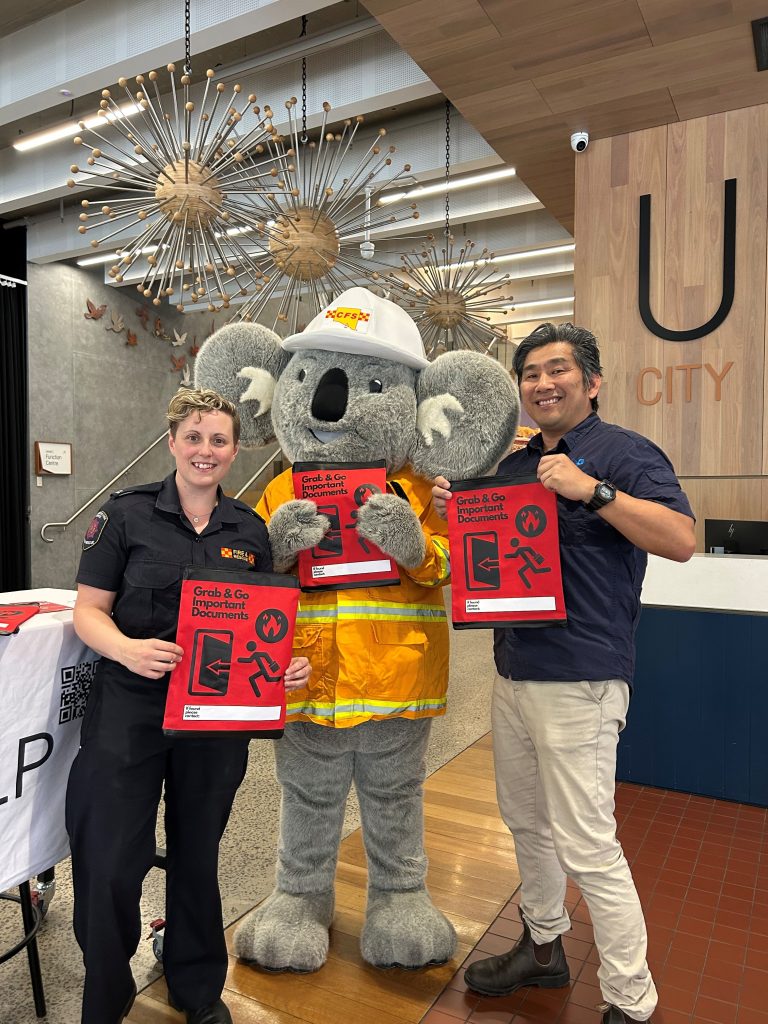
“Smokey” the Koala from the South Australia Country Fire Service with Ippei Okazaki from Community Legal Centres South Australia. Community Legal Centres South Australia designed, manufactured and distributed over 10,000 of these durable Grab and Go (important documents) bags that list out “what are important documents” on the back.
The report finds that the efficacy of a disaster response program, particularly in a rural context, lies in the relational aspects of service provision, which are equally as important as the actual services provided. This is what South Australian services did right.
The way programs like these could be improved is through the government’s funding models that account for the immediacy, scope and longevity of a project.
“Feedback shows that respondents were very satisfied with the project team and the services they provide, and would simply like more of them”
The Disaster Legal Support Program took out the 2021 Resilient Australia Awards State Award for Community Project and was national runner-up for the Kangaroo Island Efforts.
For those working in disaster response – this way of working is not new, we simply need governments to see the value in supporting the planning of this work.
That is why in our Actions for the 48th Parliament we are calling on the Federal Government to:
- Deliver additional funding via the National Access to Justice Partnership for community legal centres to deliver community legal education and other risk-reduction, preparedness, and resilience-building programs as part of business-as-usual service delivery.
- In consultation with the community legal sector, reform the National Emergency Management Association’s (NEMA) standardised disaster recovery legal assistance package. Ensure the funding model is fit for purpose and delivers timely and flexible funding to community legal centres when a disaster is declared.
- Task NEMA to work with states and territories to ensure a nationally consistent approach.