
Justice where we live
Justice in regional and remote communities
All people deserve equitable access to justice and due process, wherever we live.
People who live in regional, rural, remote and very remote (‘regional and remote’) communities face unique barriers to accessing justice.
Regional and remote communities are seeing growing numbers of victim-survivors of domestic and family violence in need of support, a deepening mental health crisis, high levels of poverty, an urgent need for support for young people to make safe decisions and avoid contact with the justice system, and an escalating rental crisis. All of these factors, and more, drive high and escalating legal and related need.
The ‘solutions’ governments put forward to justice barriers in regional and remote areas are often one-size-fits-all and can be ineffective. Government funding models for frontline services rely too heavily on population data, and don’t aim to provide full geographic service coverage. They don’t accurately reflect the true cost of delivering effective services in regional and remote areas. This means people in regional and remote communities have less access to services, both in number and diversity of services. Frontline services in those areas are left trying to meet a great number of different needs for people who rely on them, with limited resources.
Community legal centres supporting access to justice and safety in regional and remote communities
There are at least 50 organisations in the community legal centres movement based in regional and remote communities. Most provide services across a very large geographic catchment area, with some making regular road trips of hundreds of kilometres to provide outreach services to the most remote communities, including Aboriginal and Torres Strait Islander communities. There are a range of statewide and national centres with offices based in metropolitan areas that also do a lot of work supporting people in regional and remote communities, including through regular outreach travel.
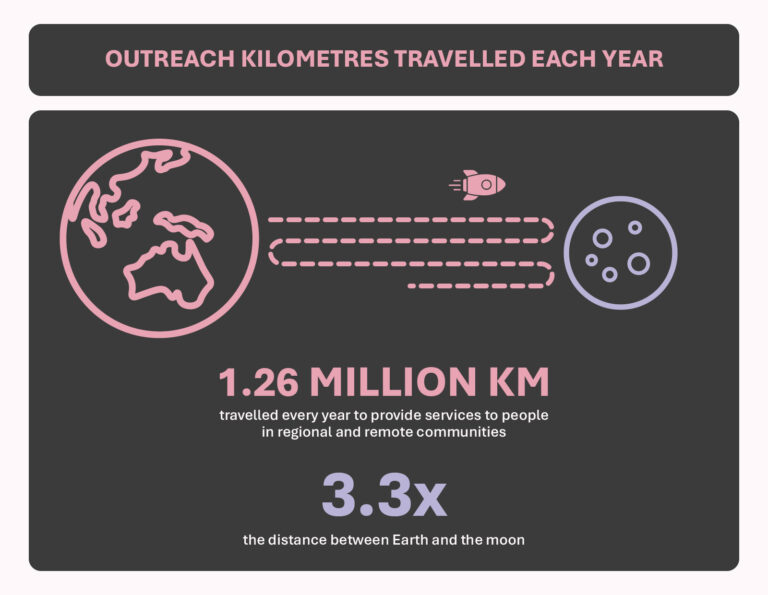
Community legal centres travel a combined 1.26 million kilometres a year to provide services to people in regional and remote communities. That’s far enough to travel between Earth and the moon 3.3 times.
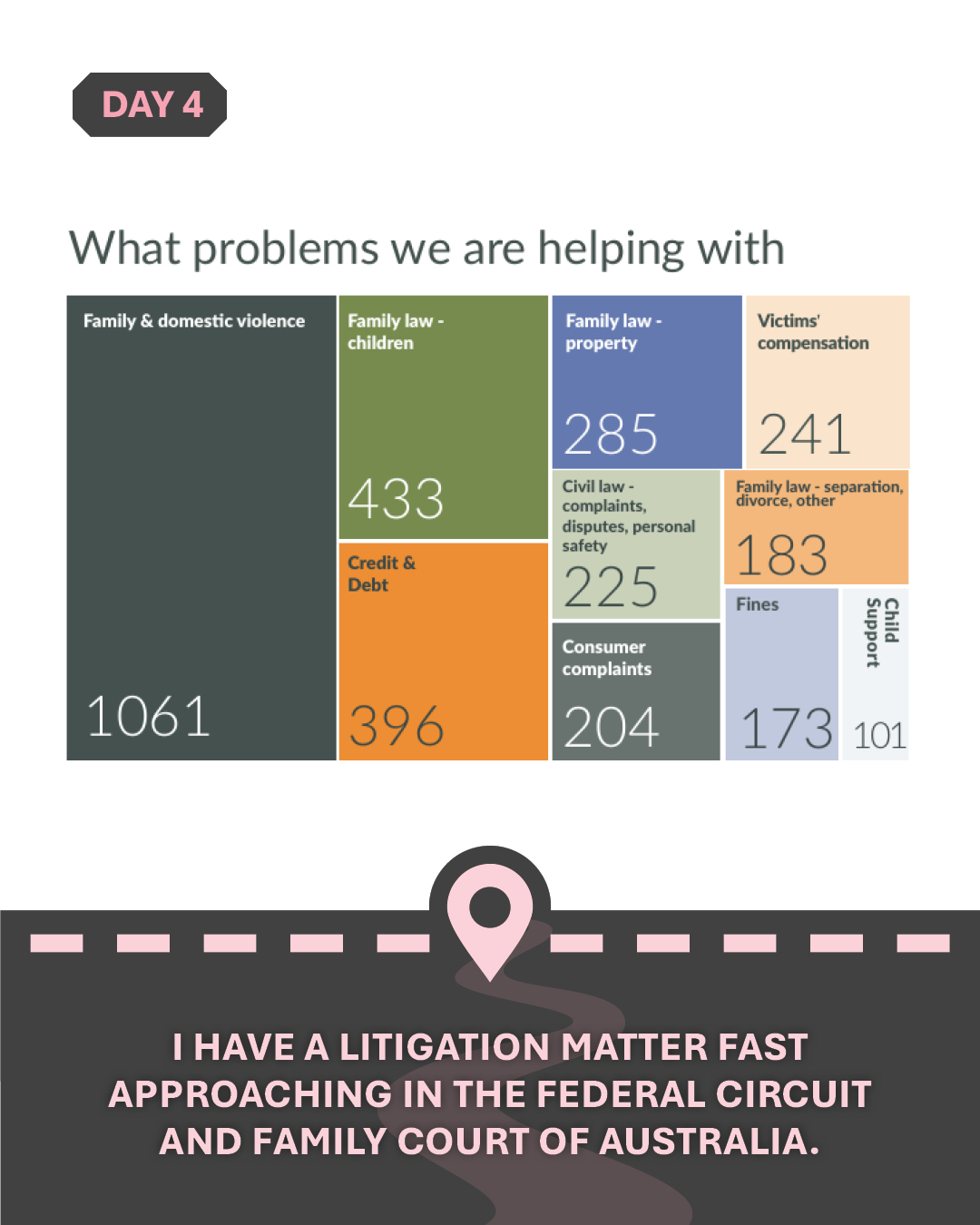
The largest area of work for the community legal sector is frontline support for victim-survivors of domestic and family violence, making up 40-50% of our work nationally. This rises to 75% for community legal centres in rural, remote and very remote areas.
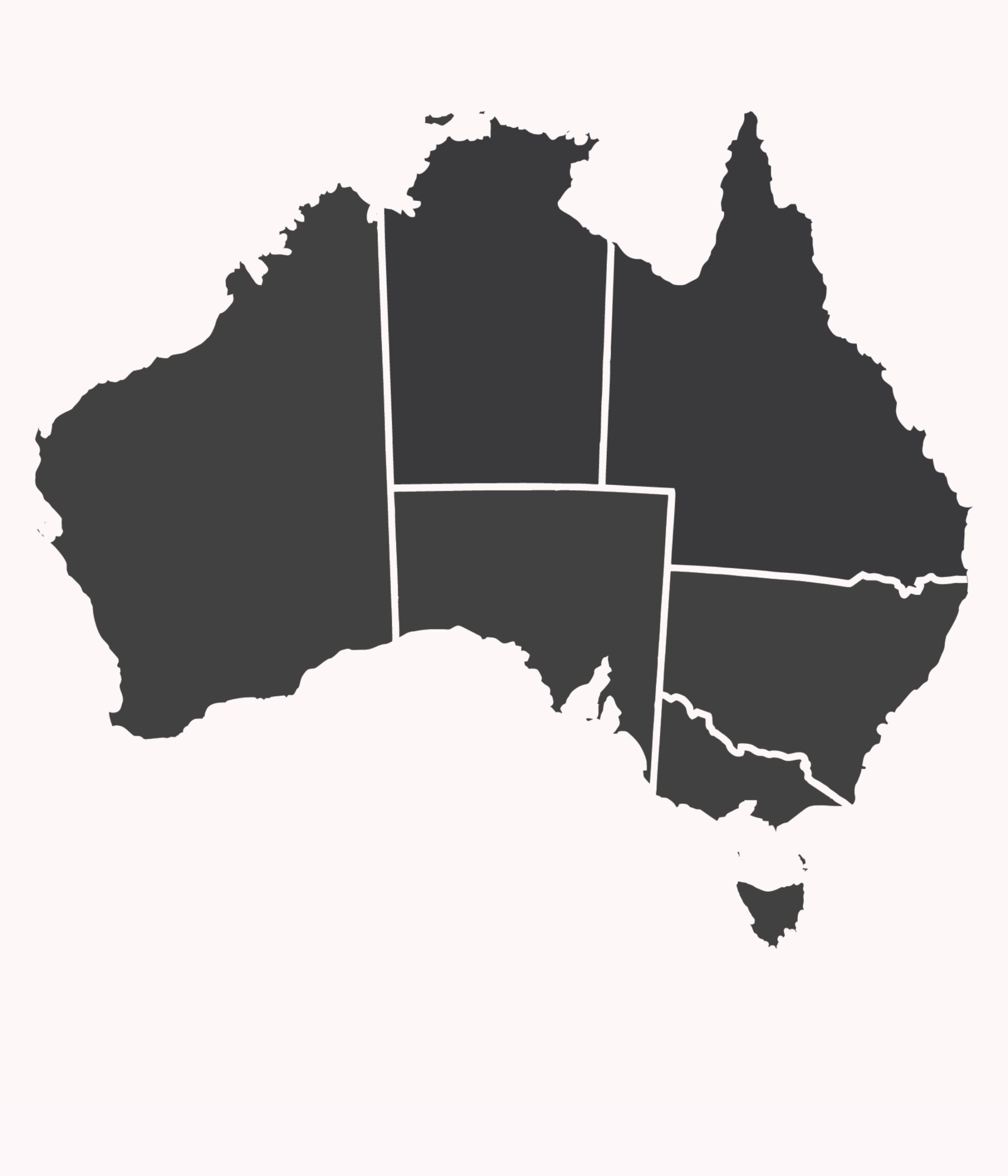
Use our interactive map tool to learn more about different aspects of the work community legal centres do to support justice and safety for people in regional and remote communities.

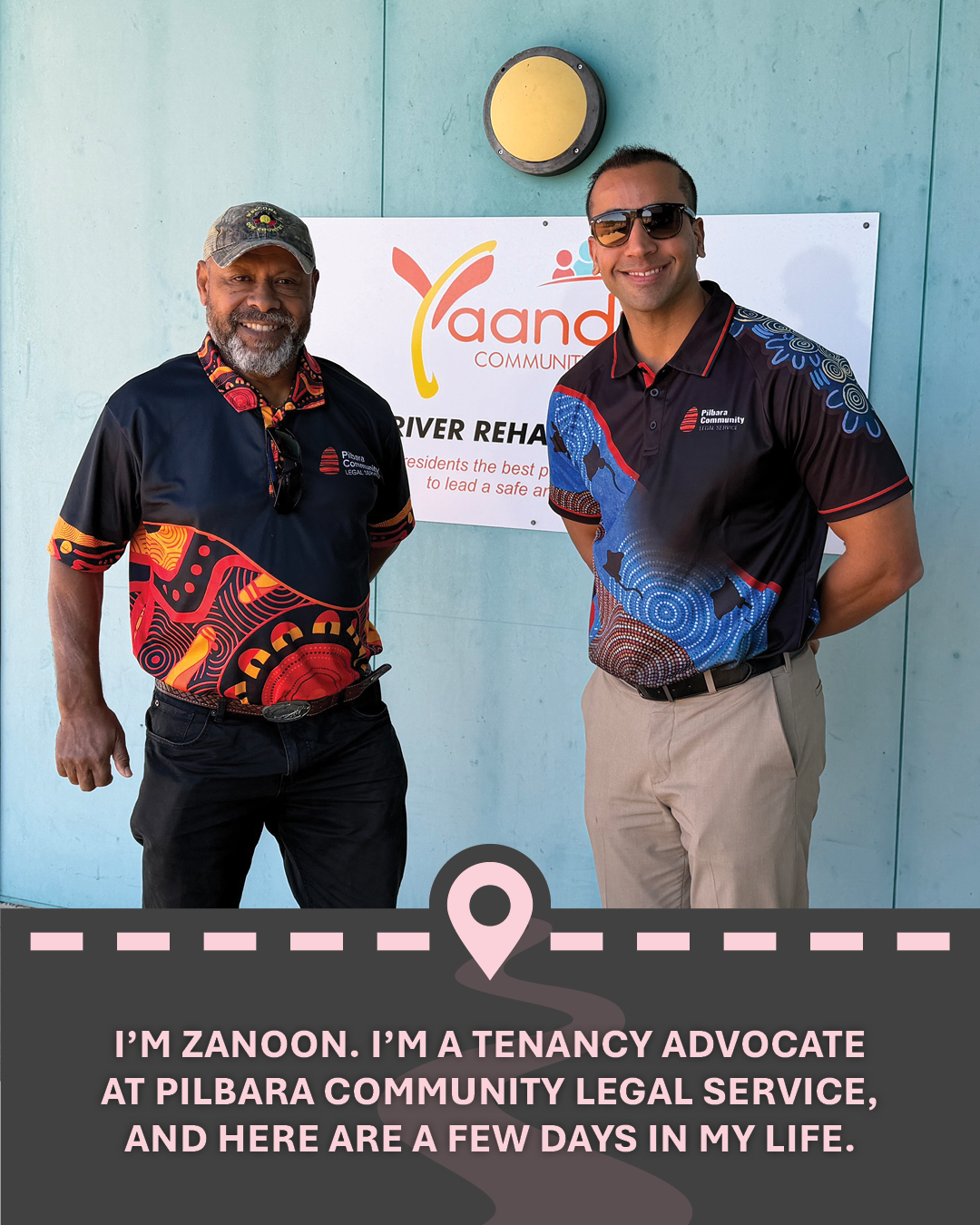
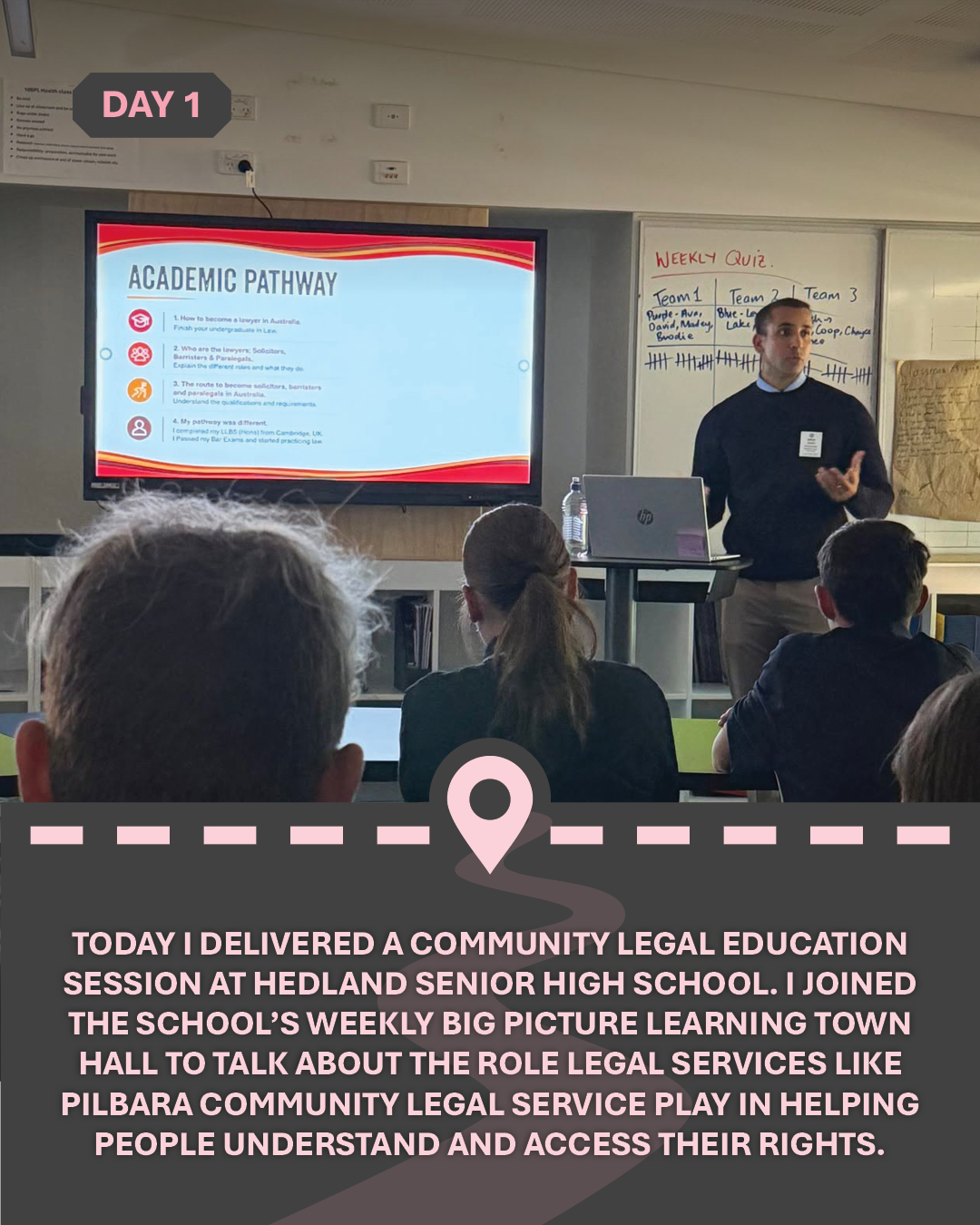
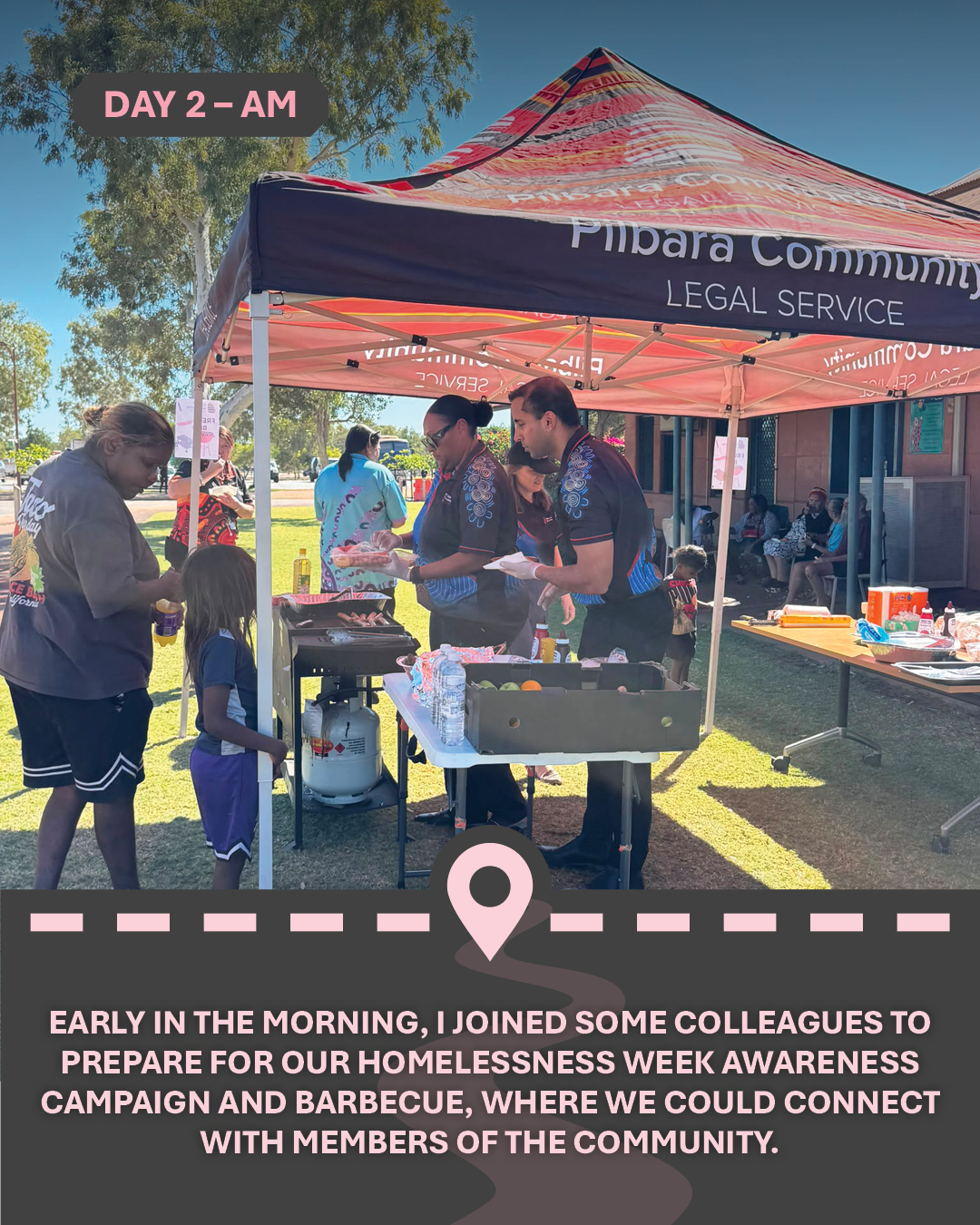
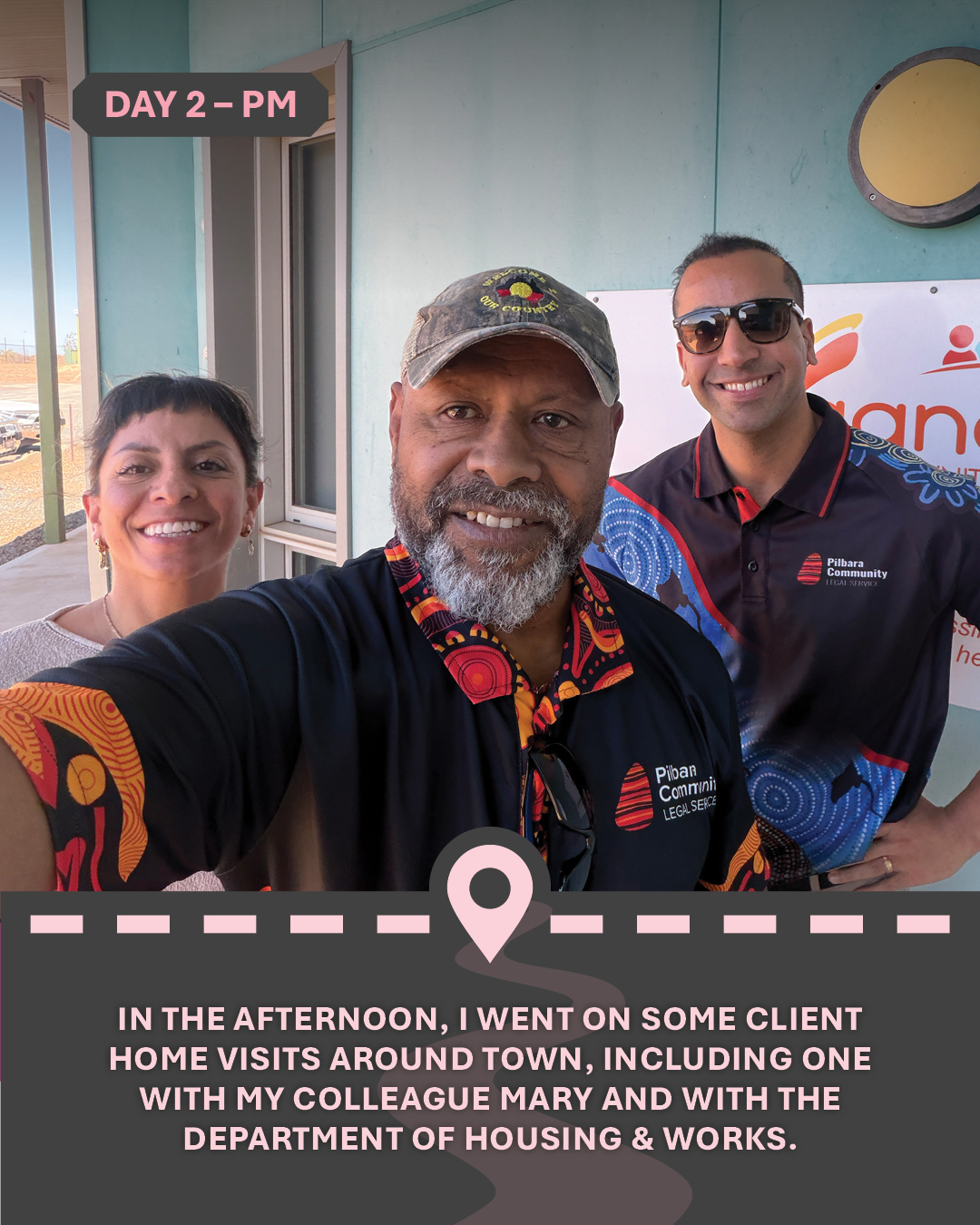
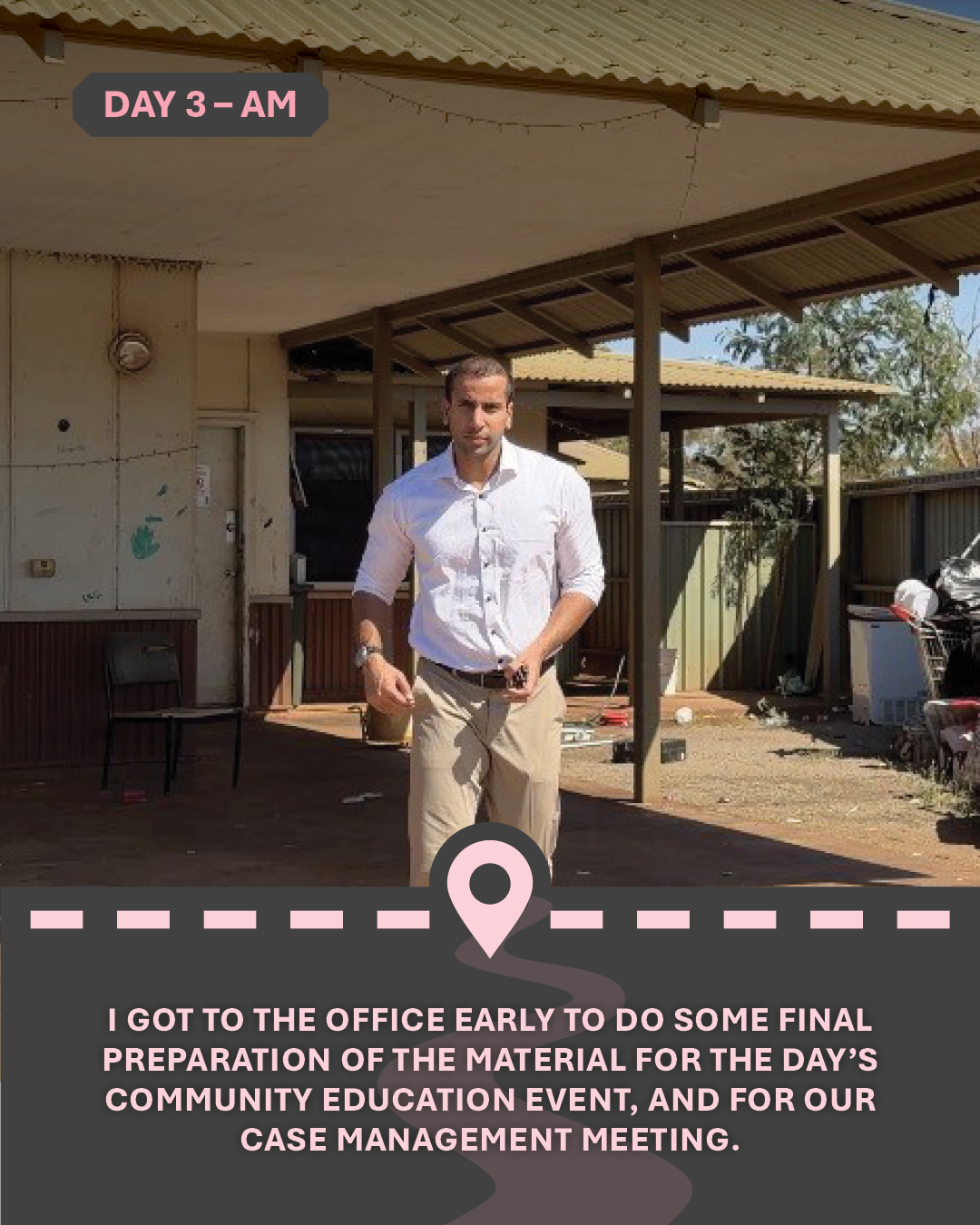
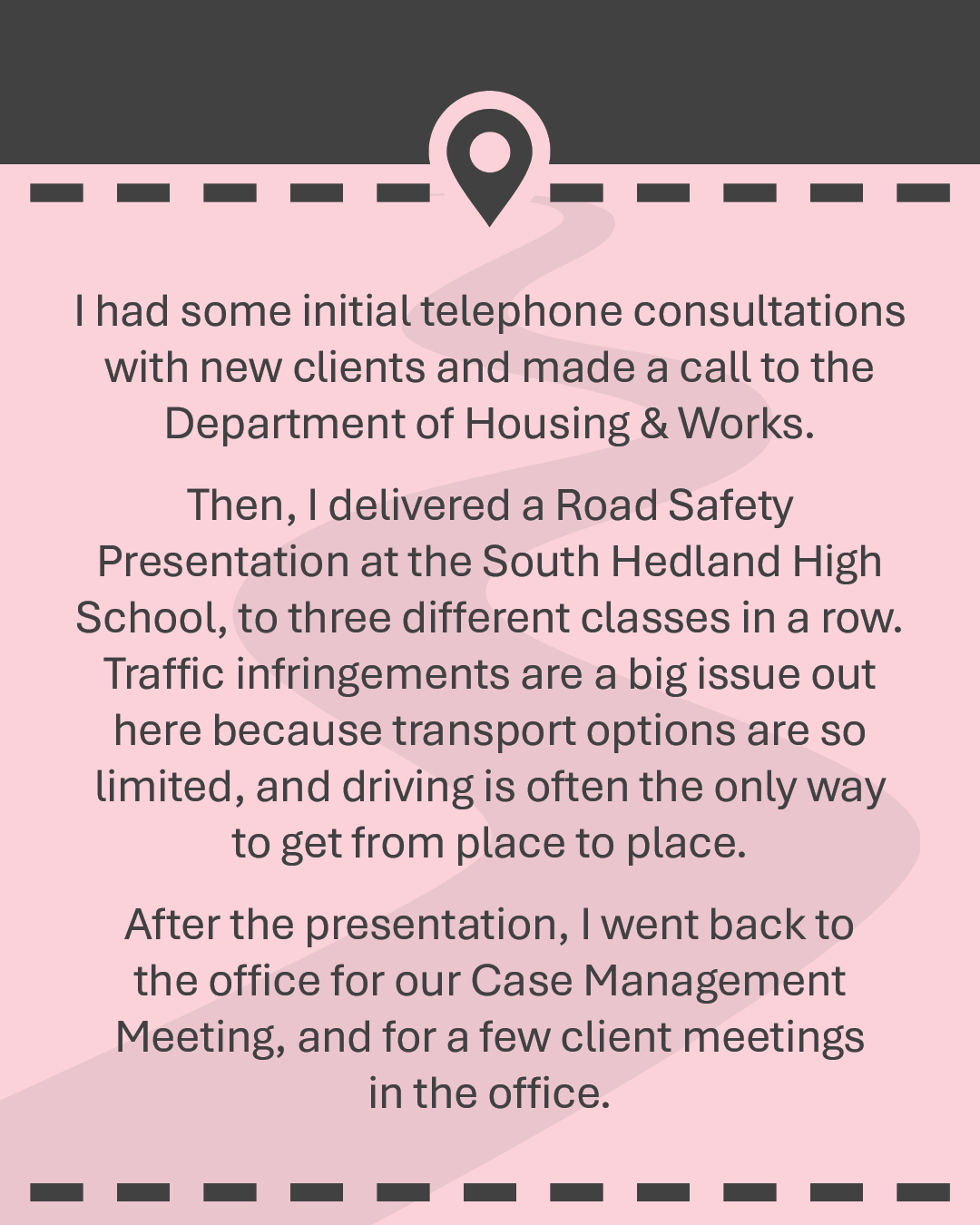
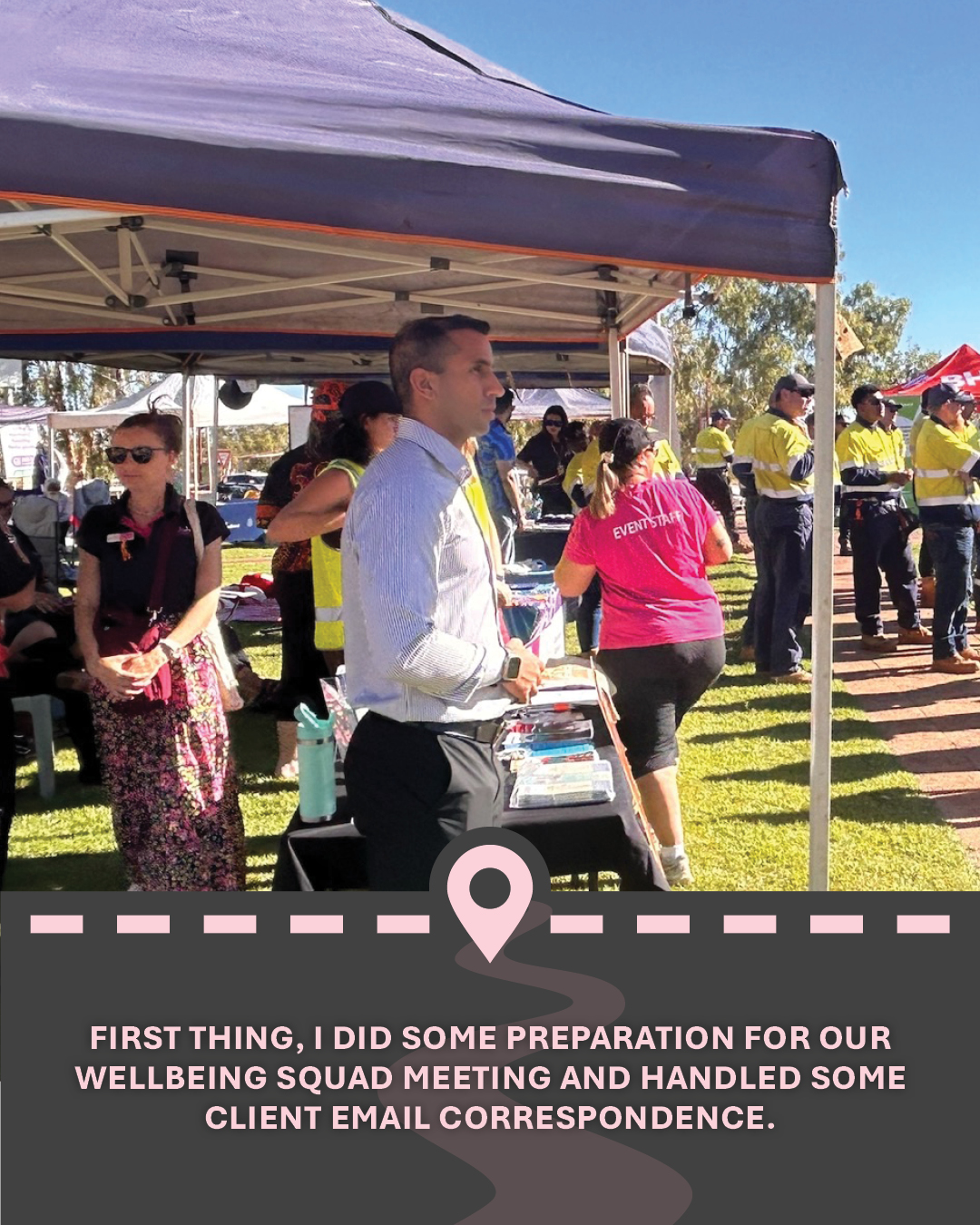
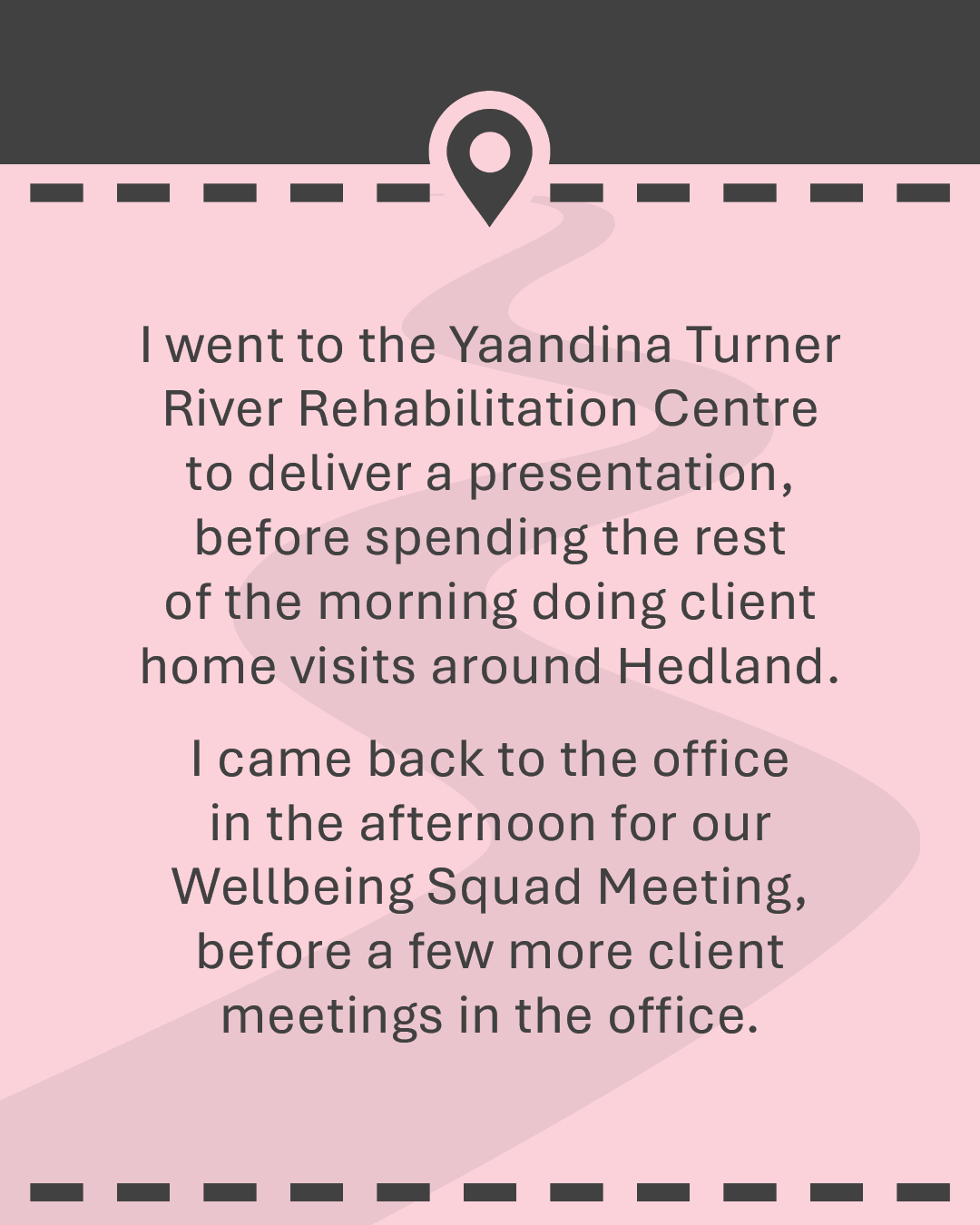
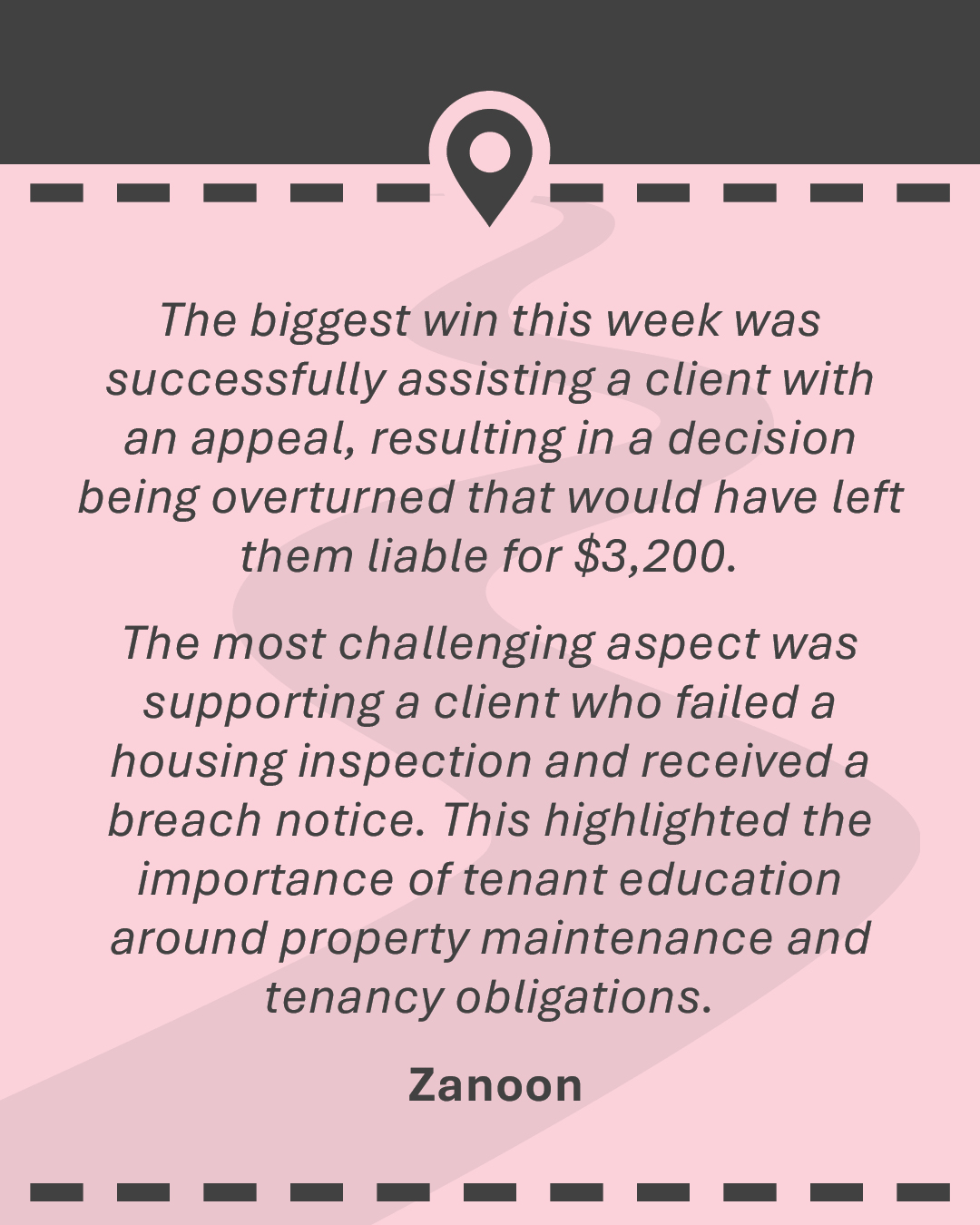
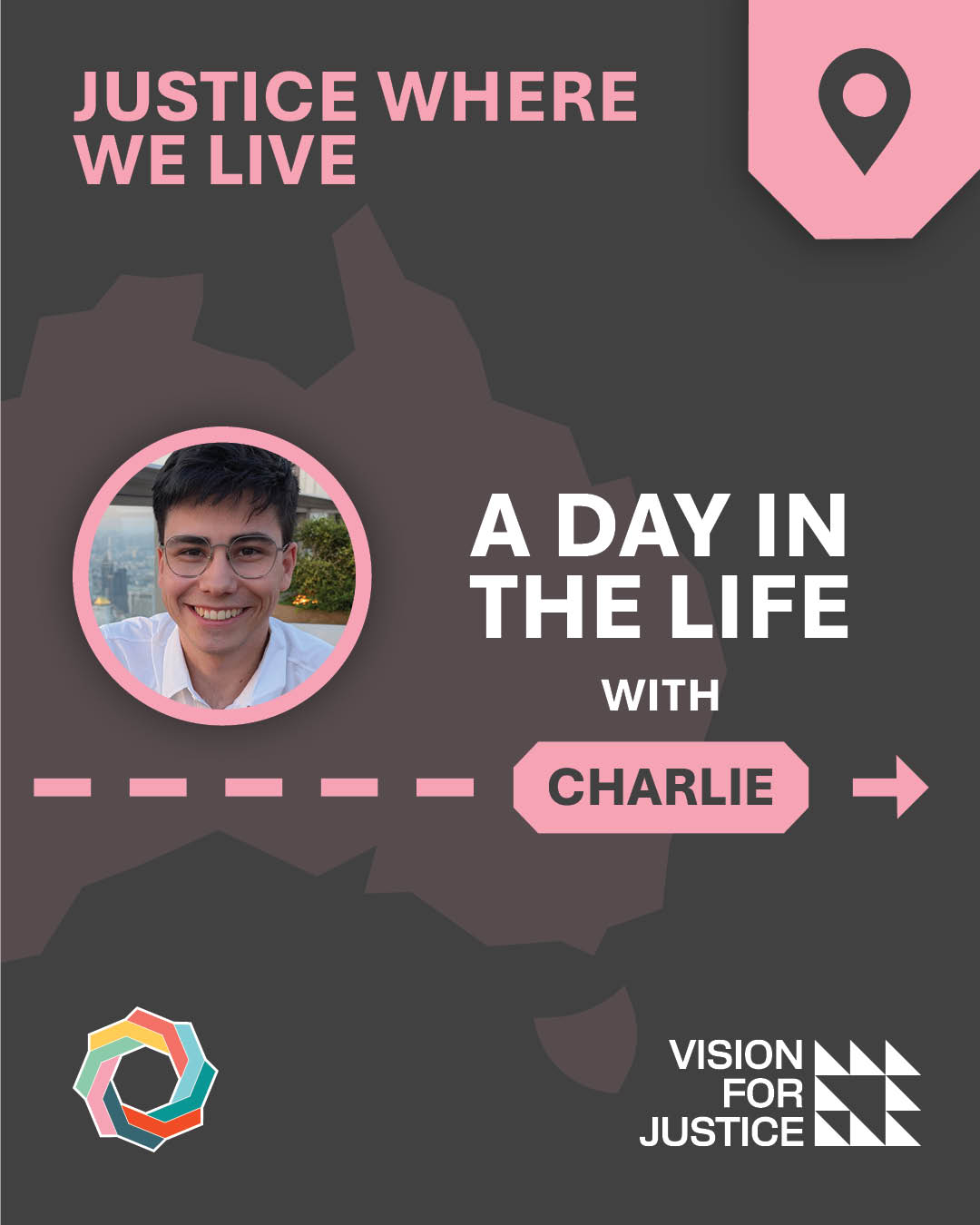
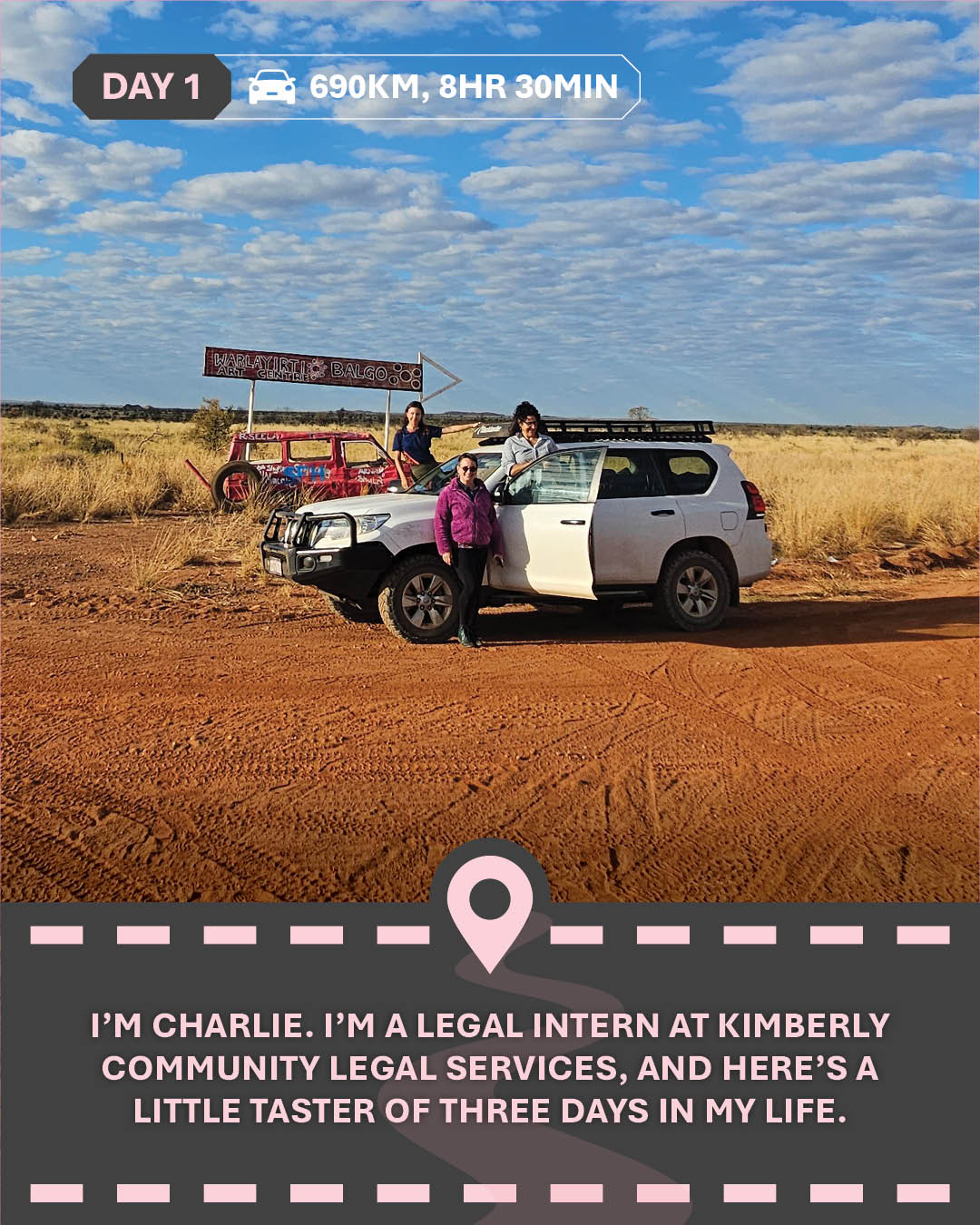
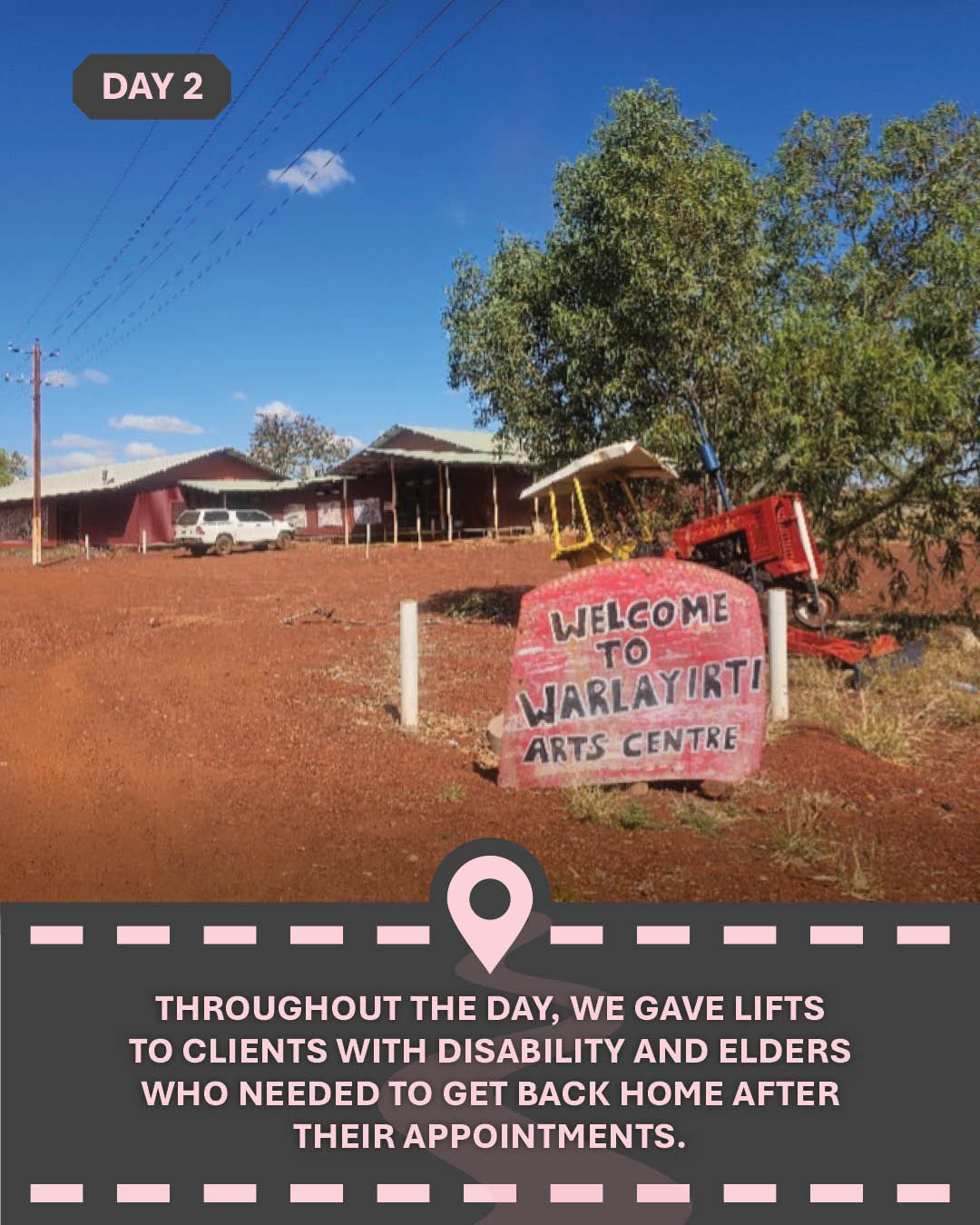
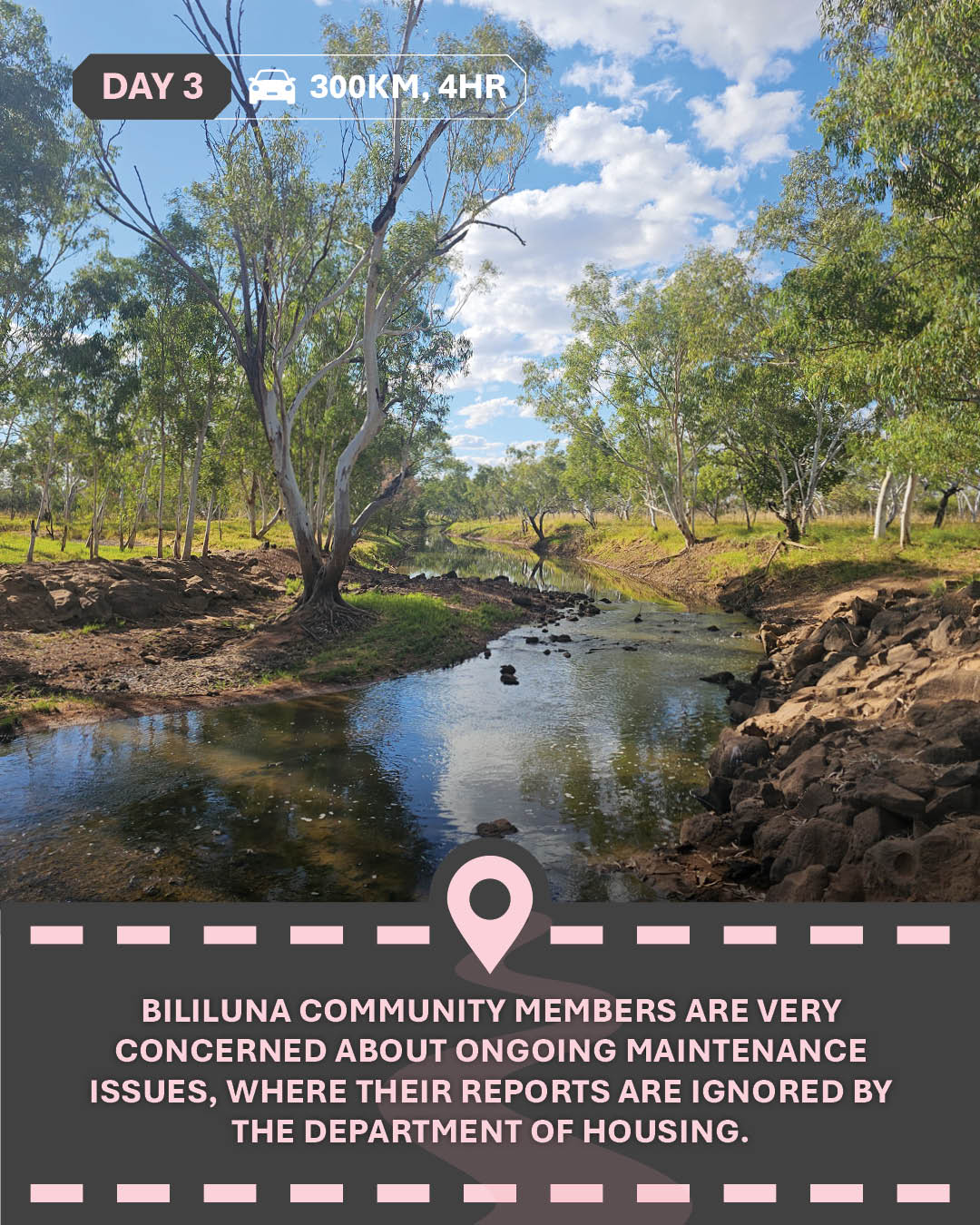
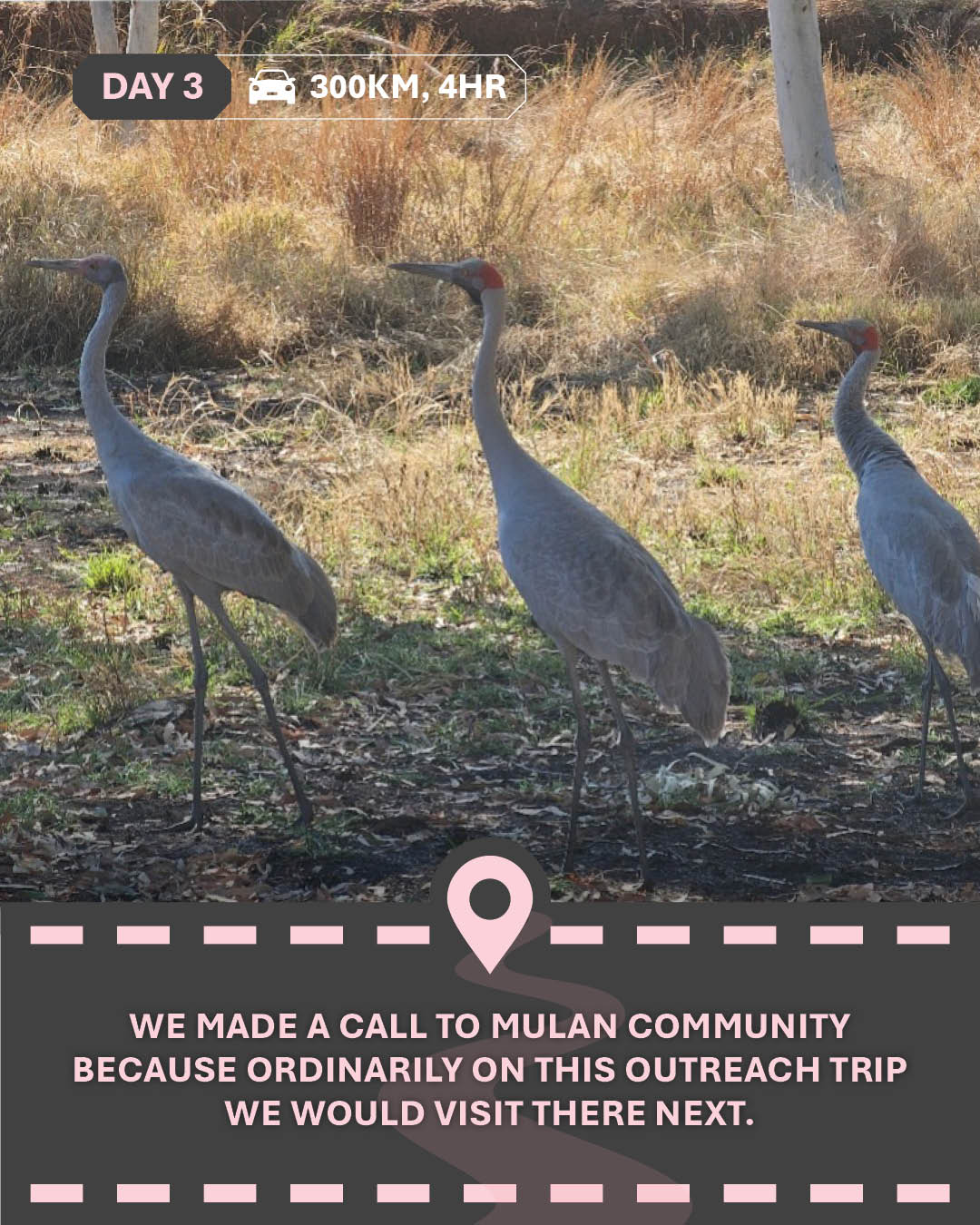
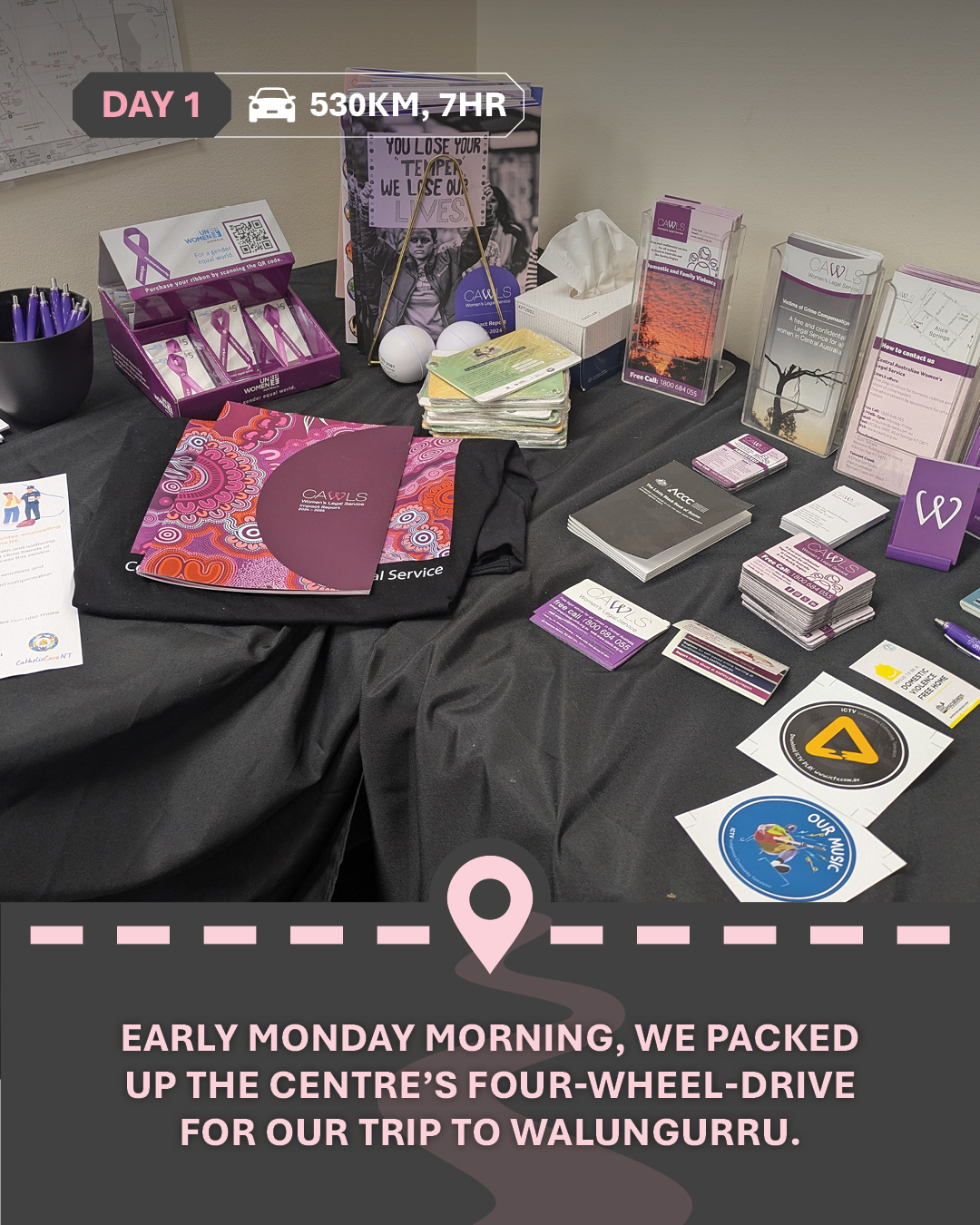
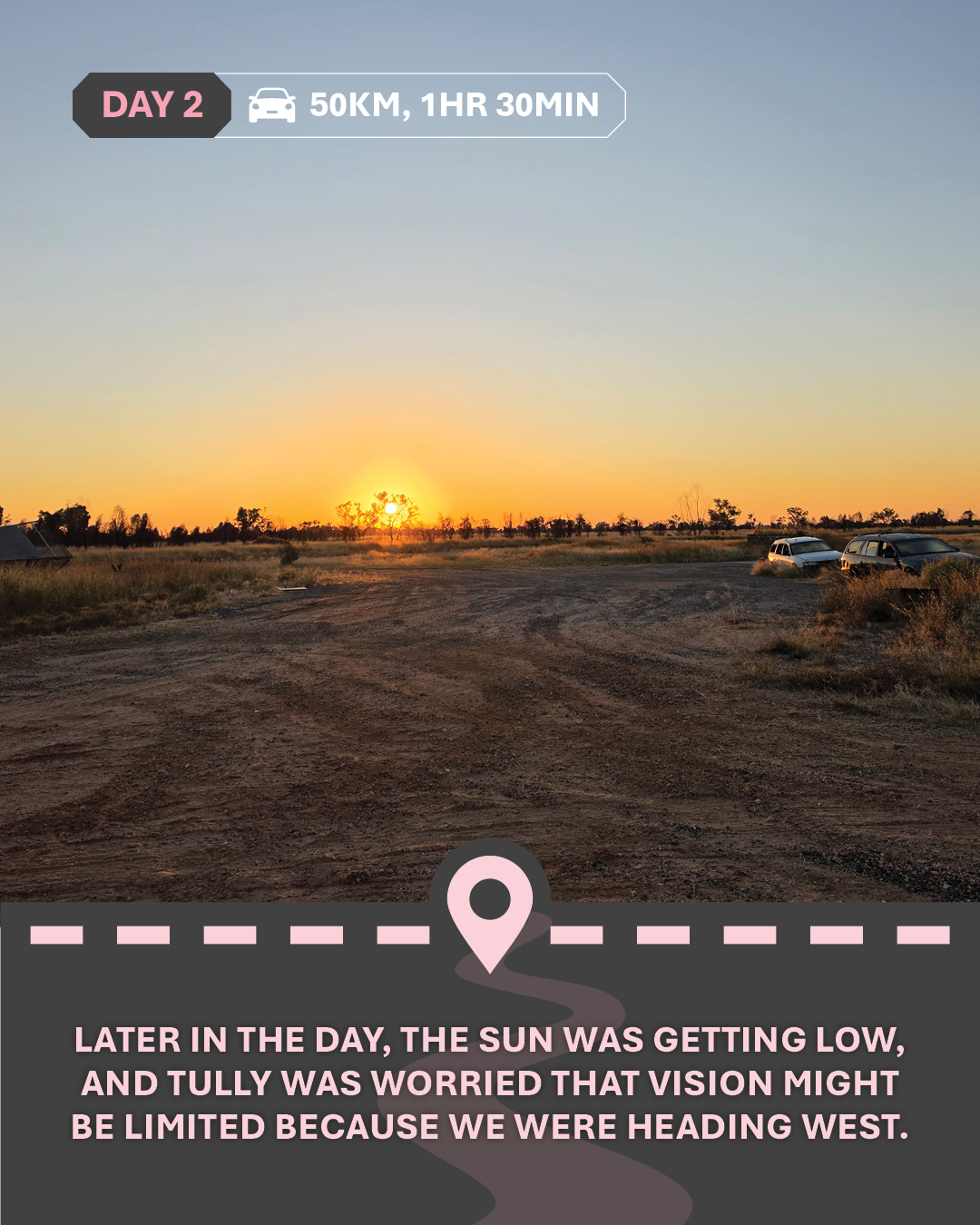
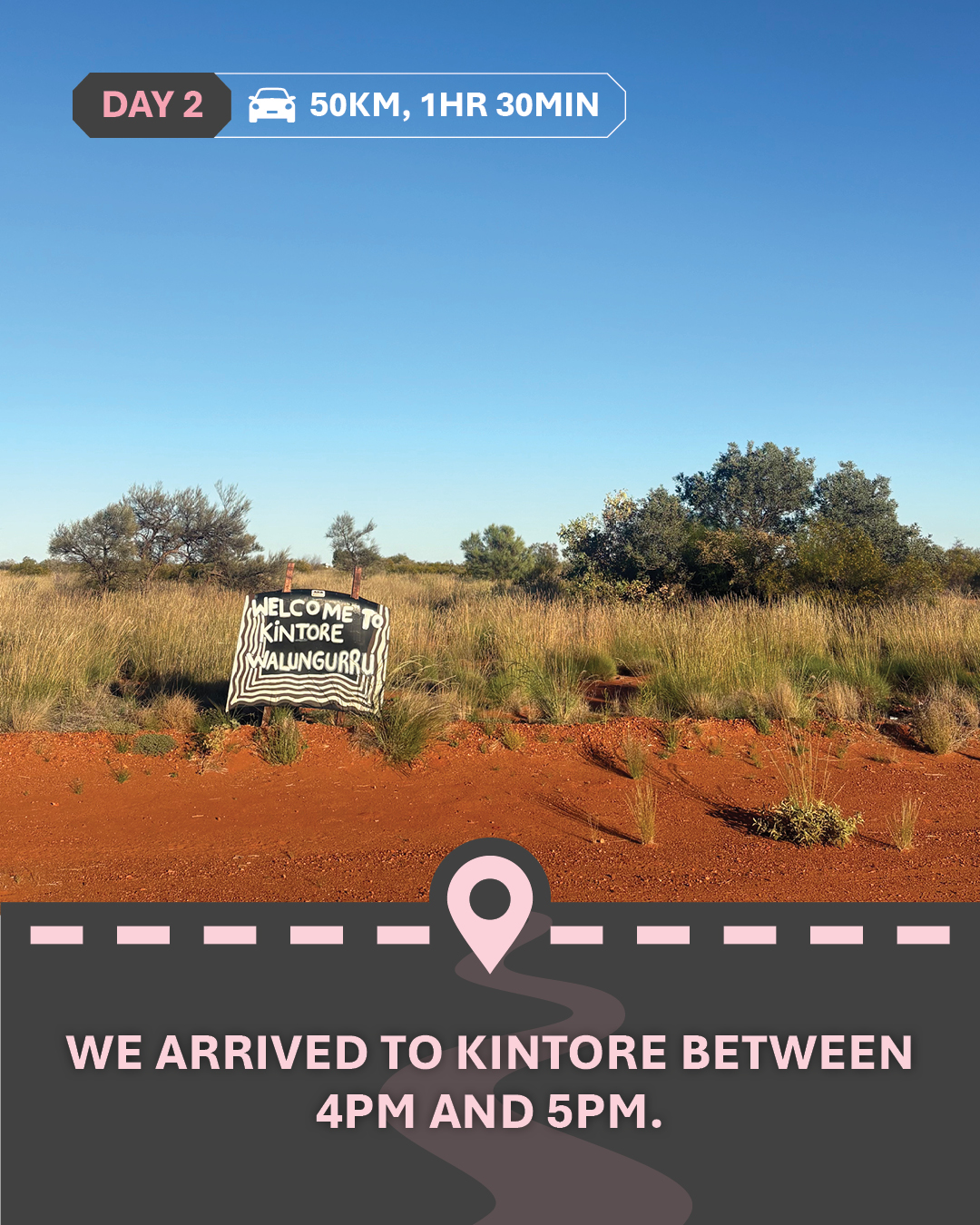
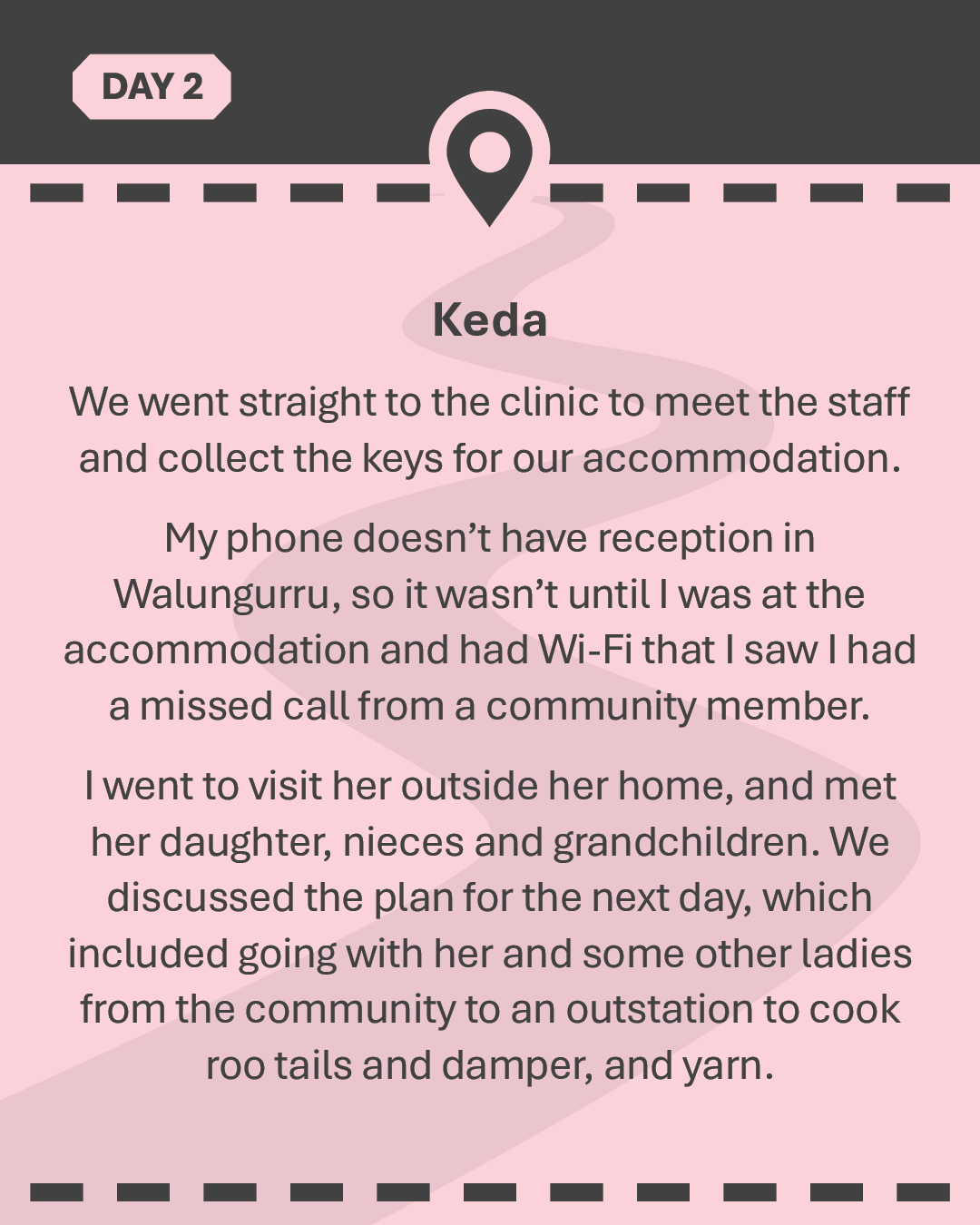
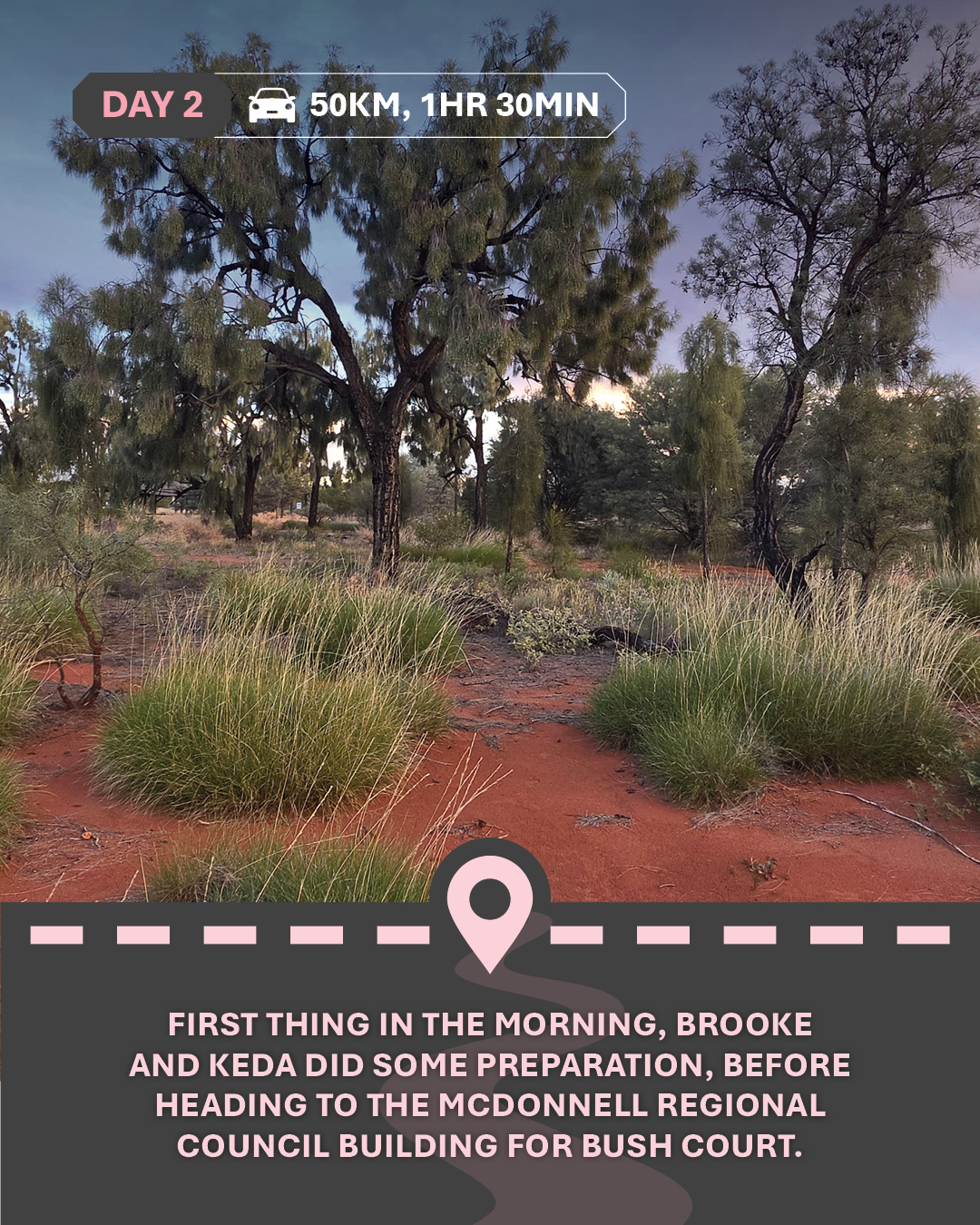
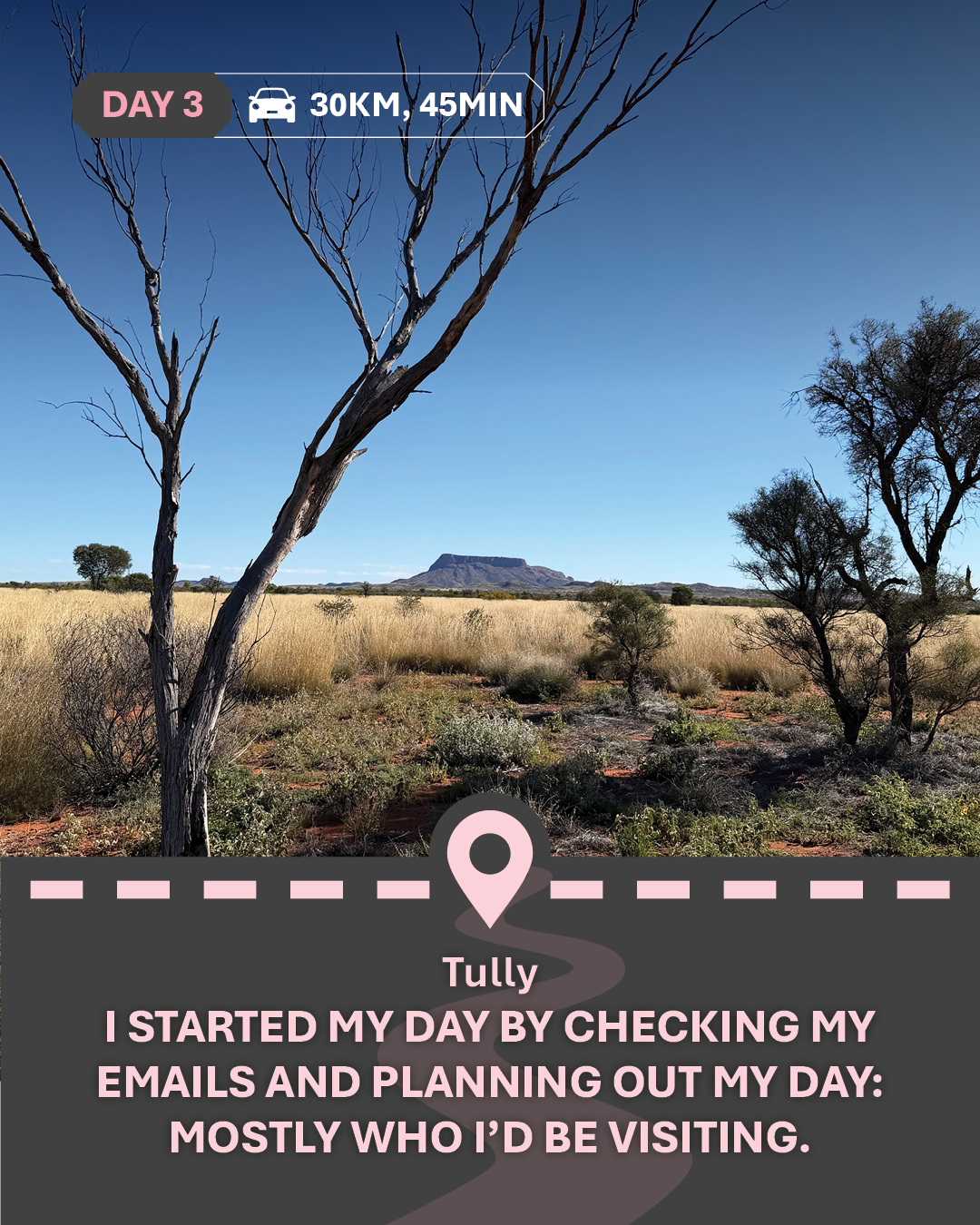
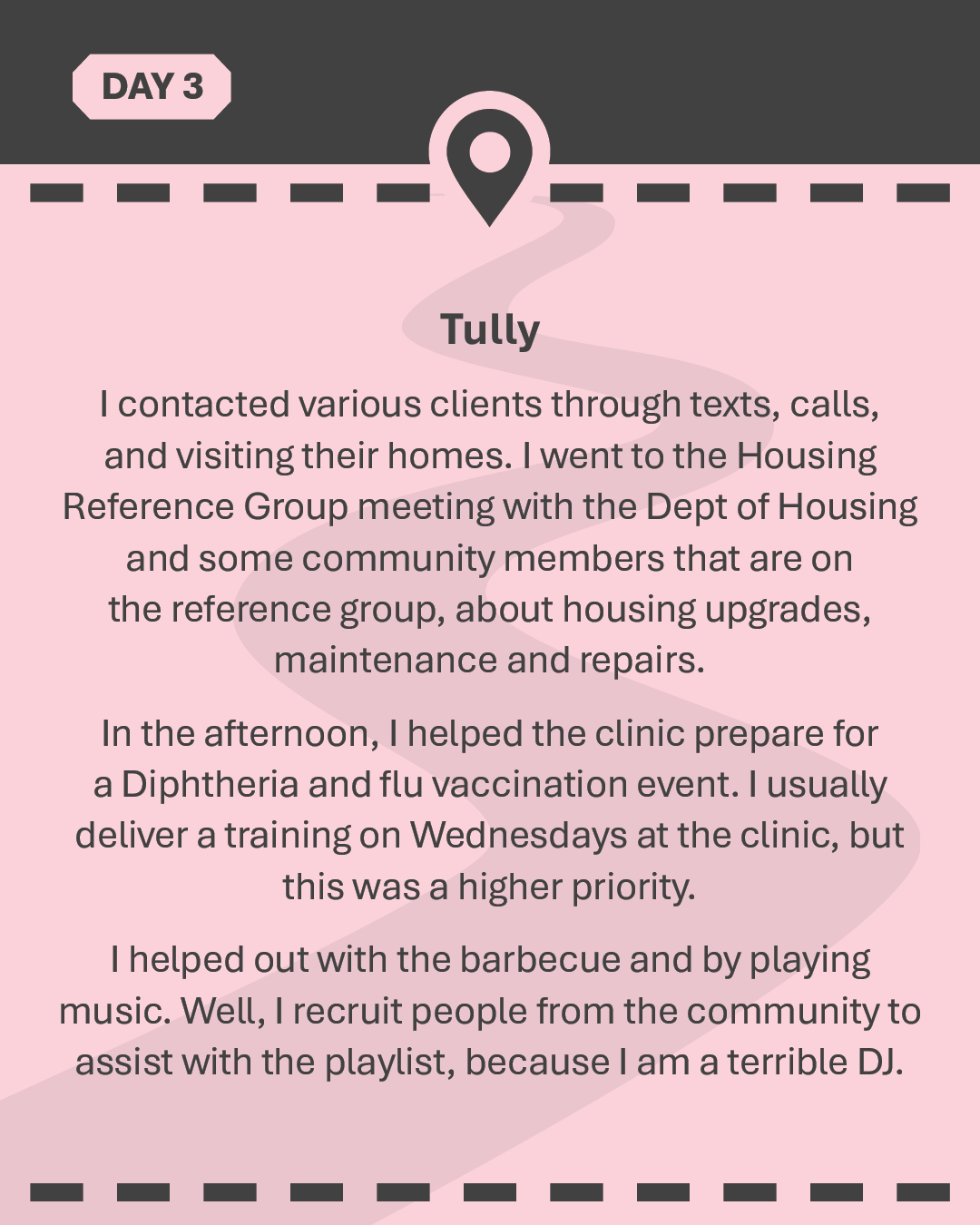
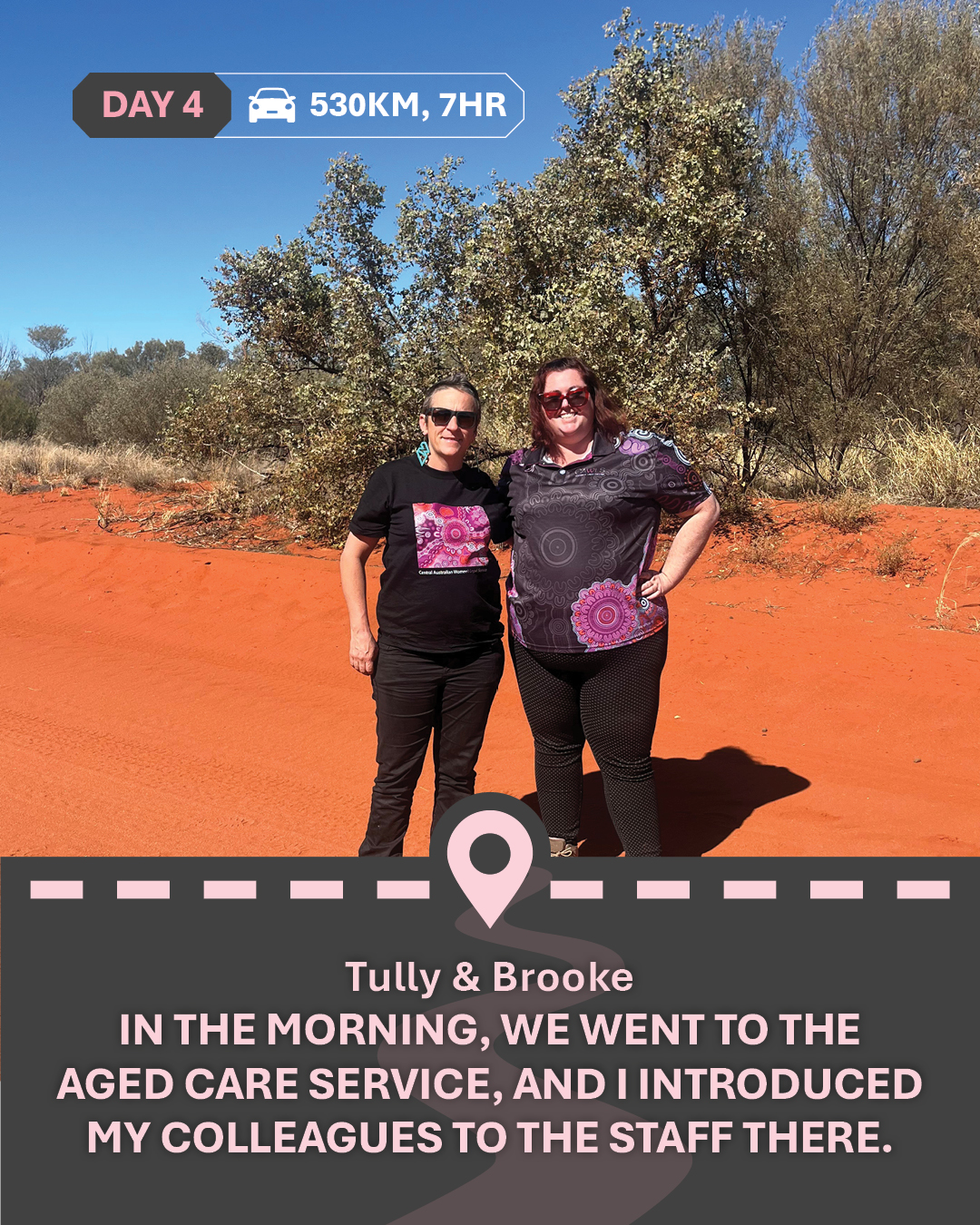
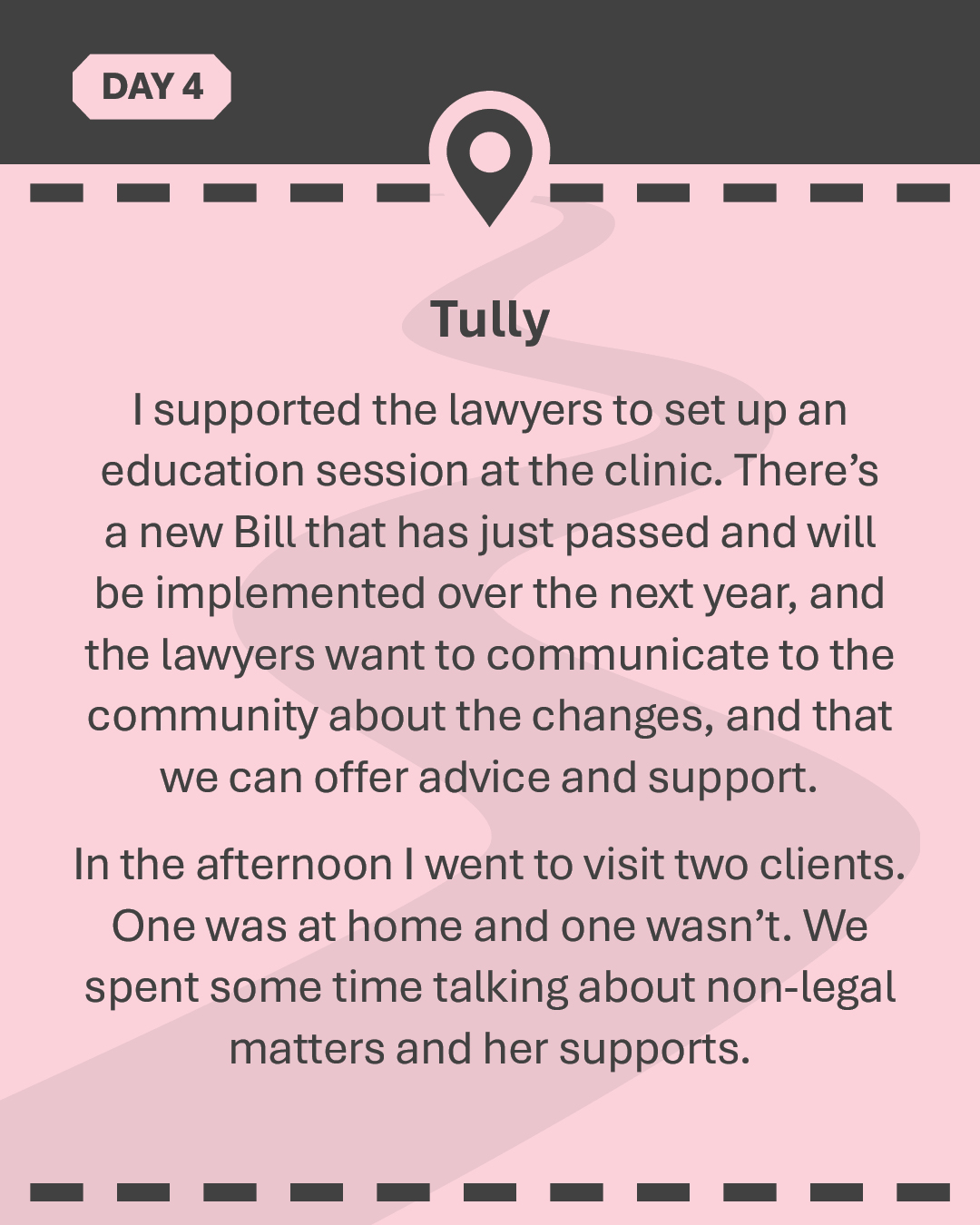
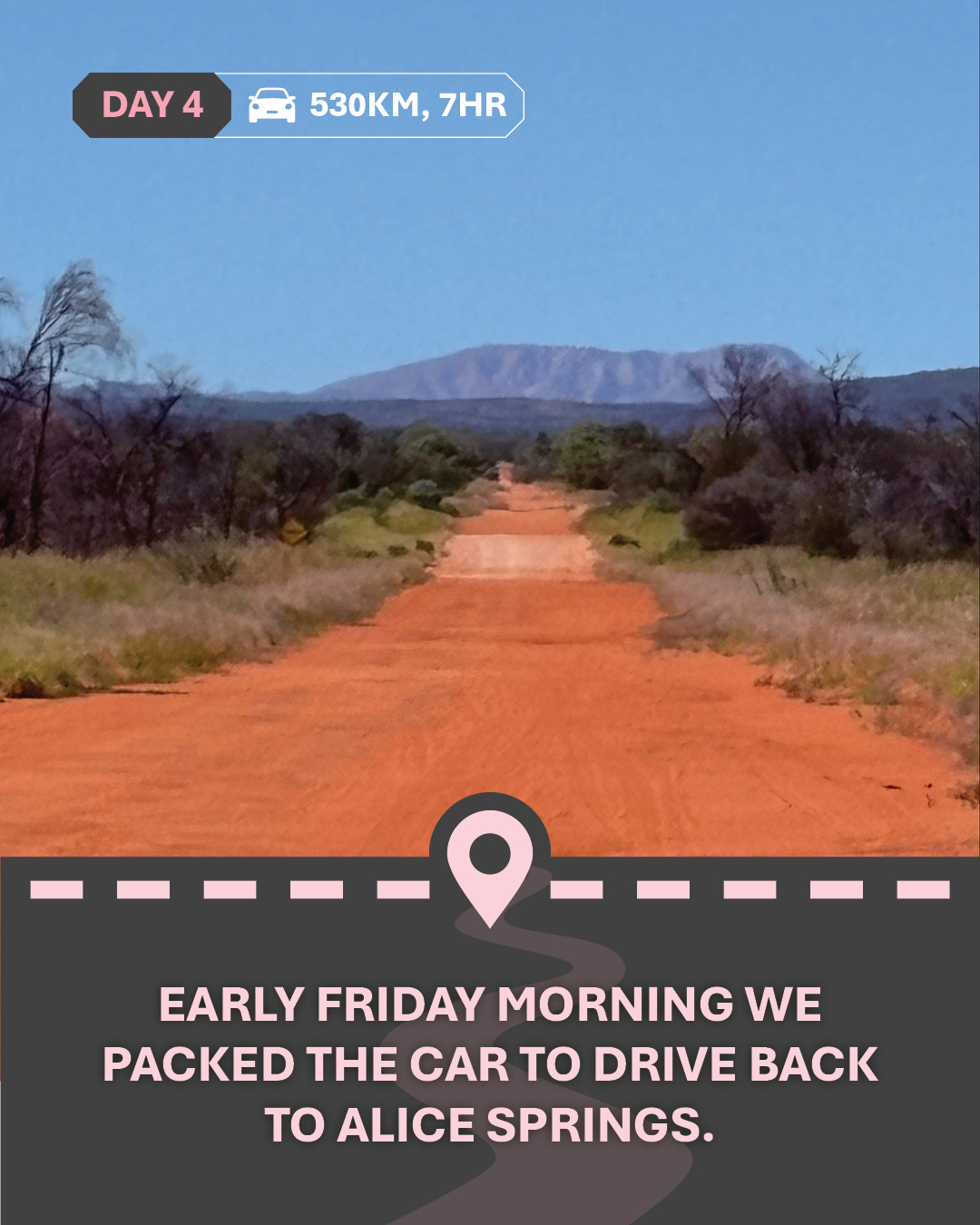
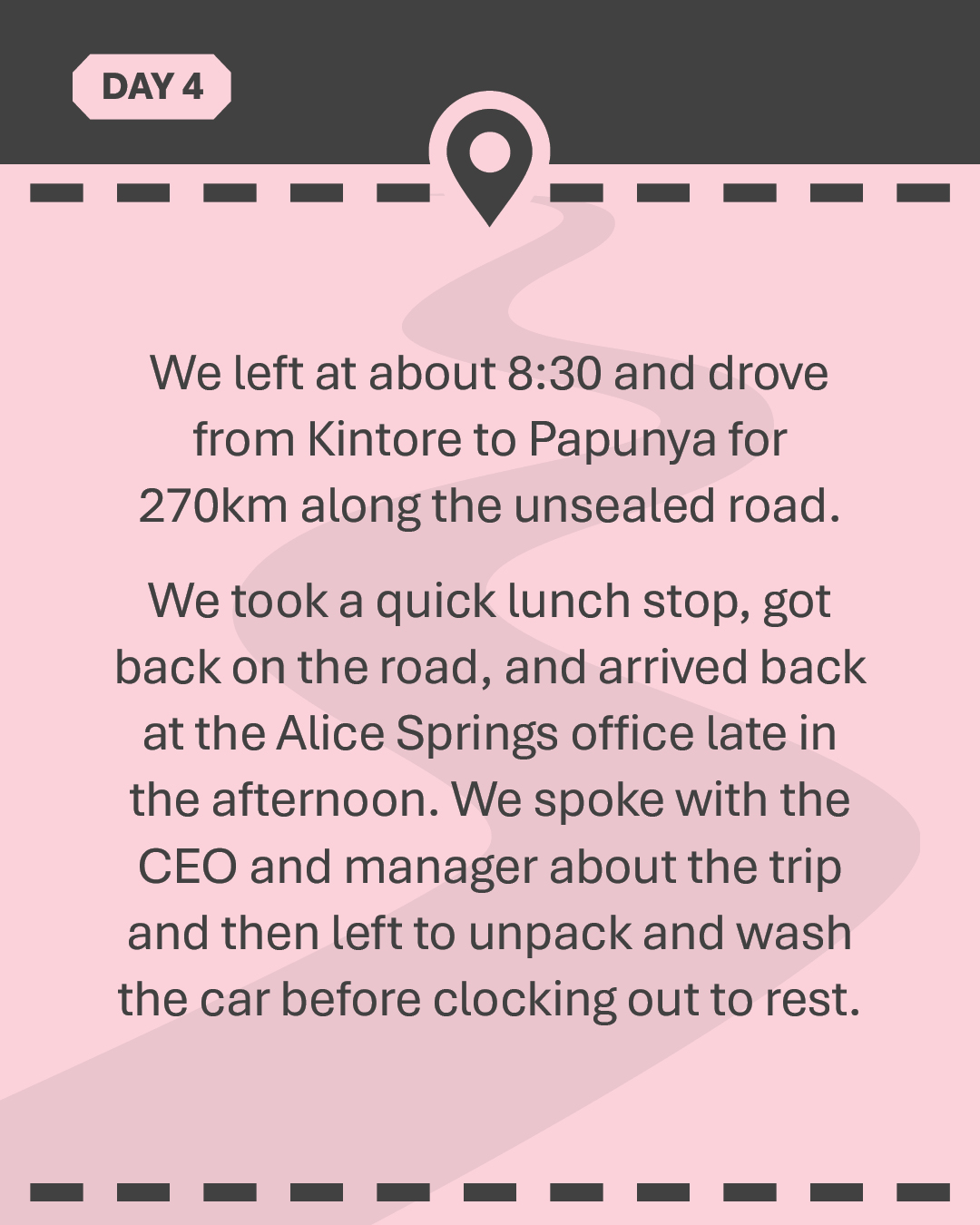
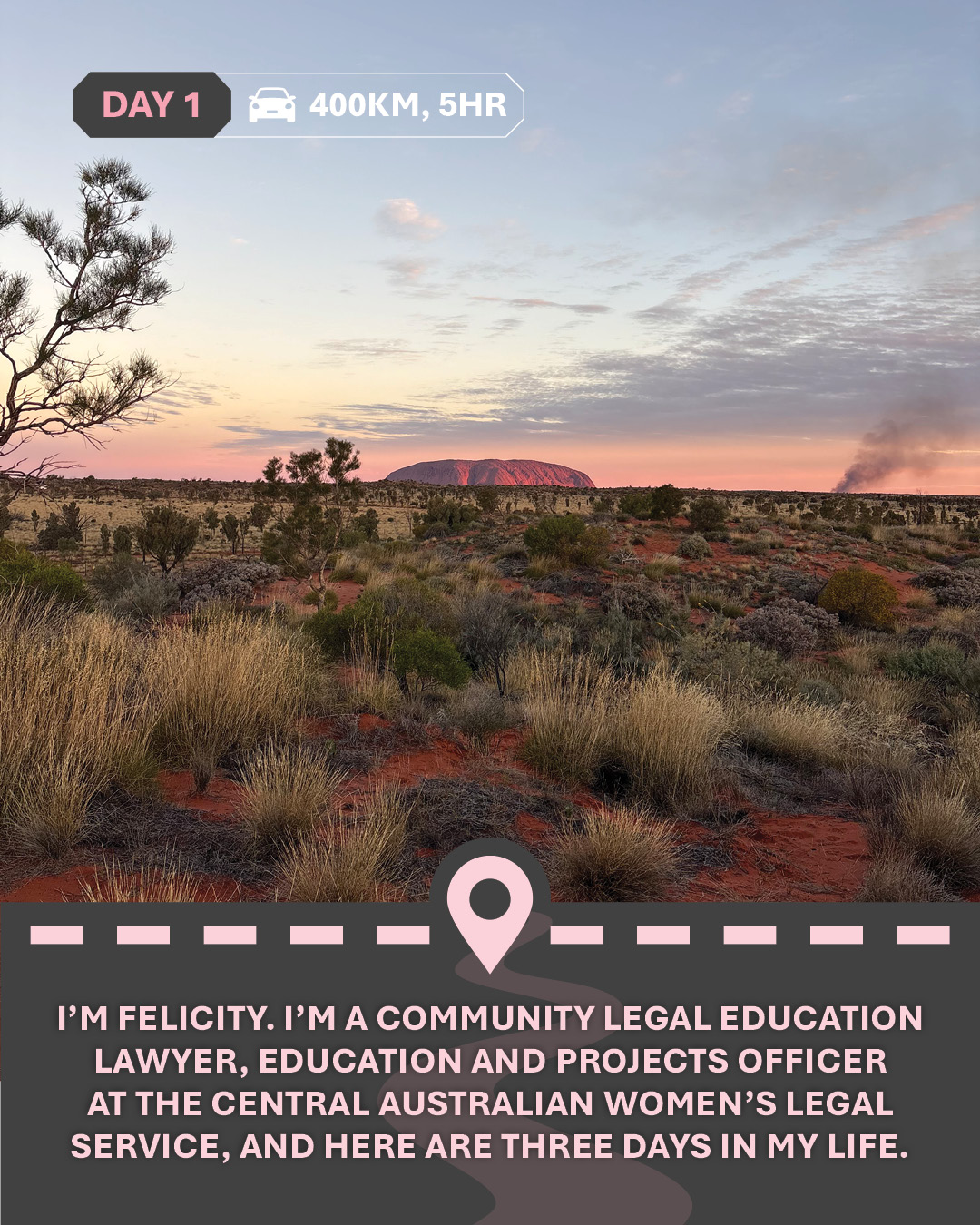
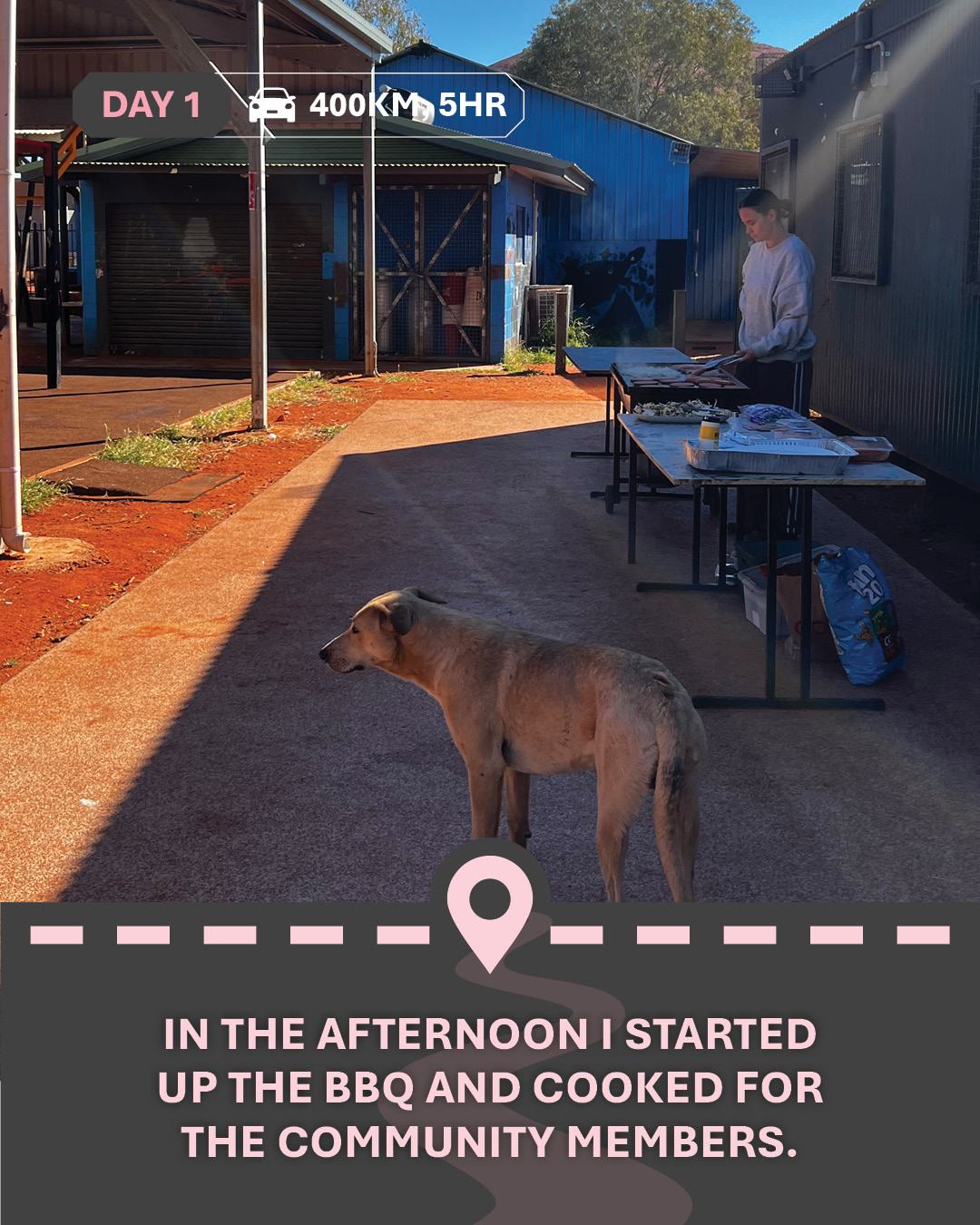
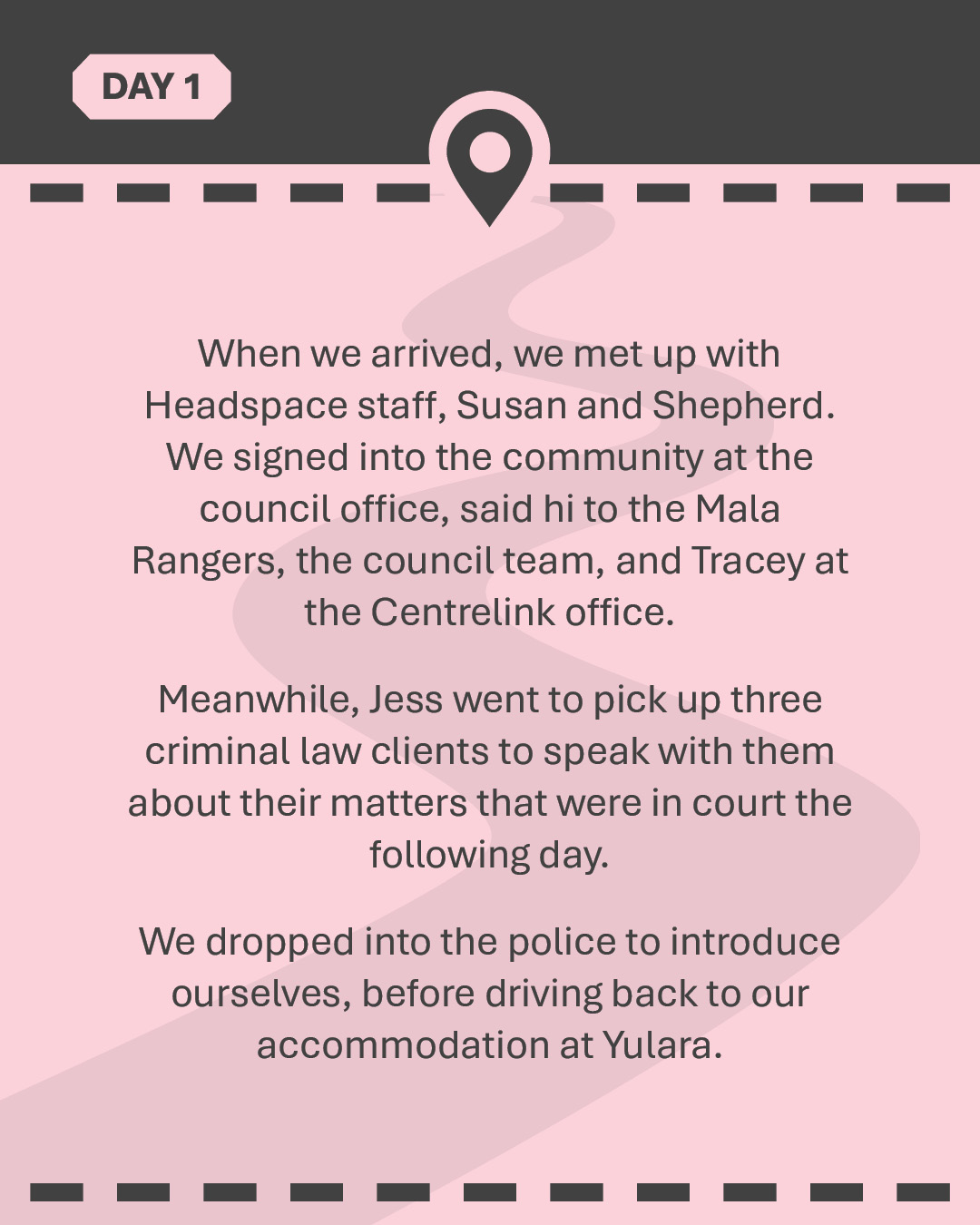
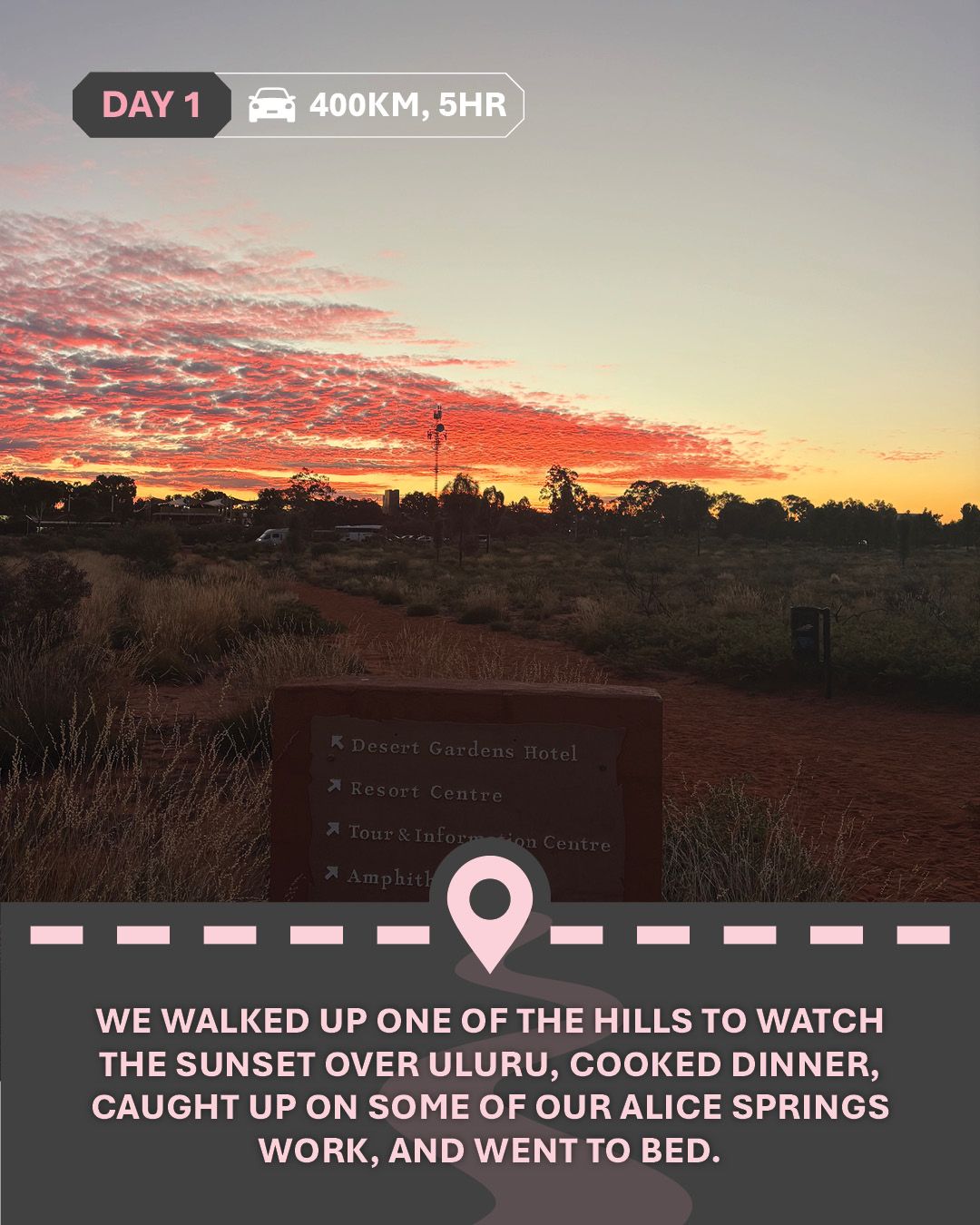
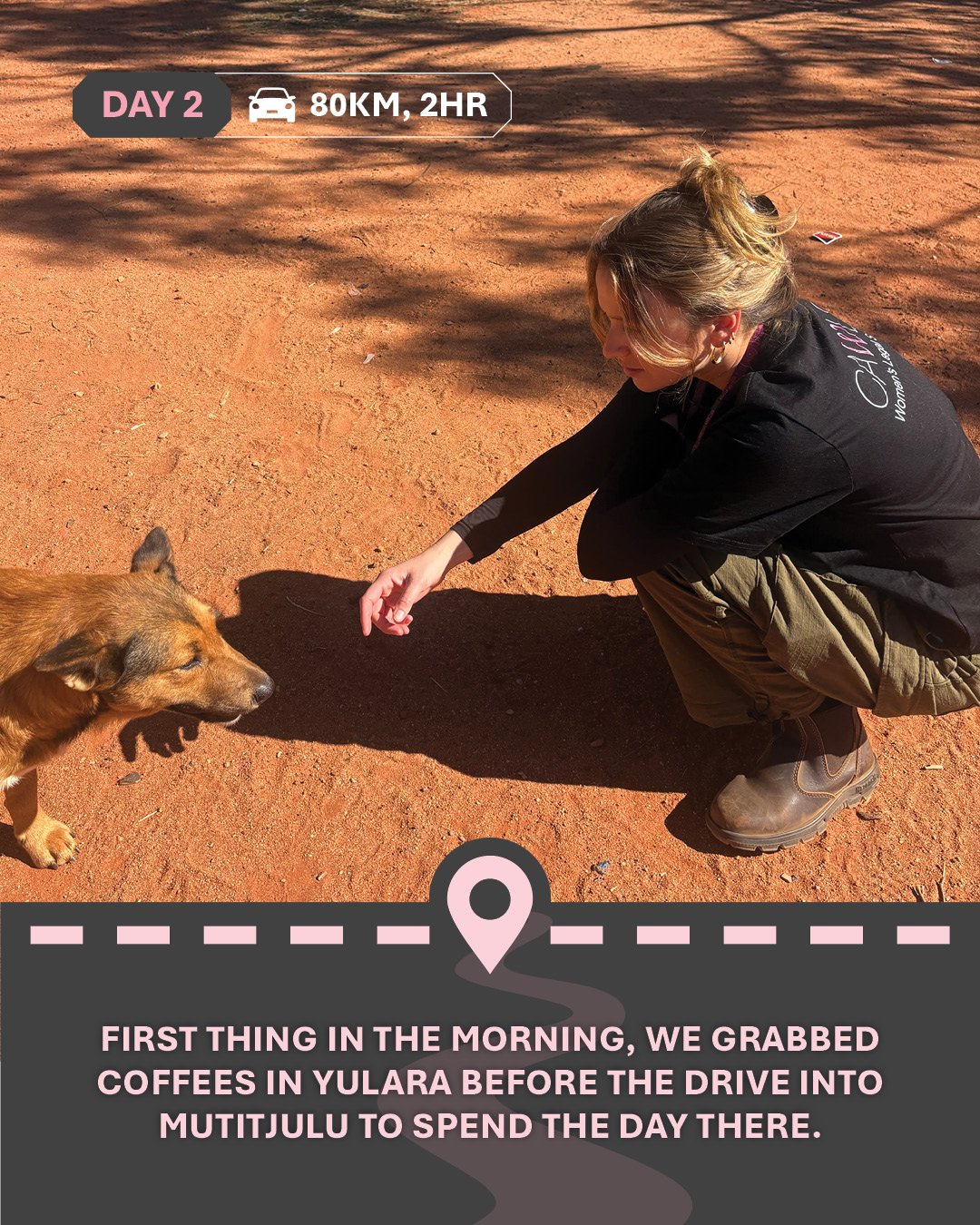
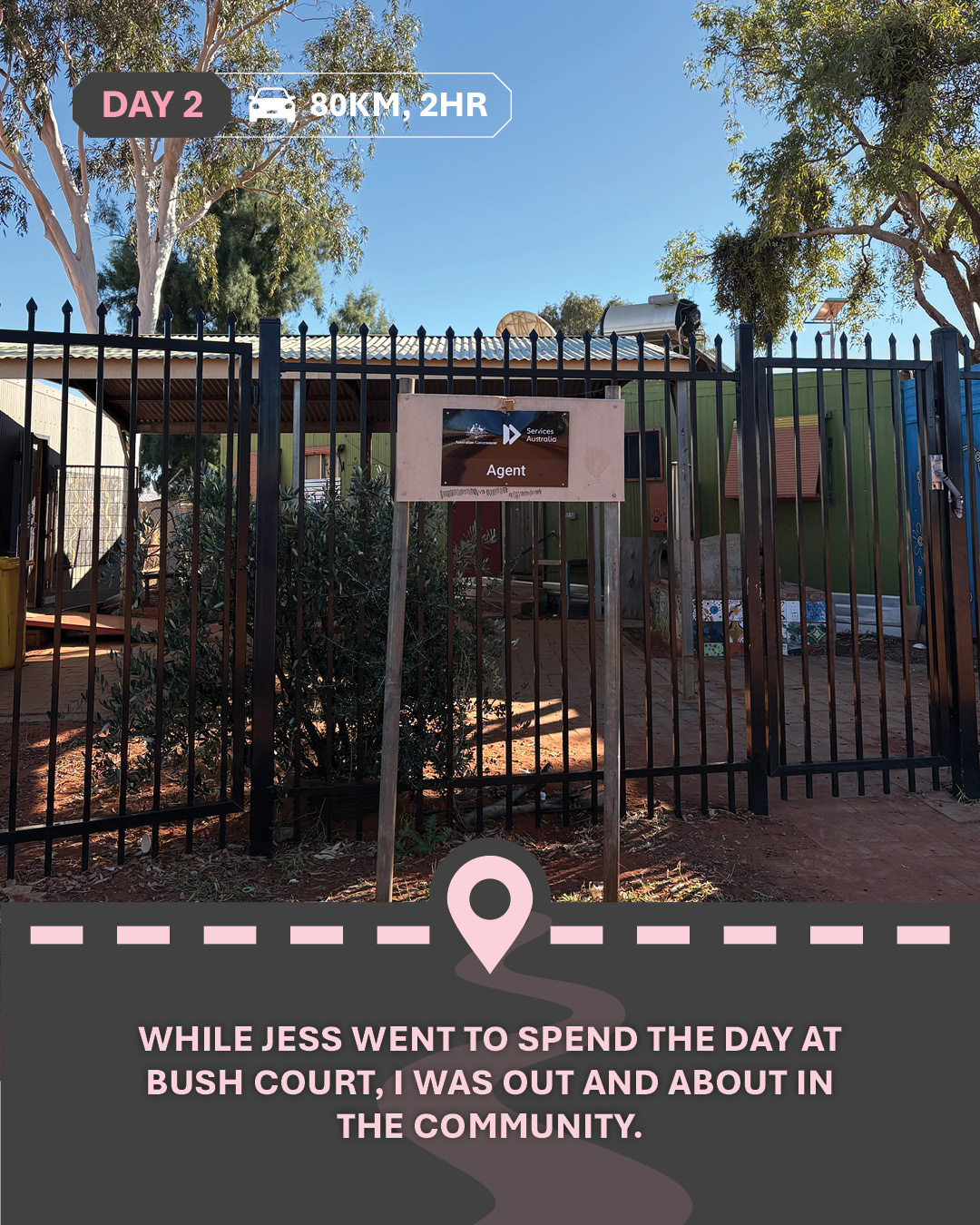
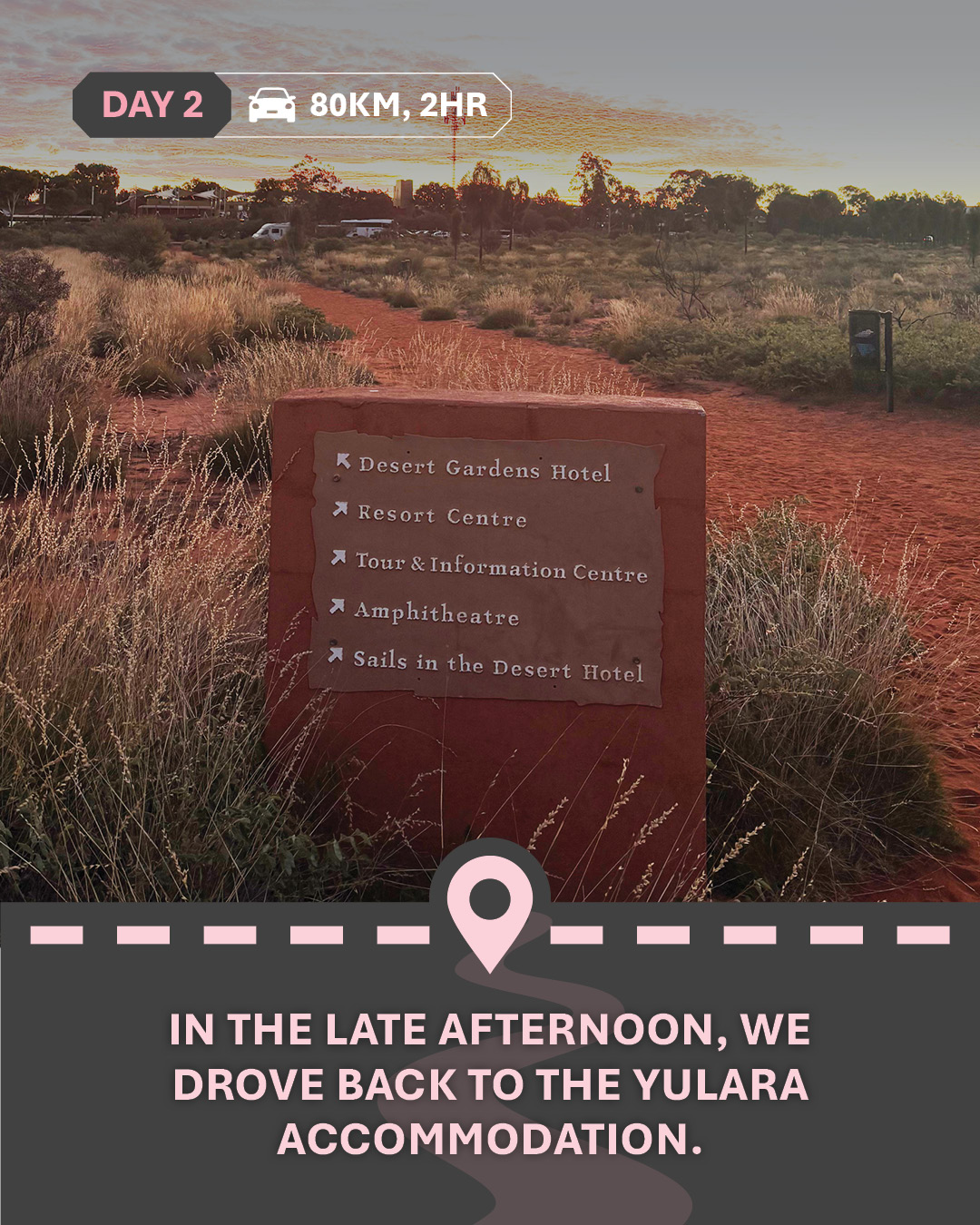
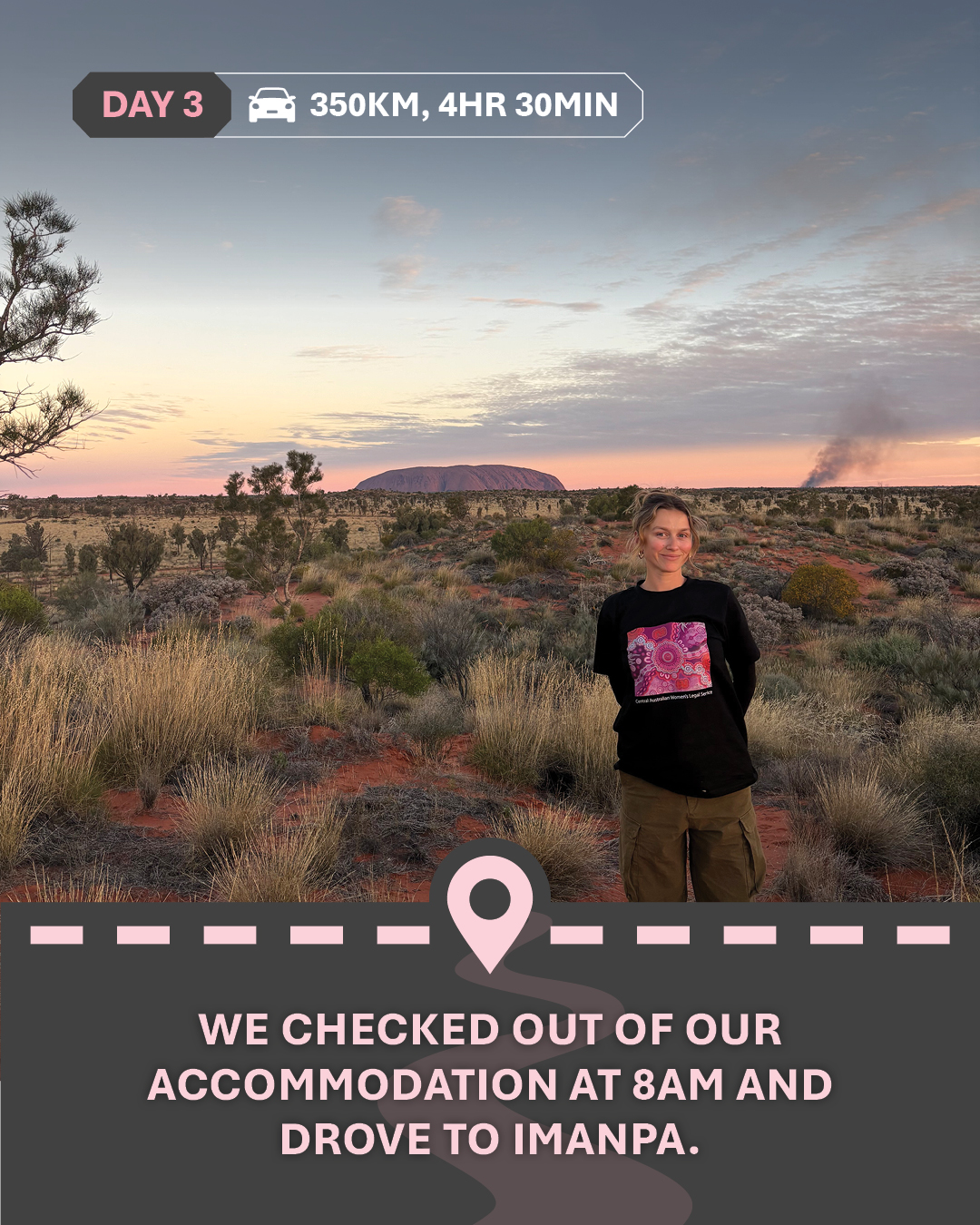
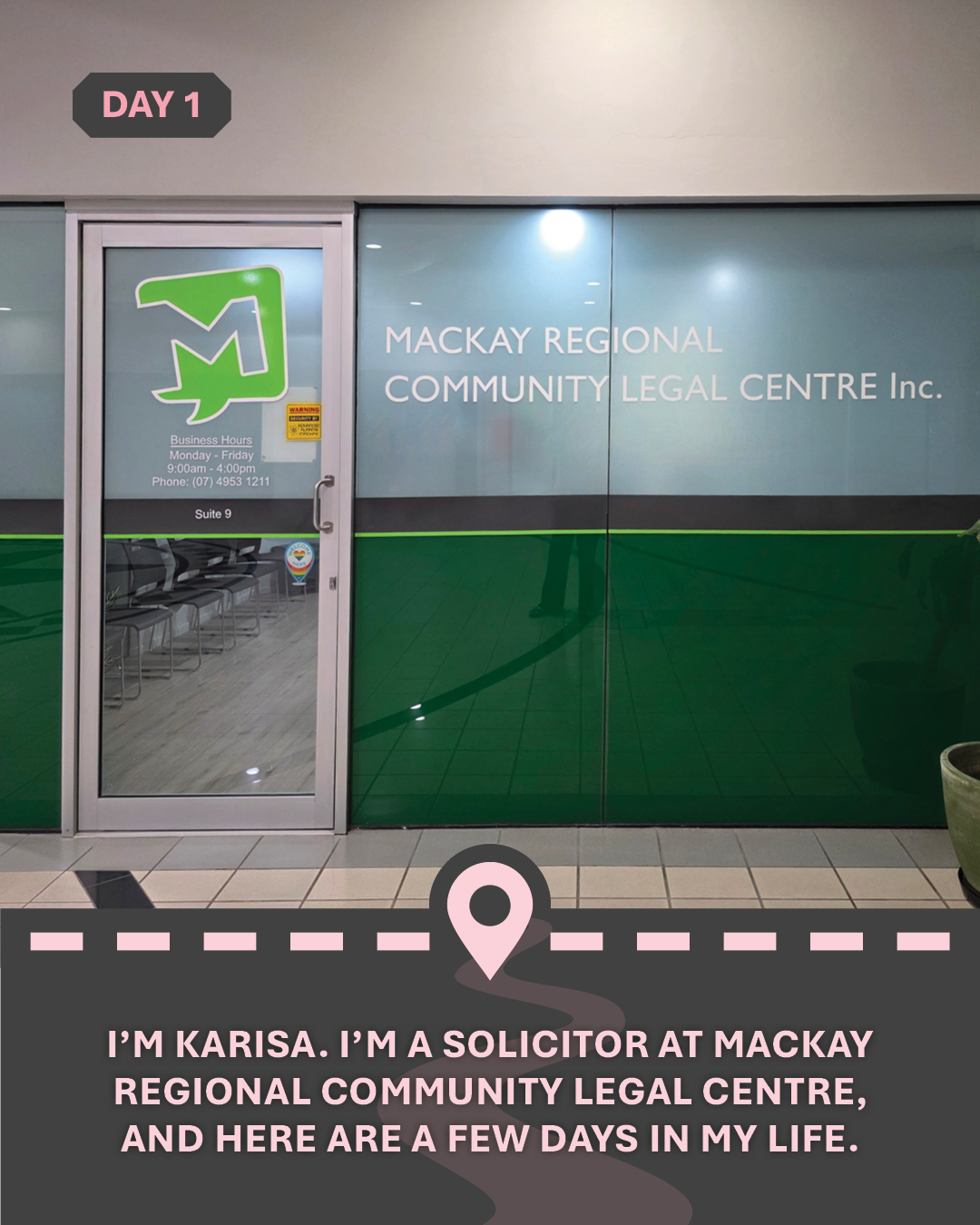
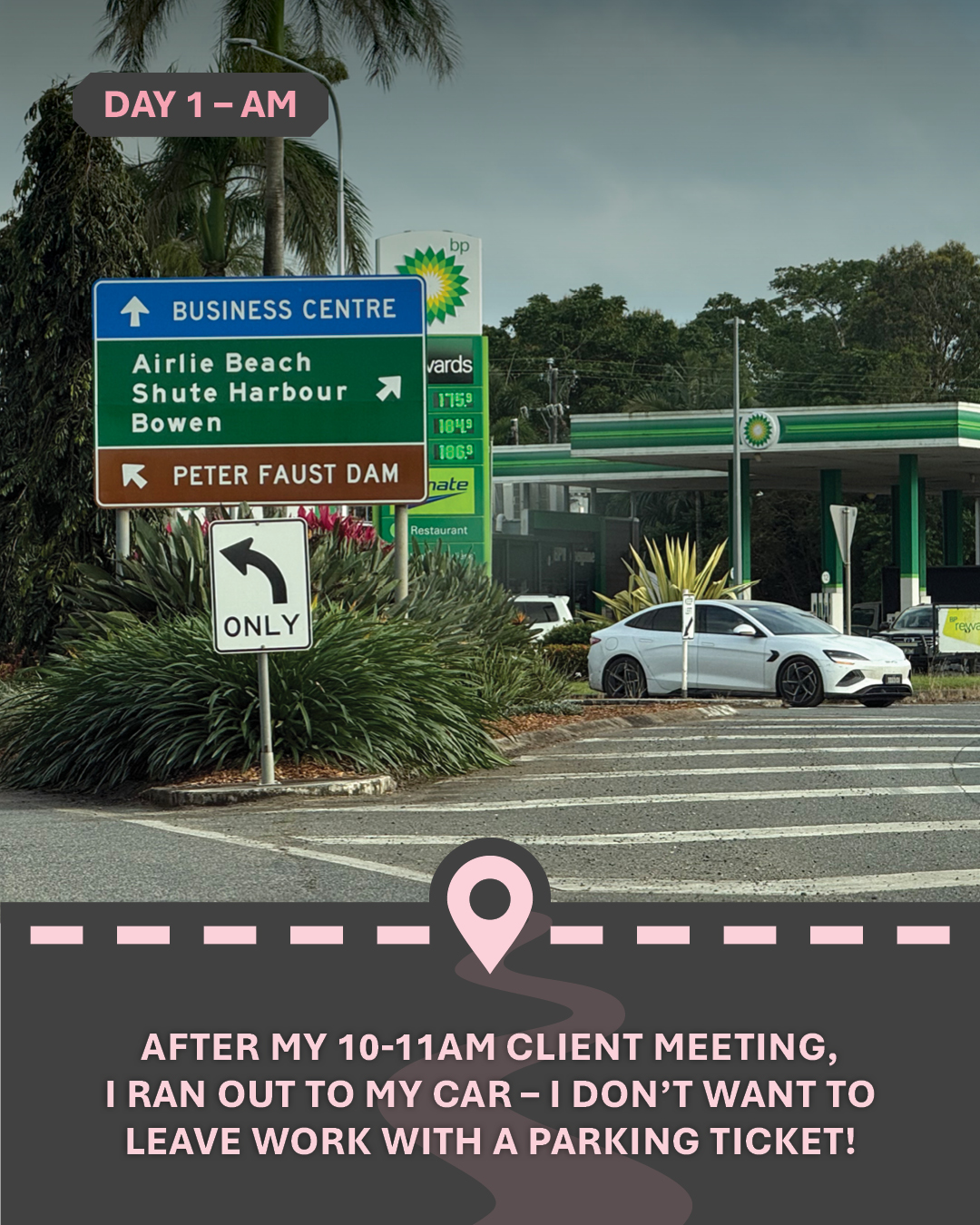
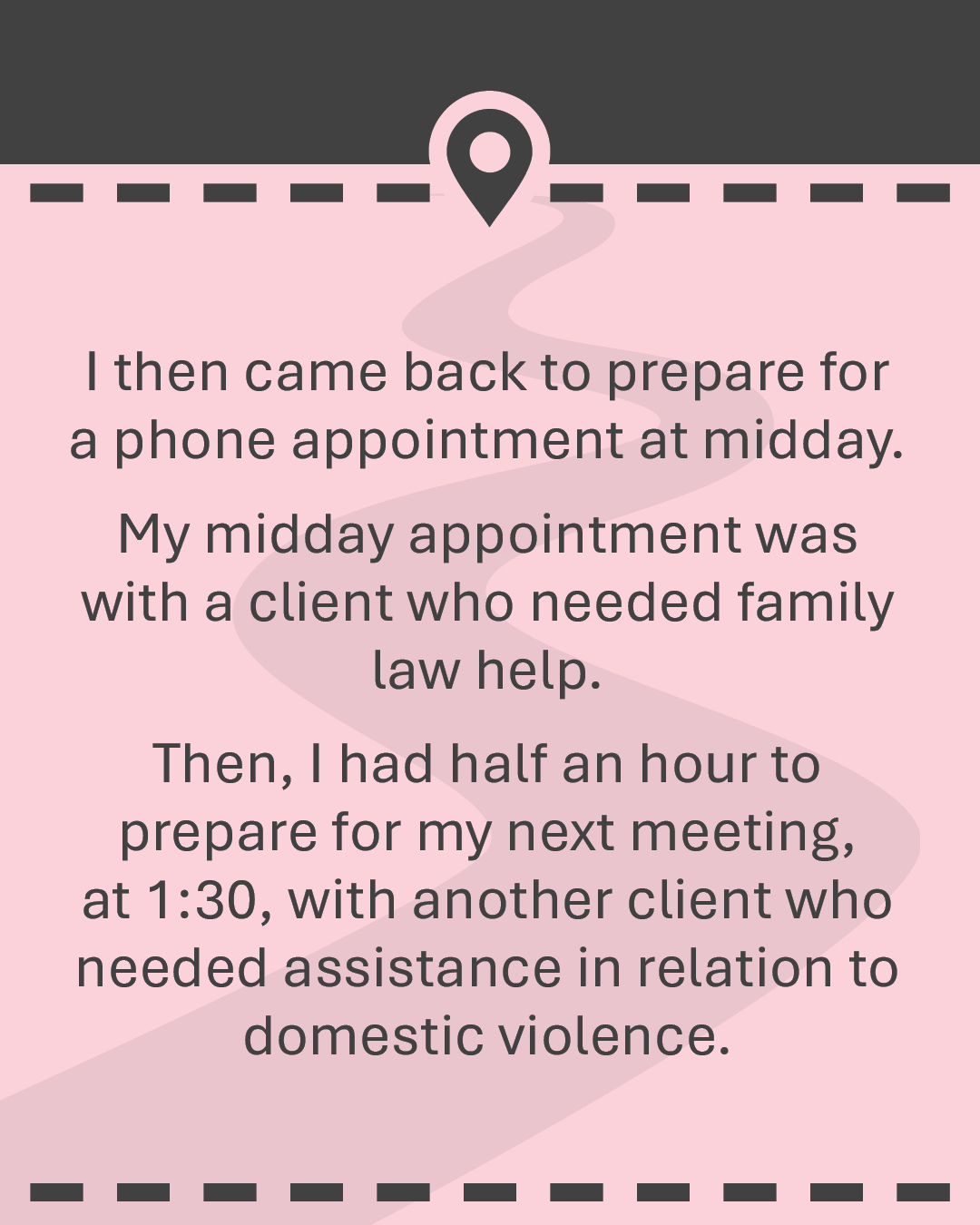
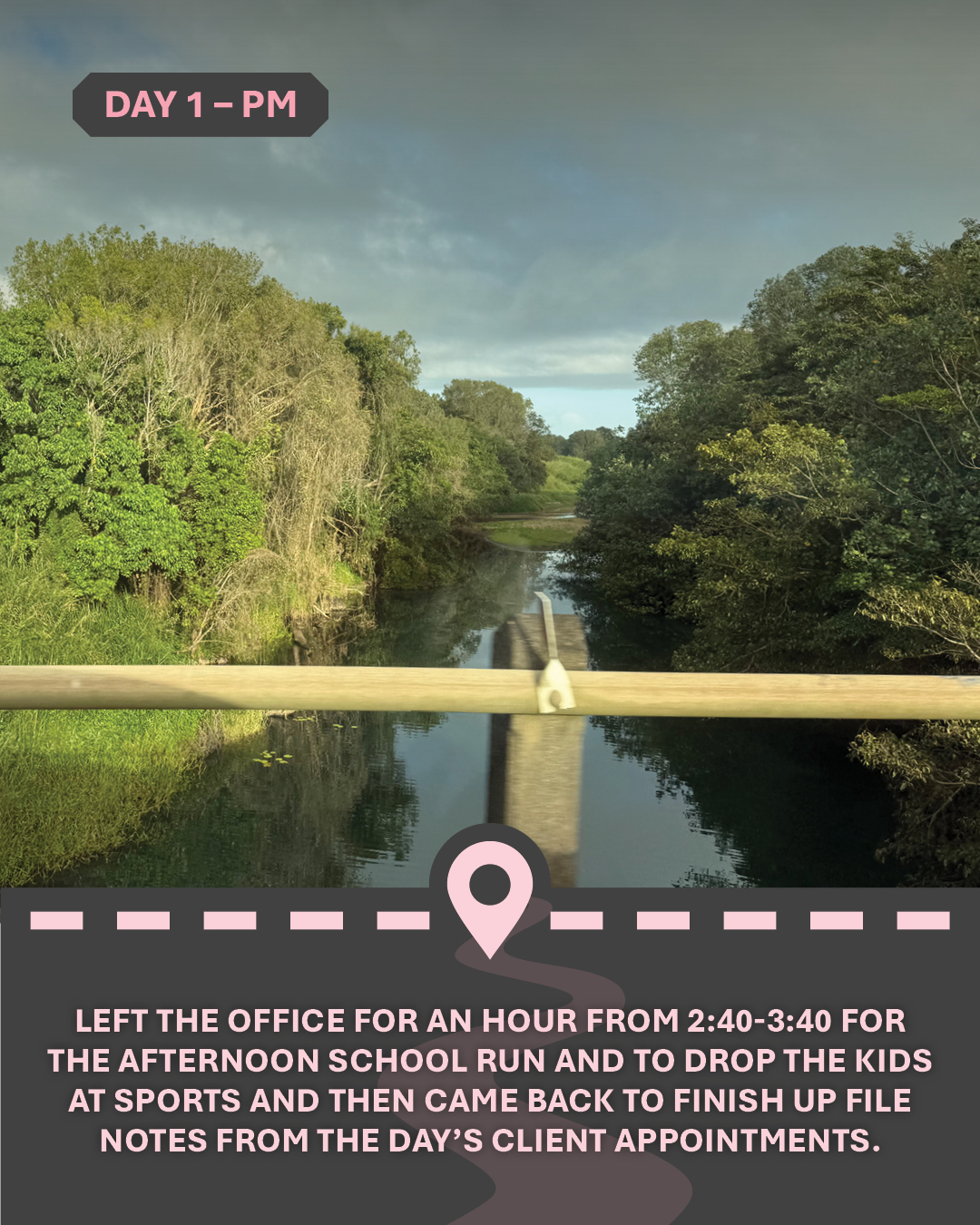
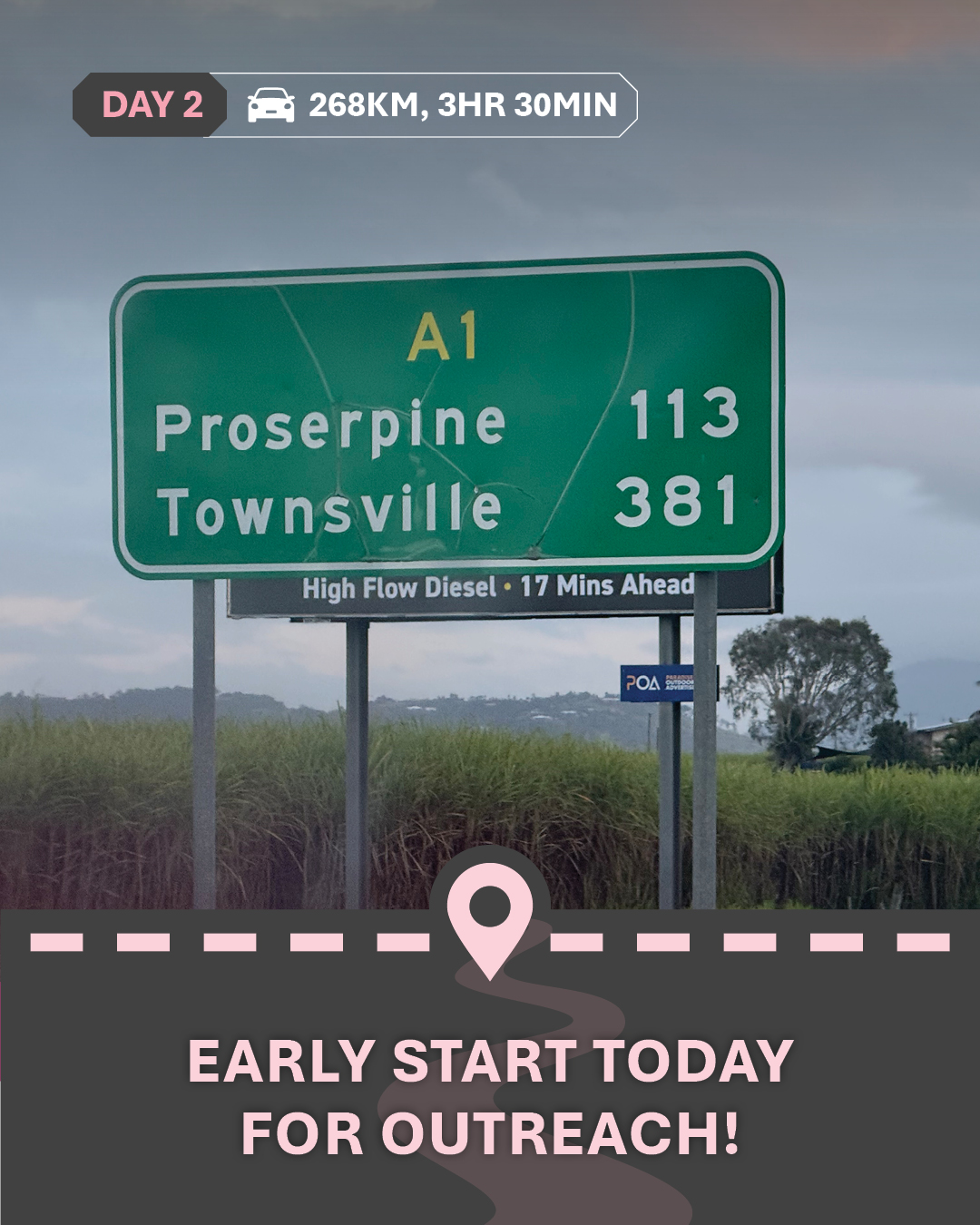
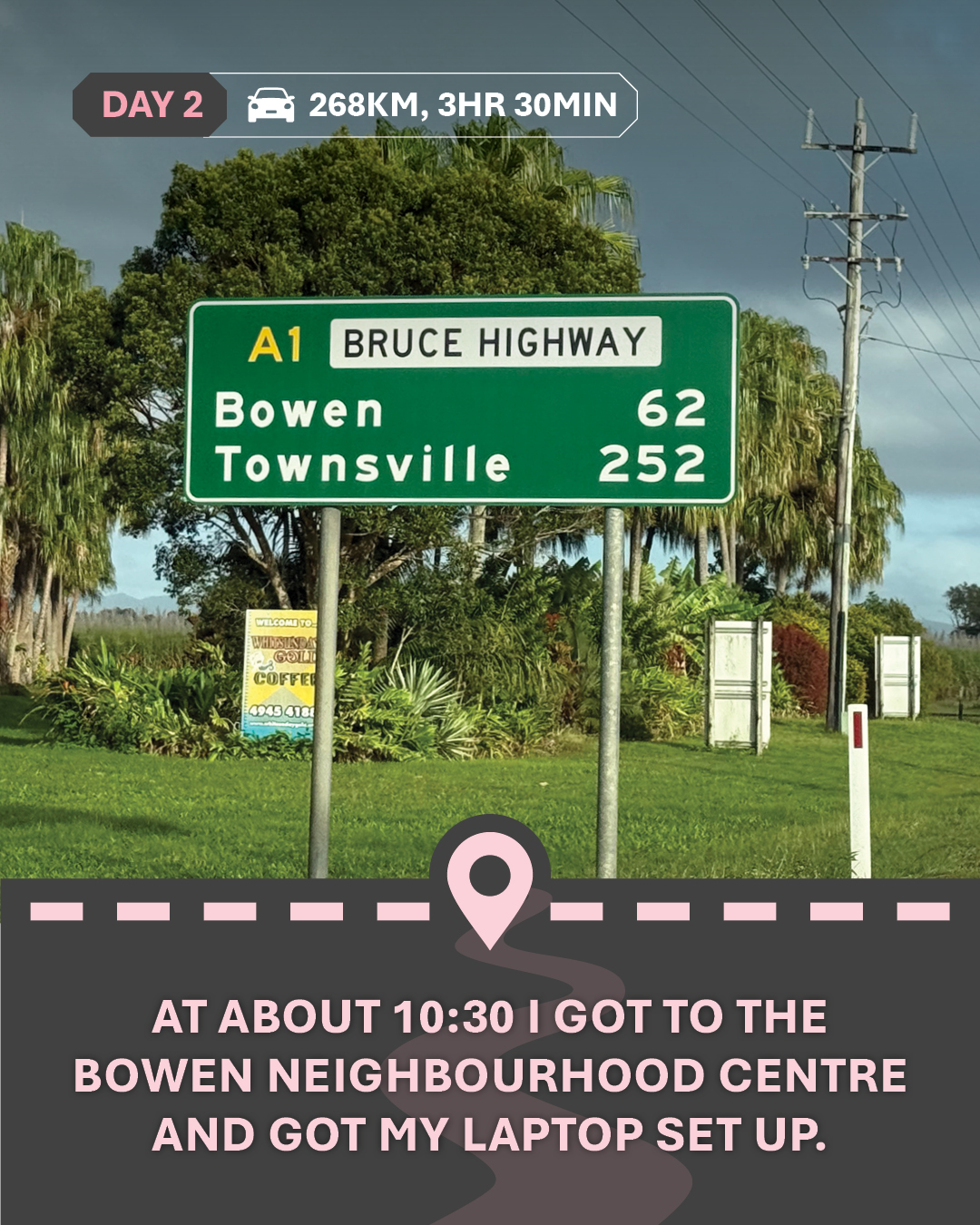
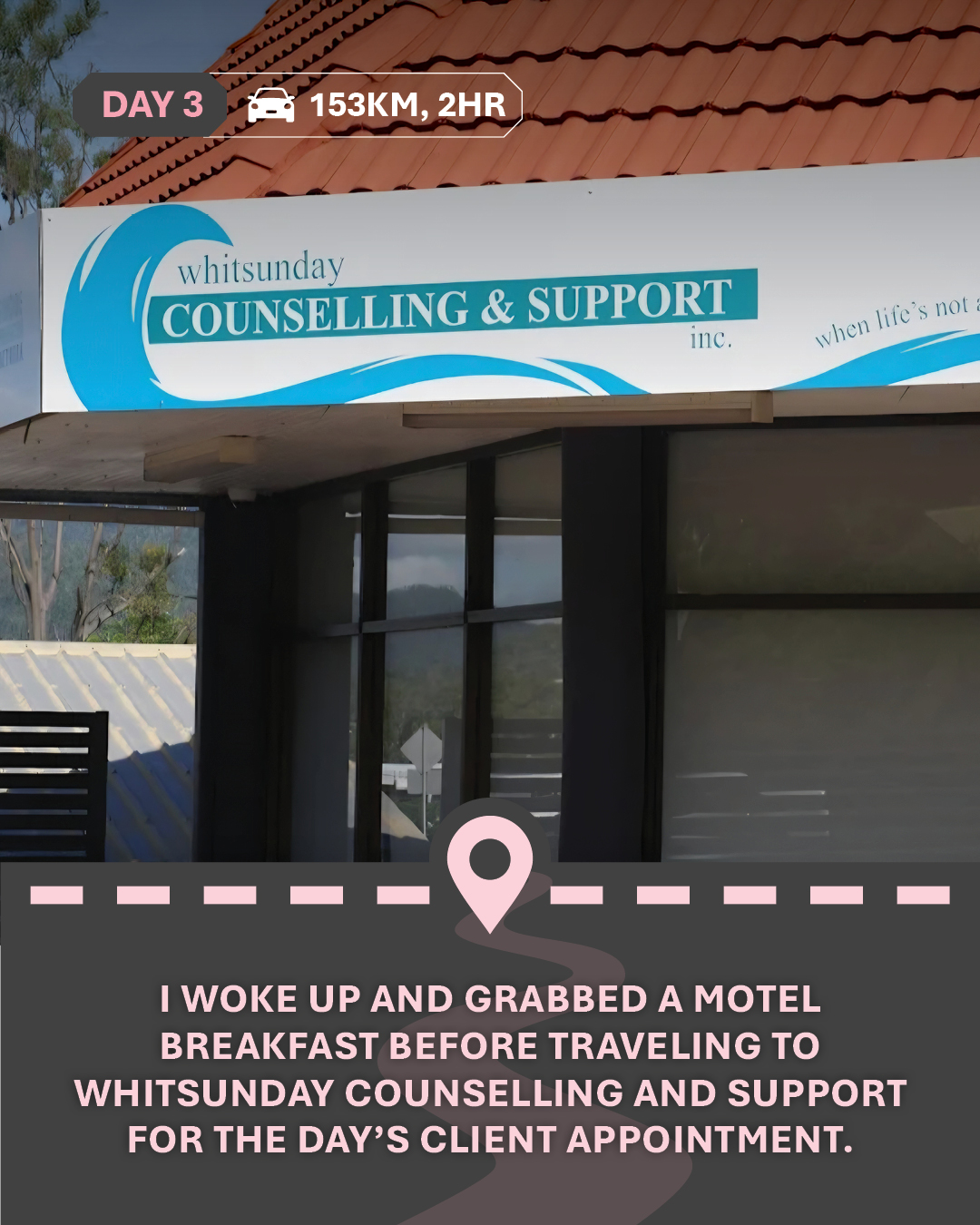
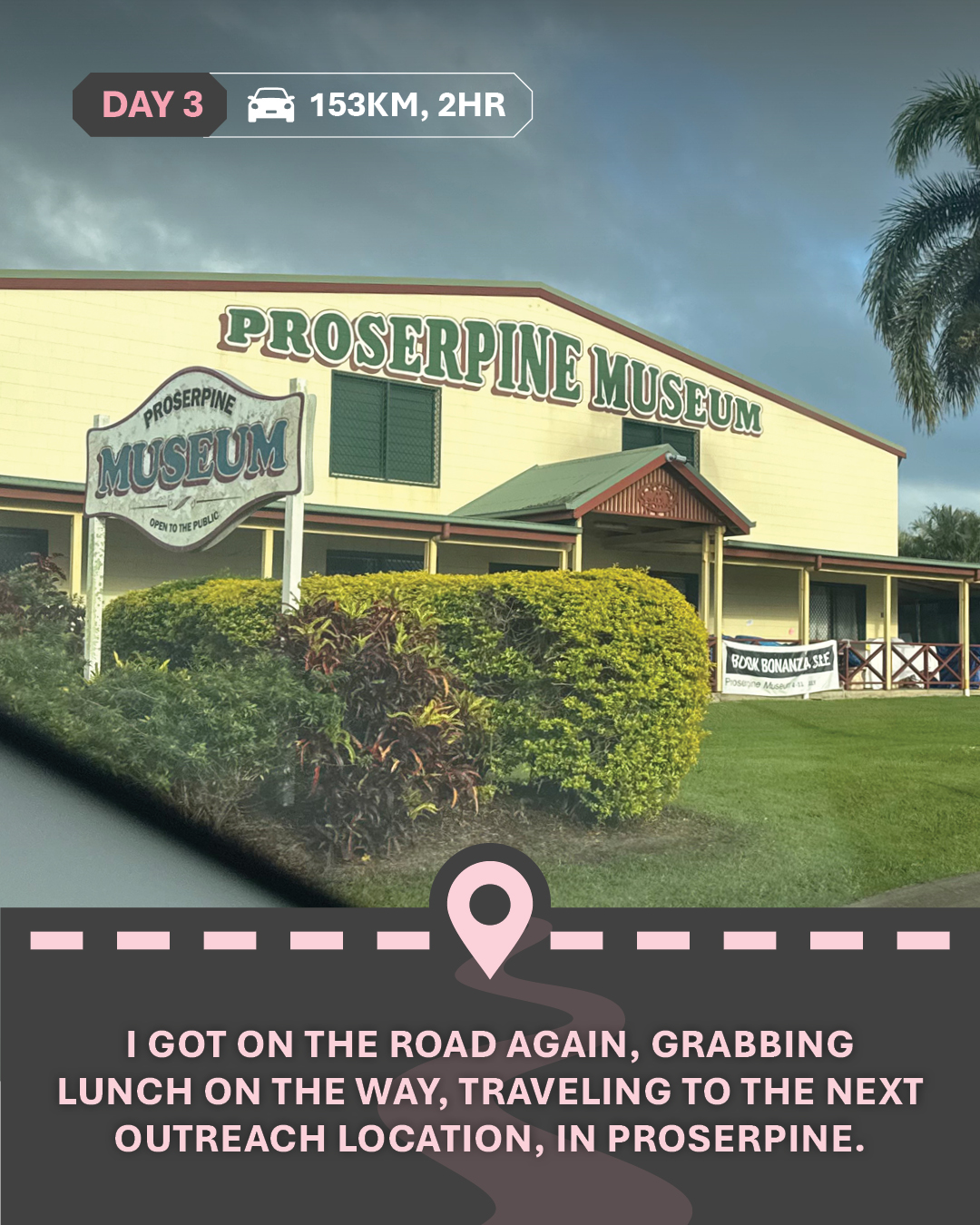
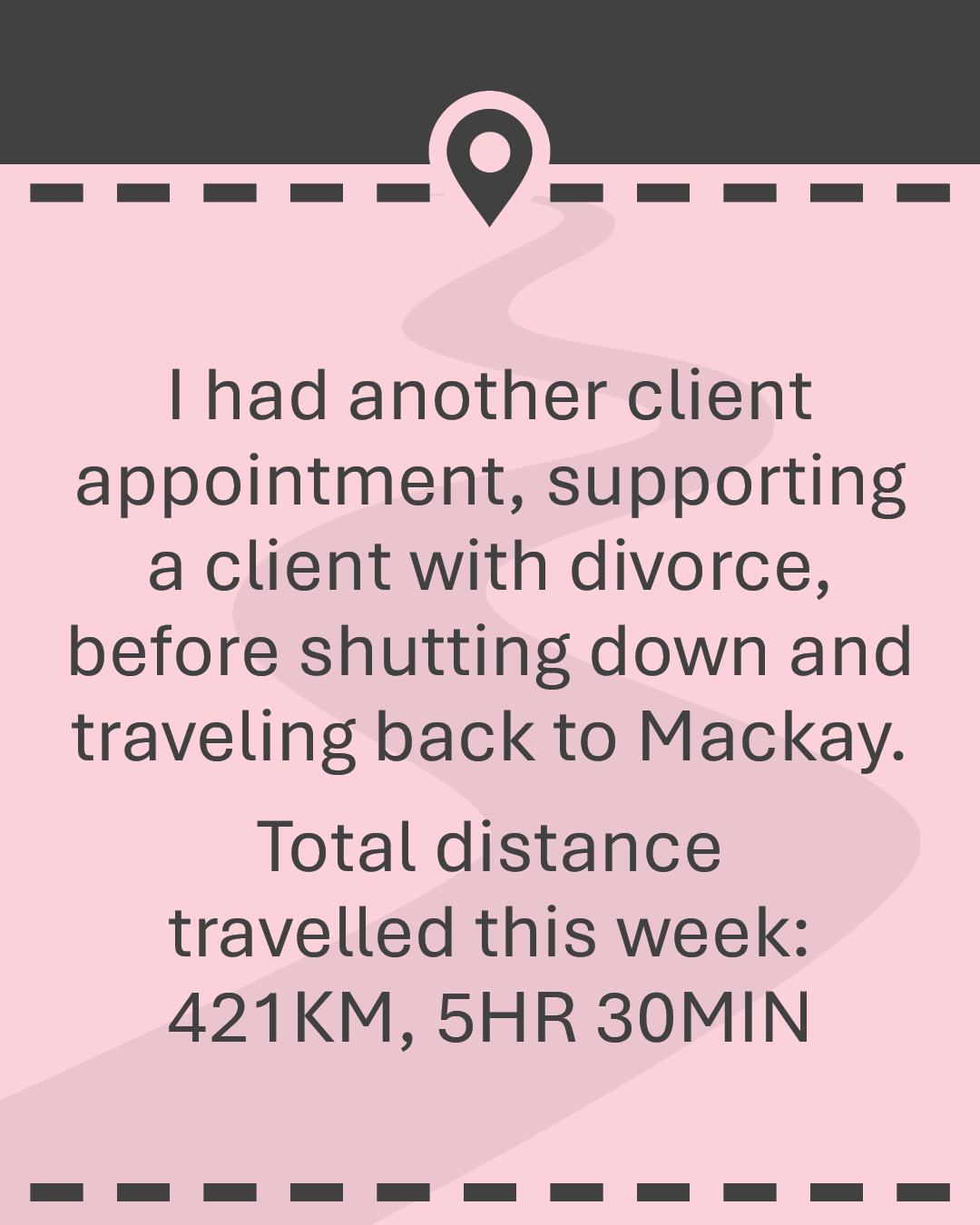
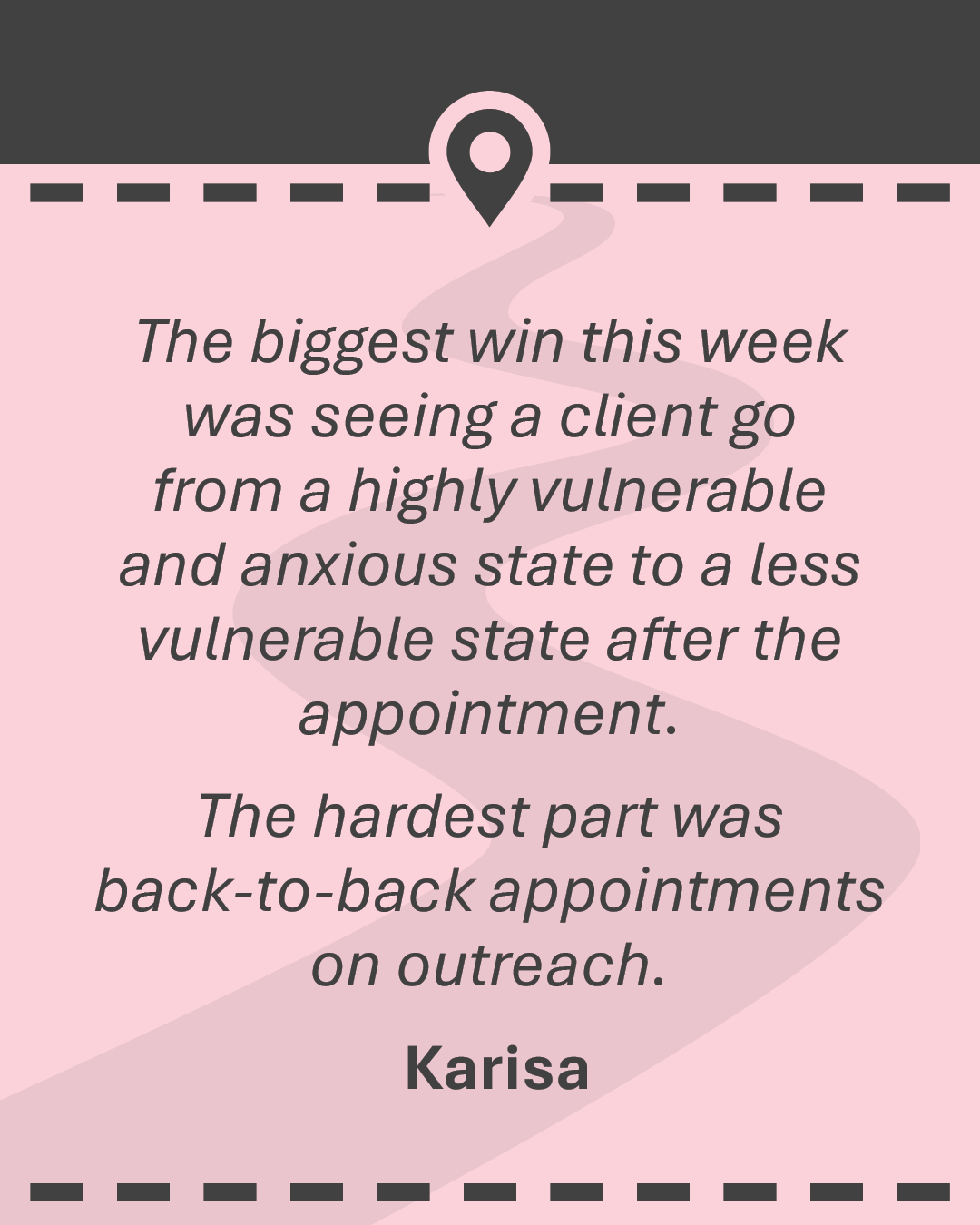
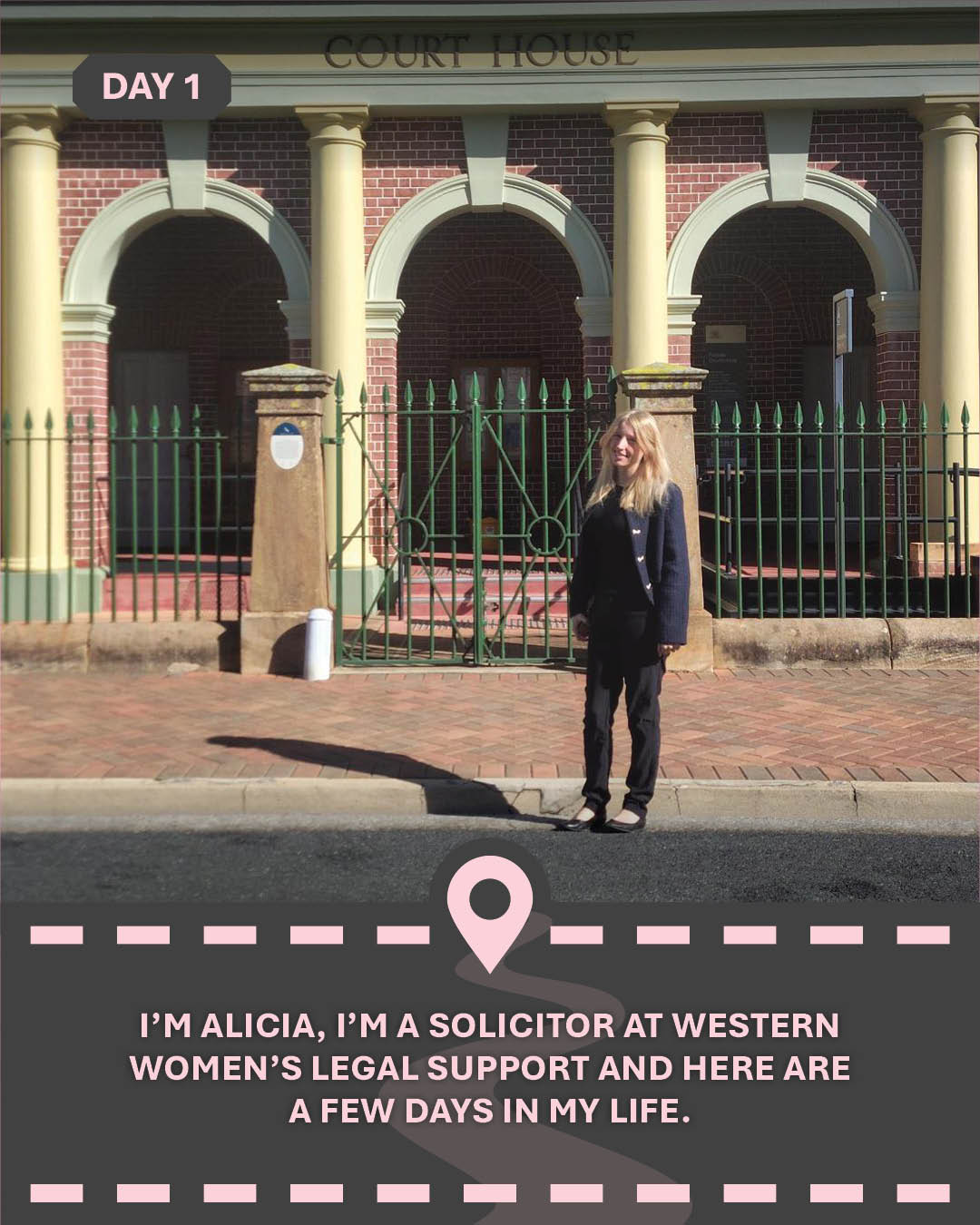
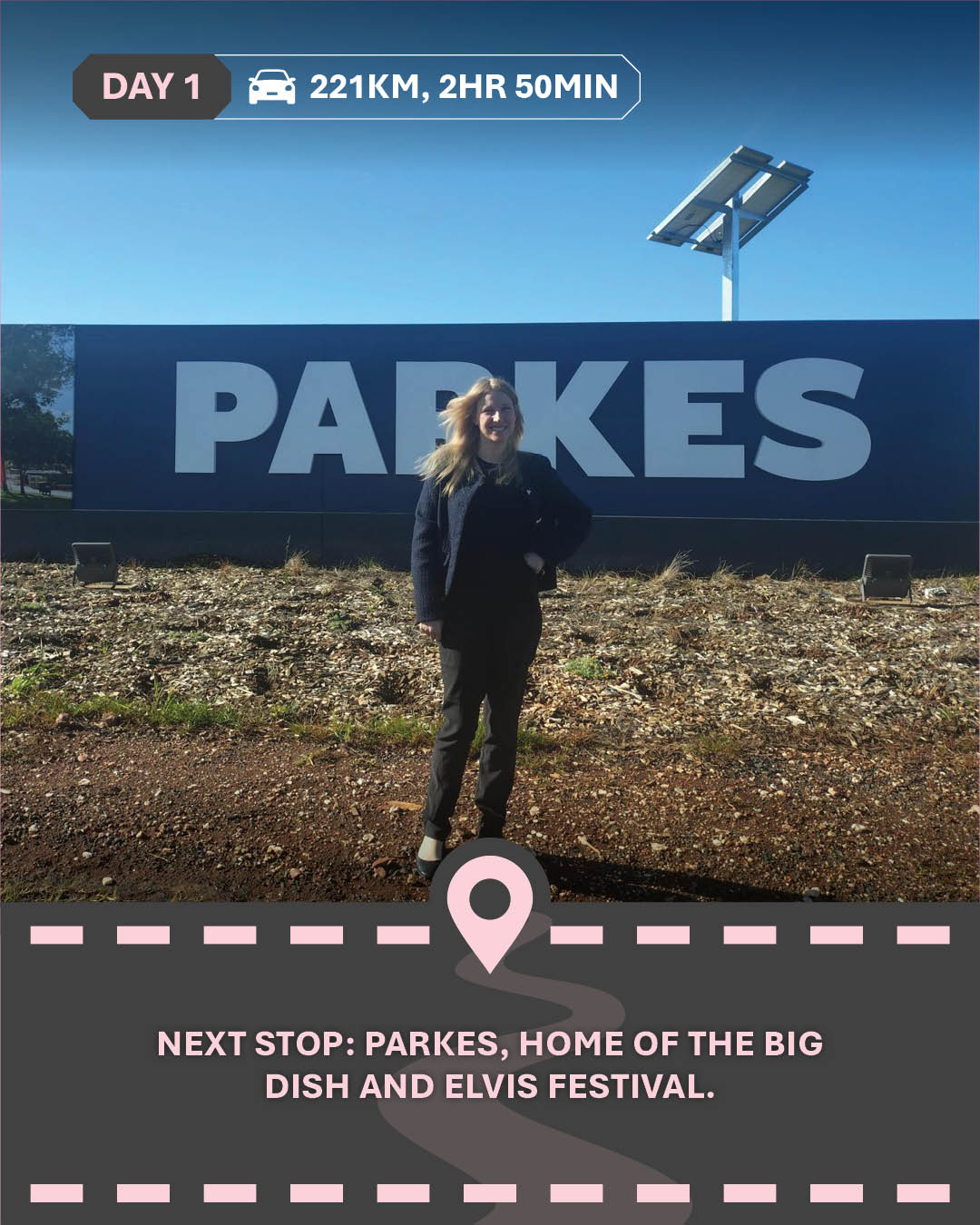
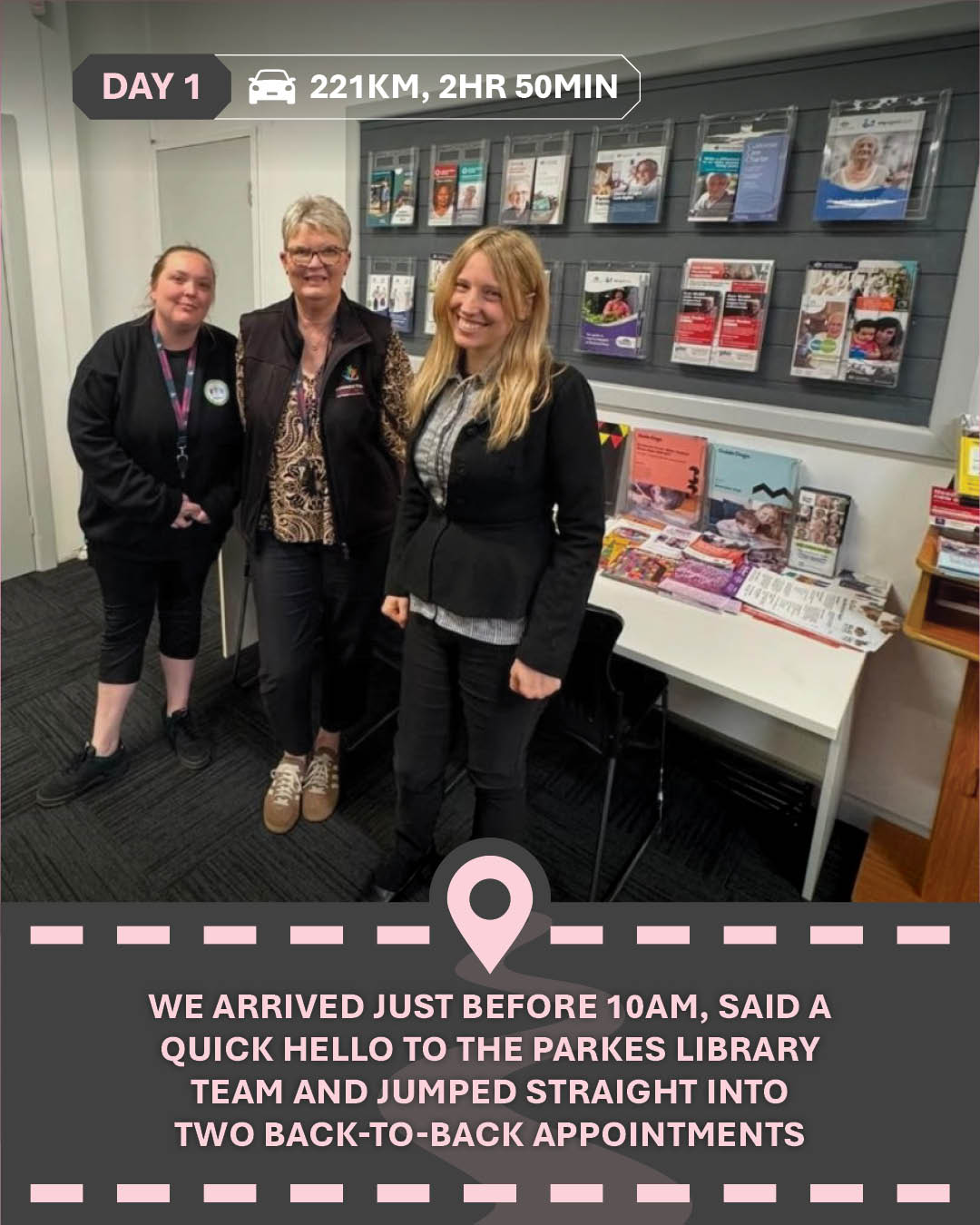
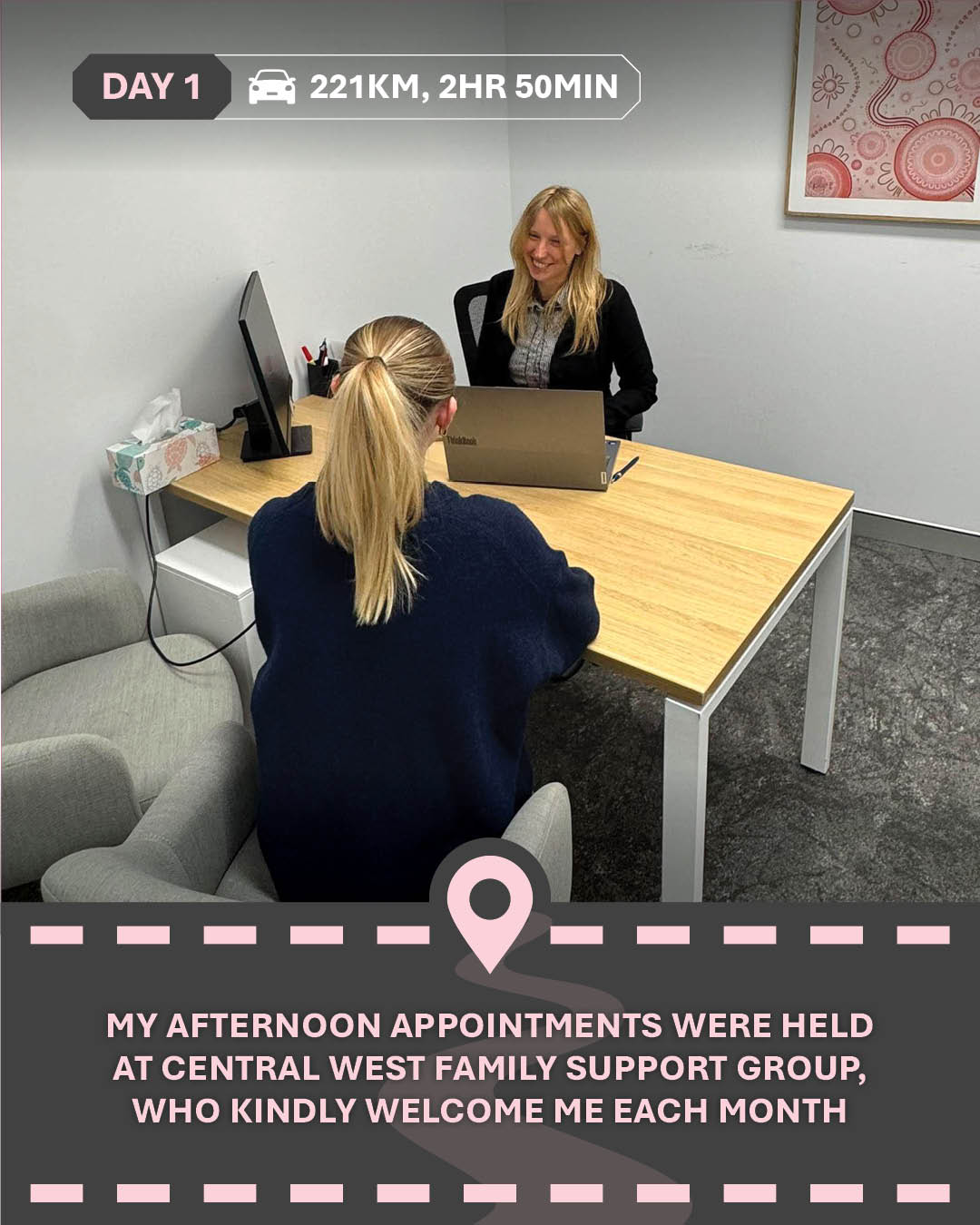
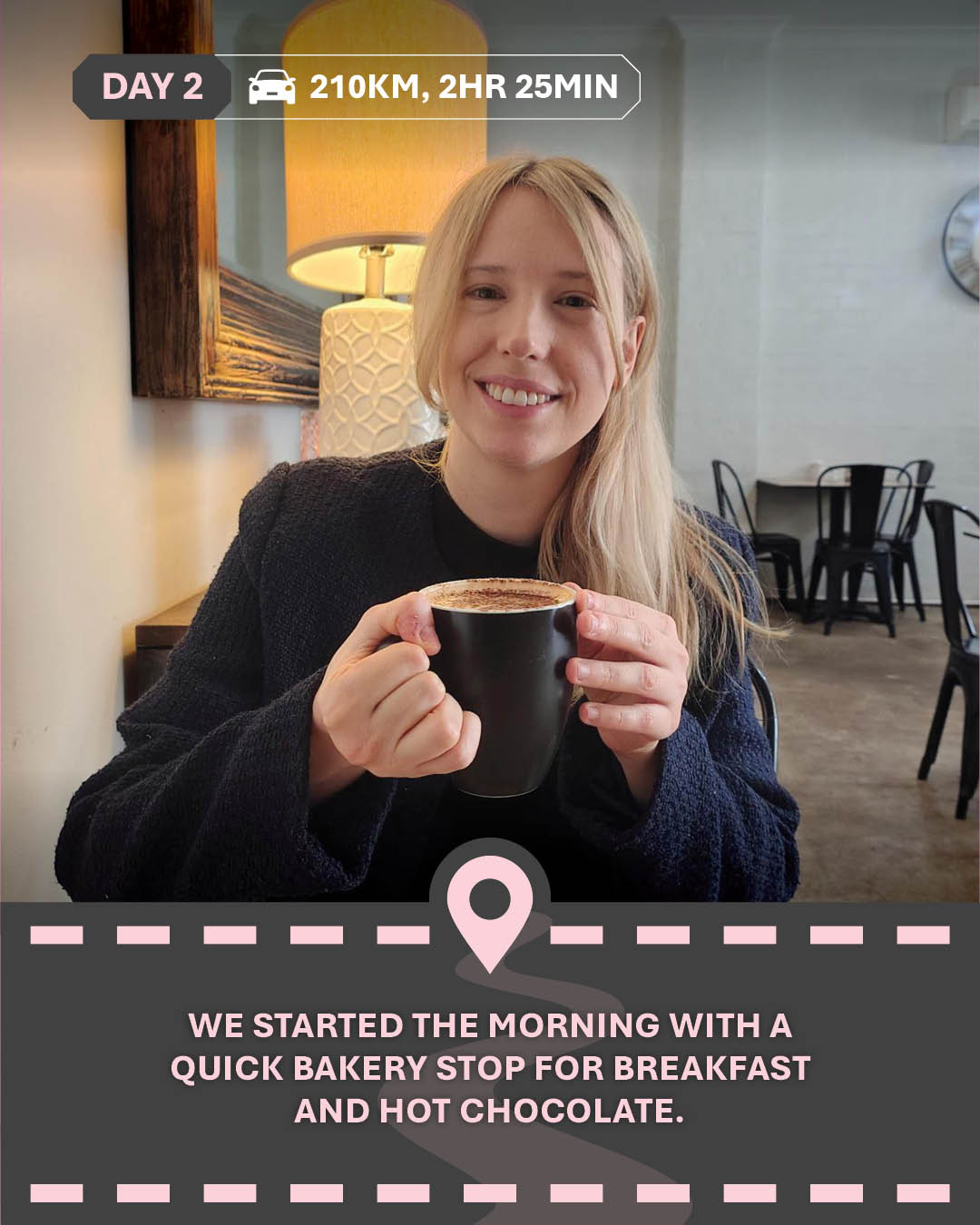
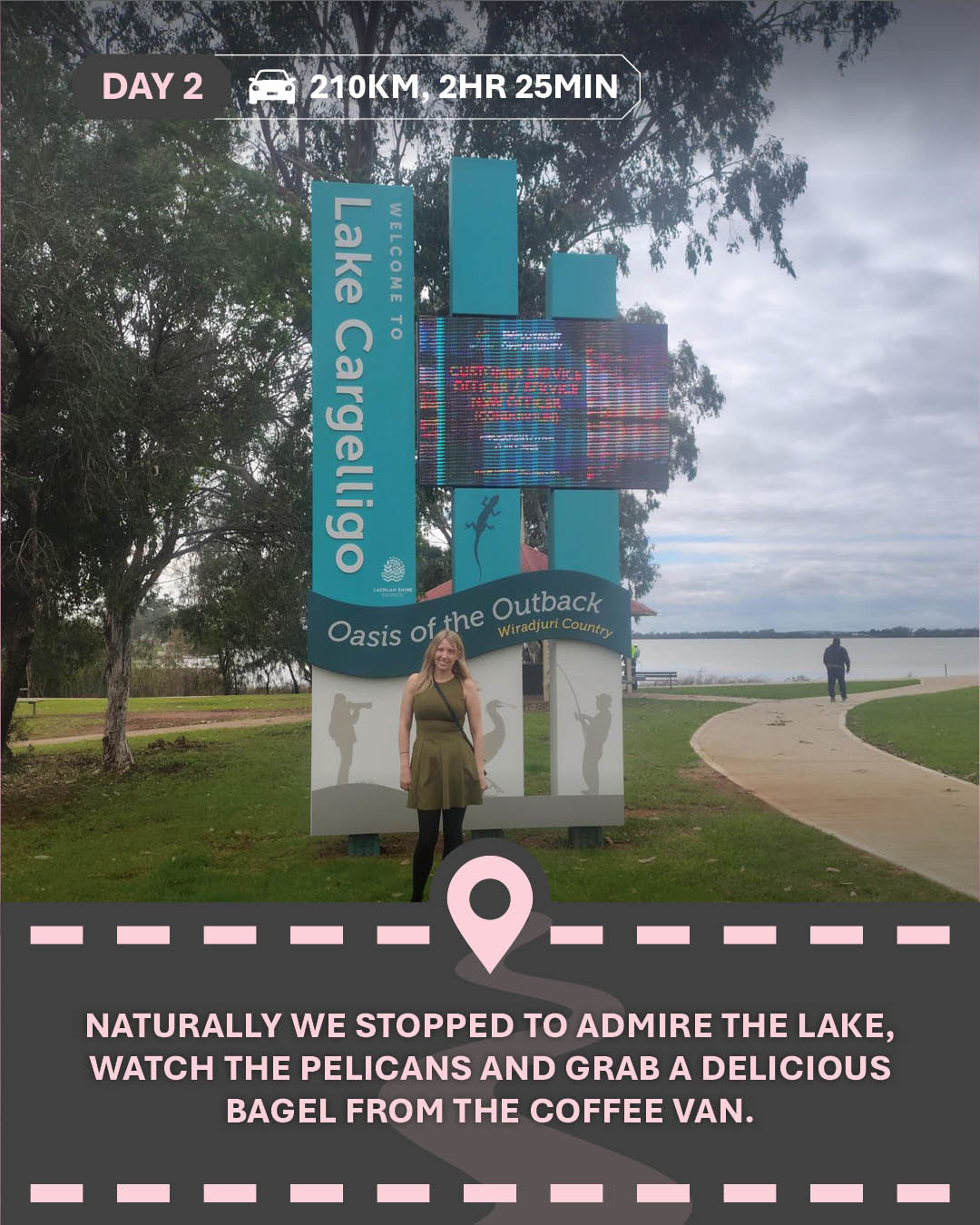
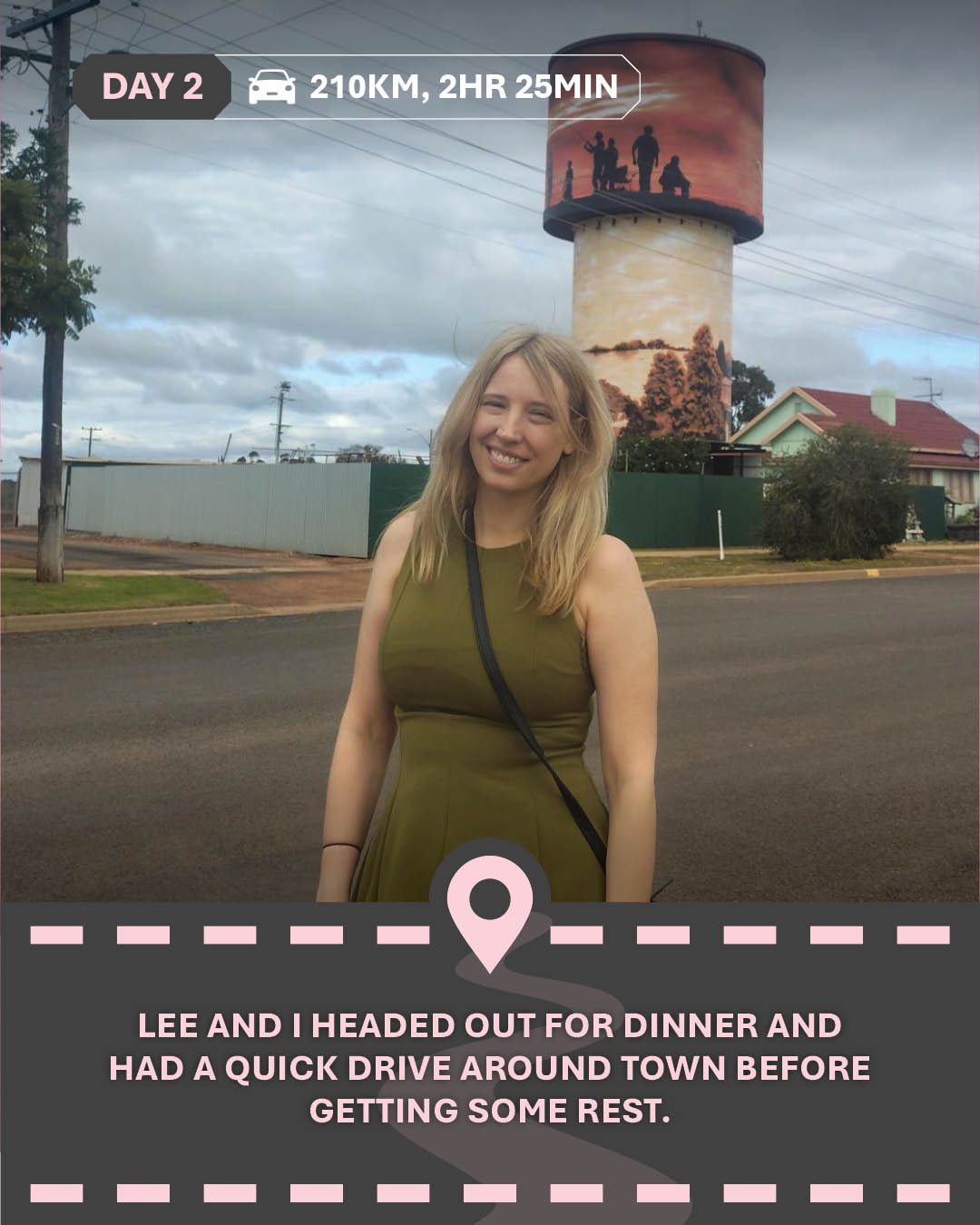
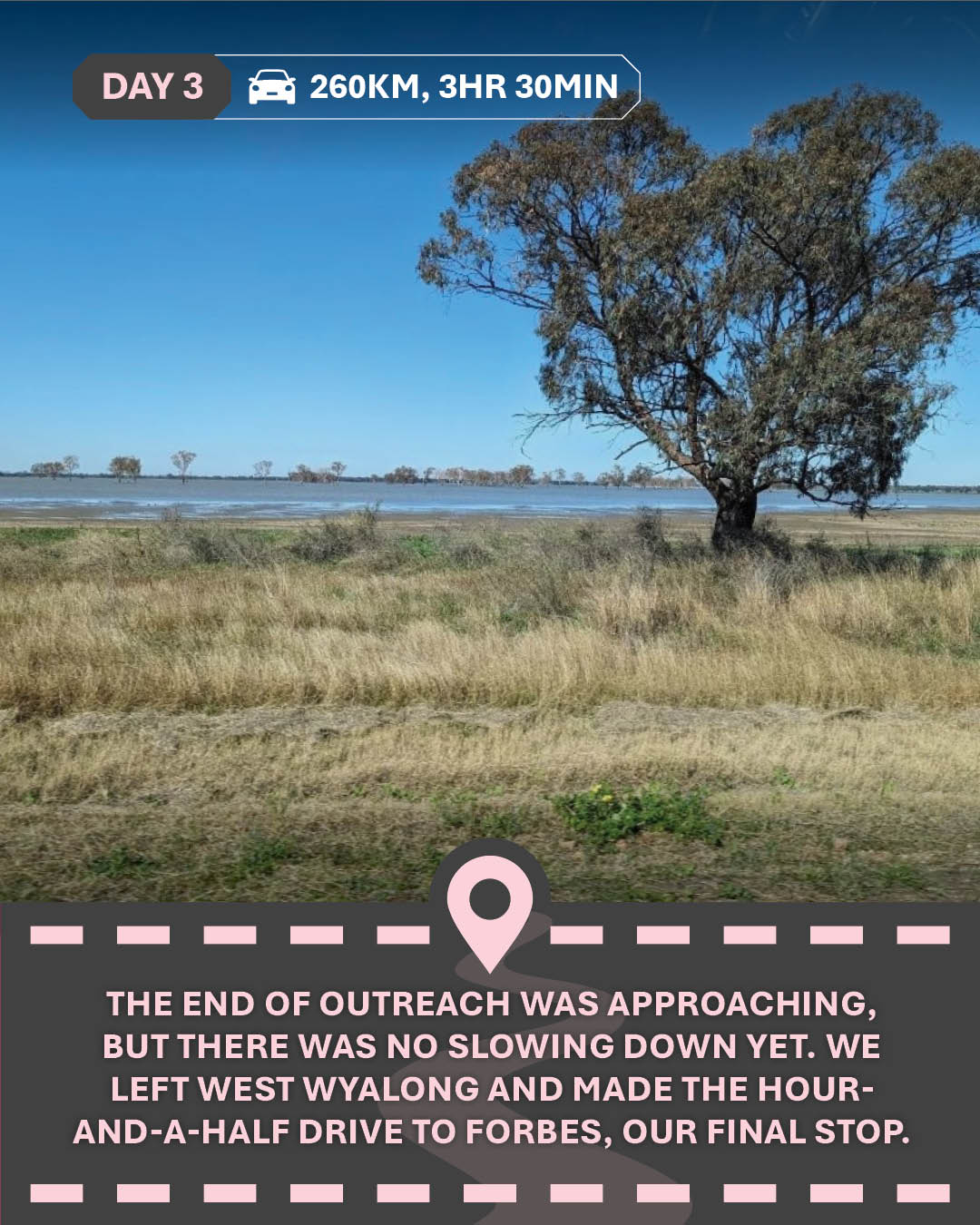
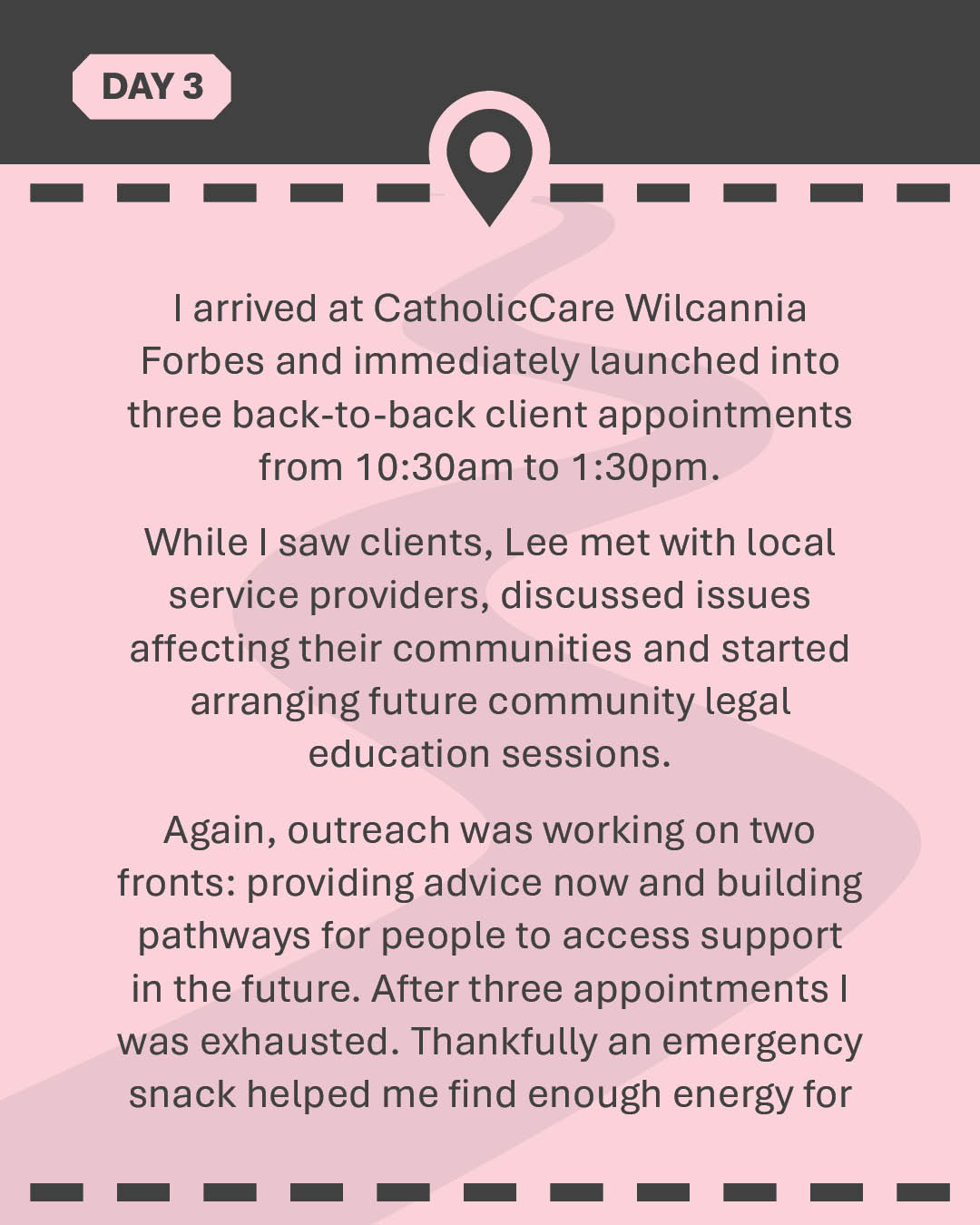
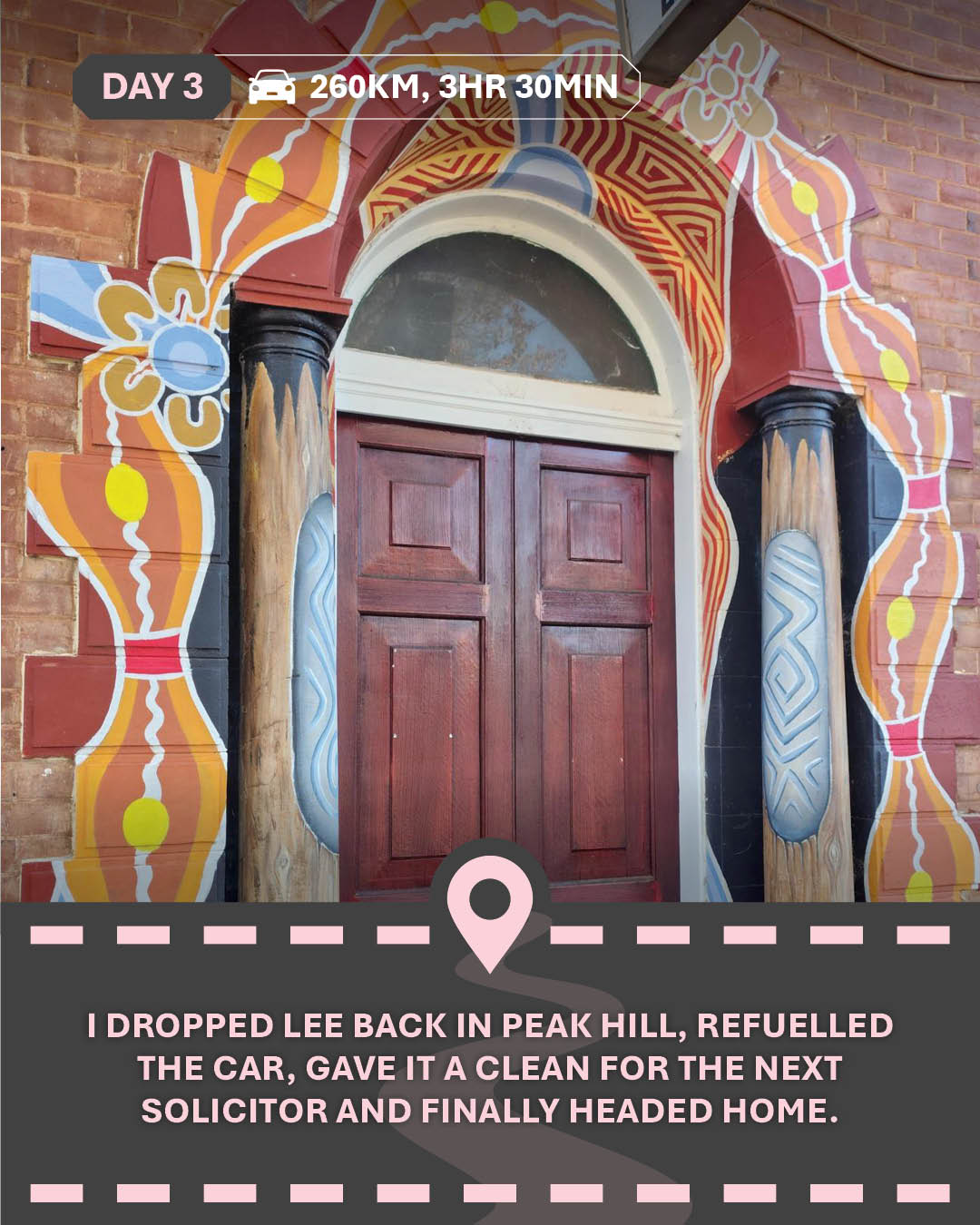
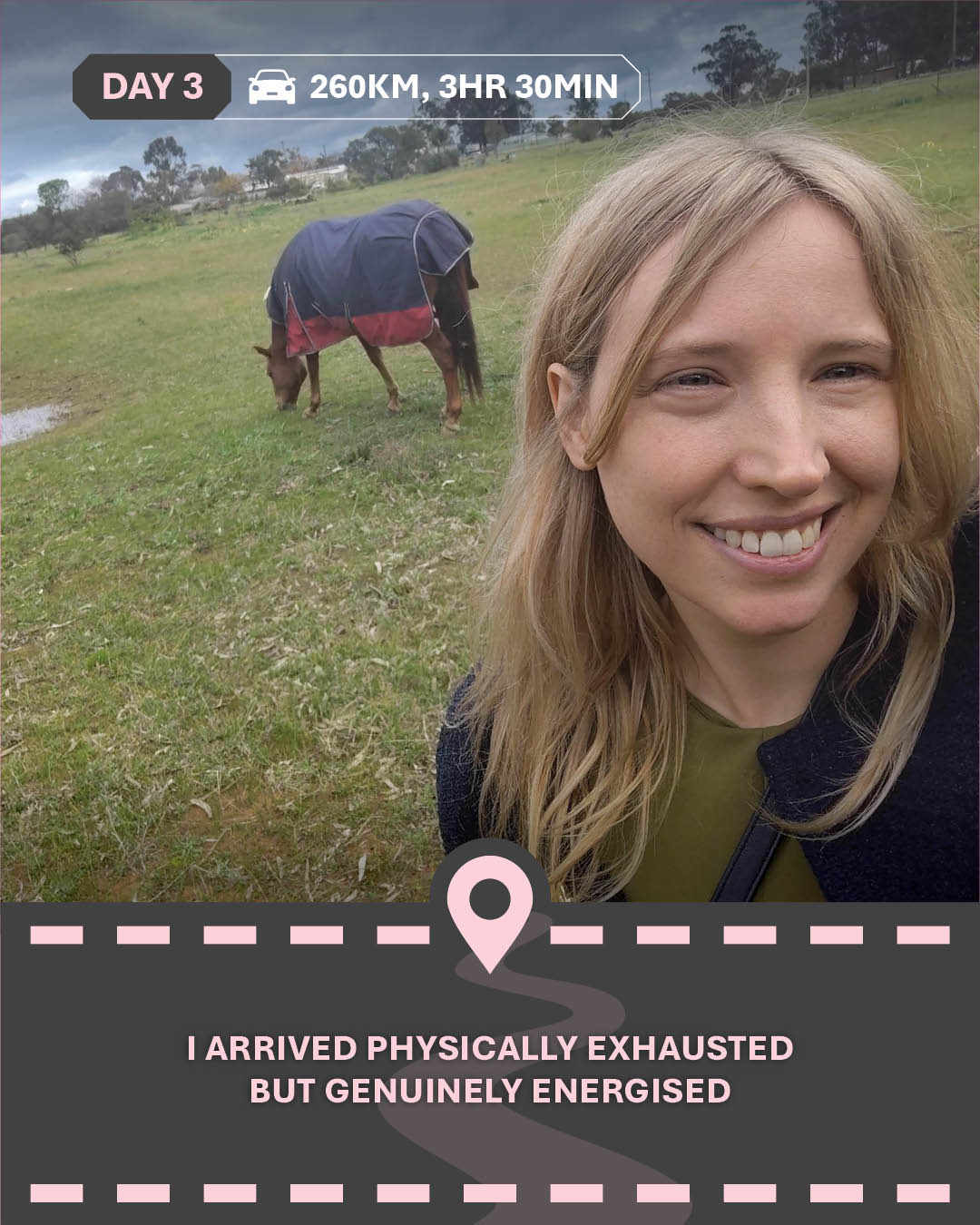
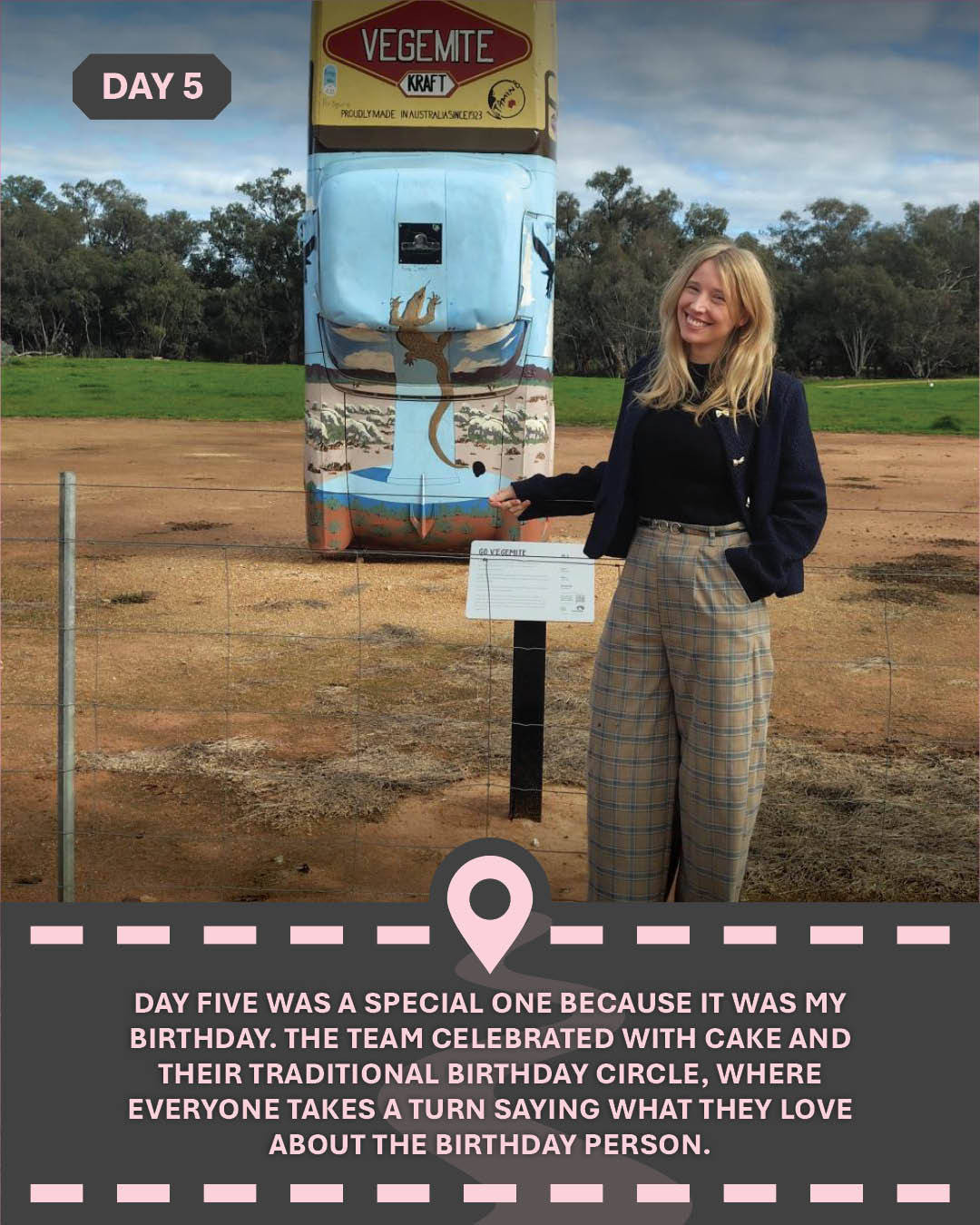
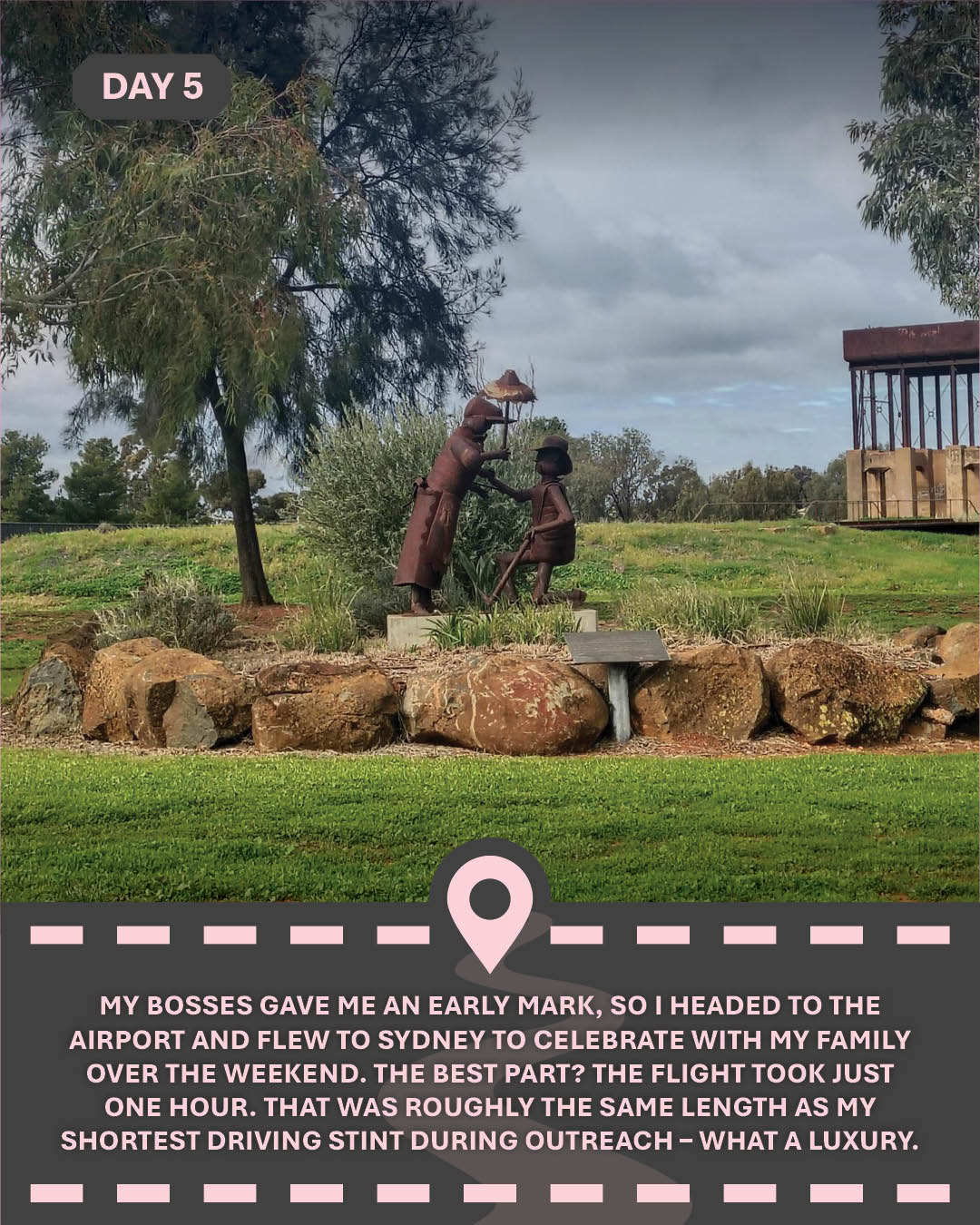
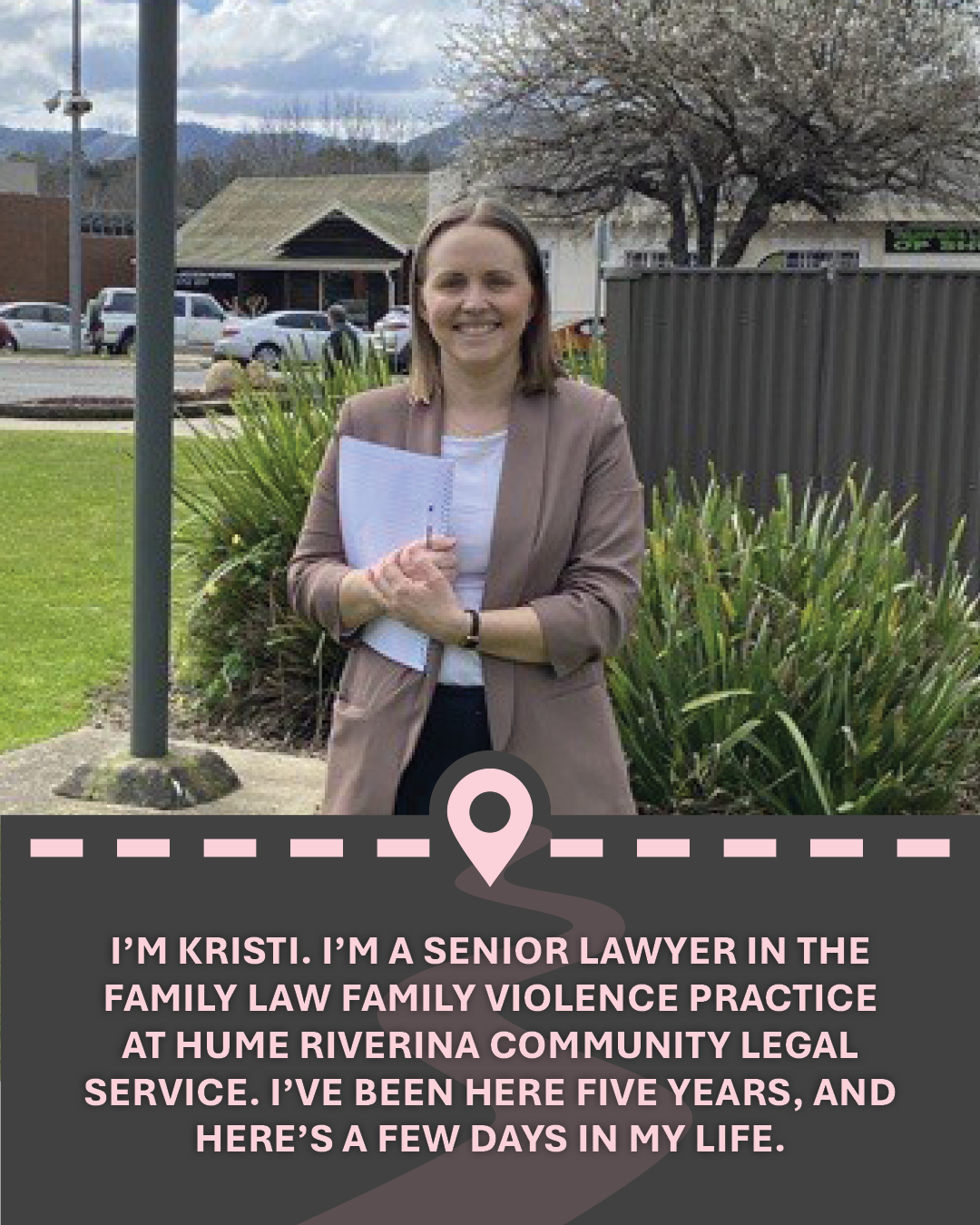
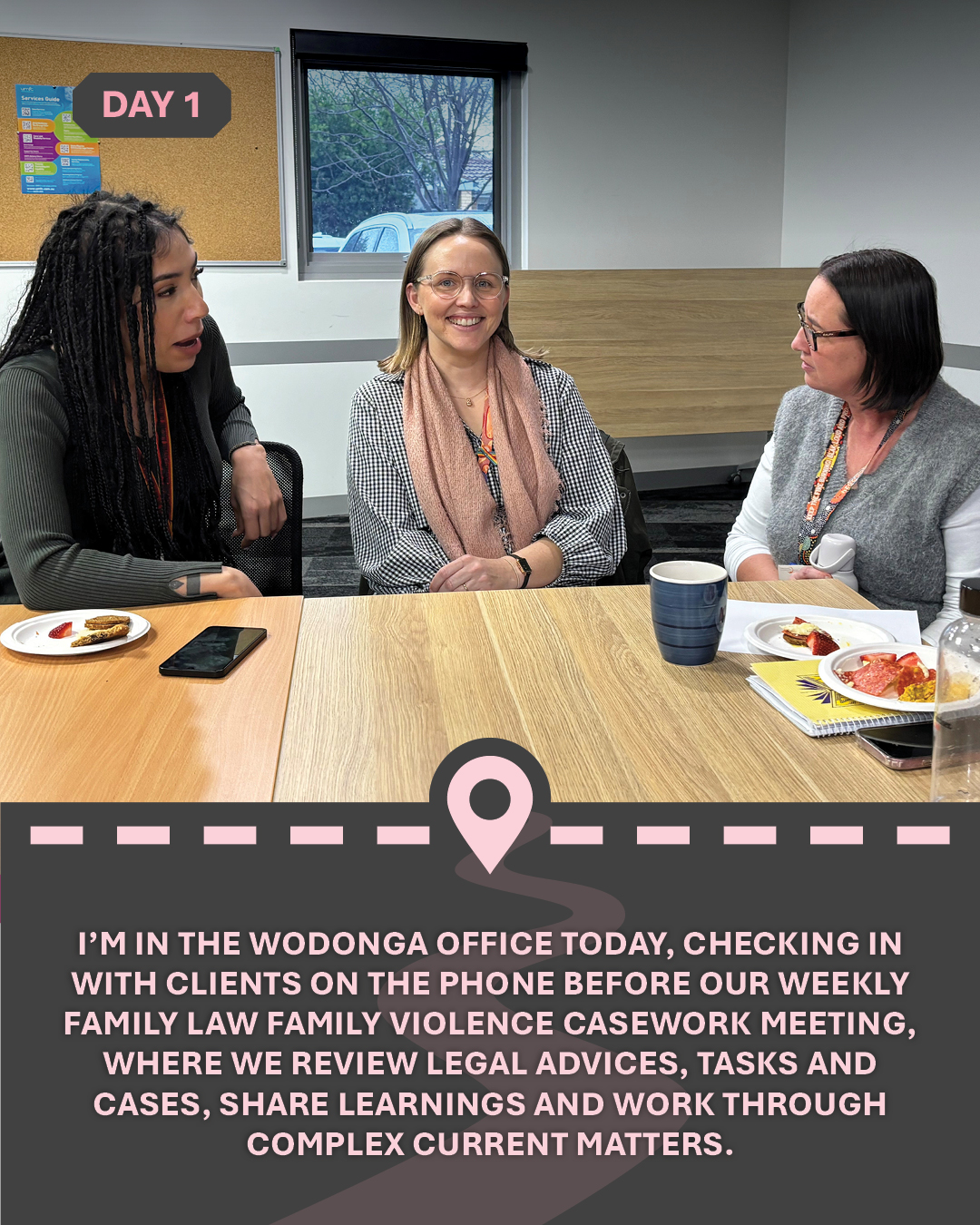
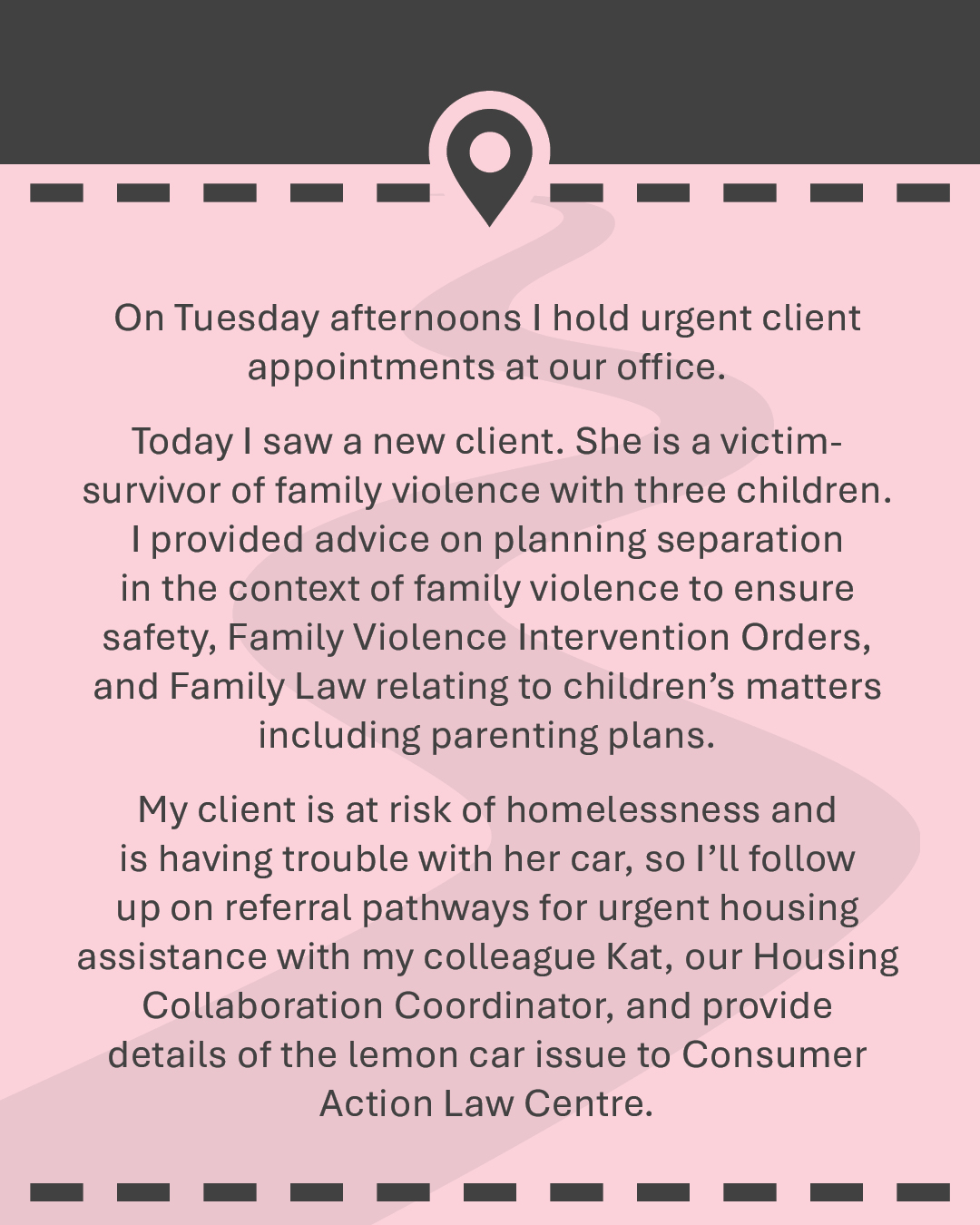
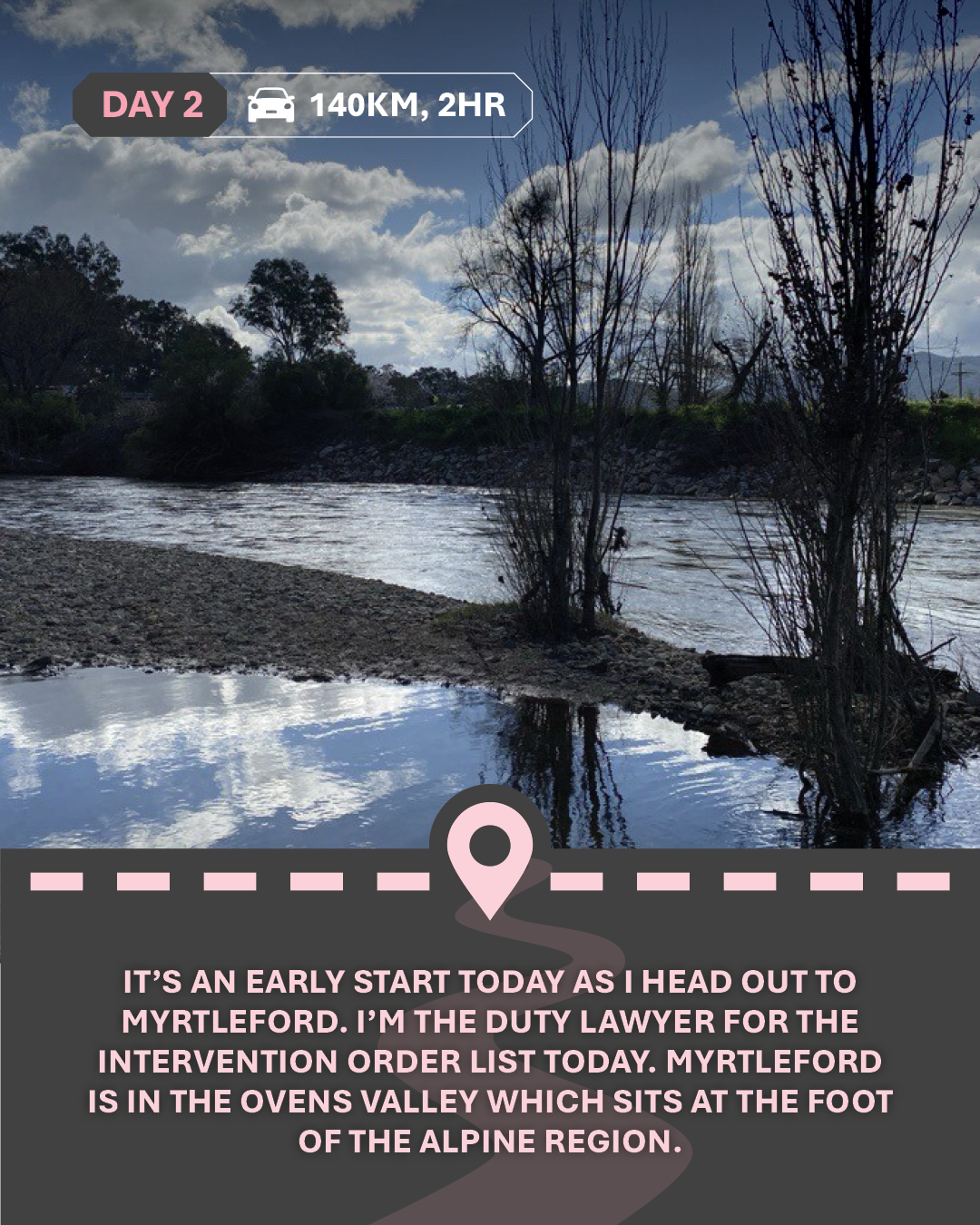
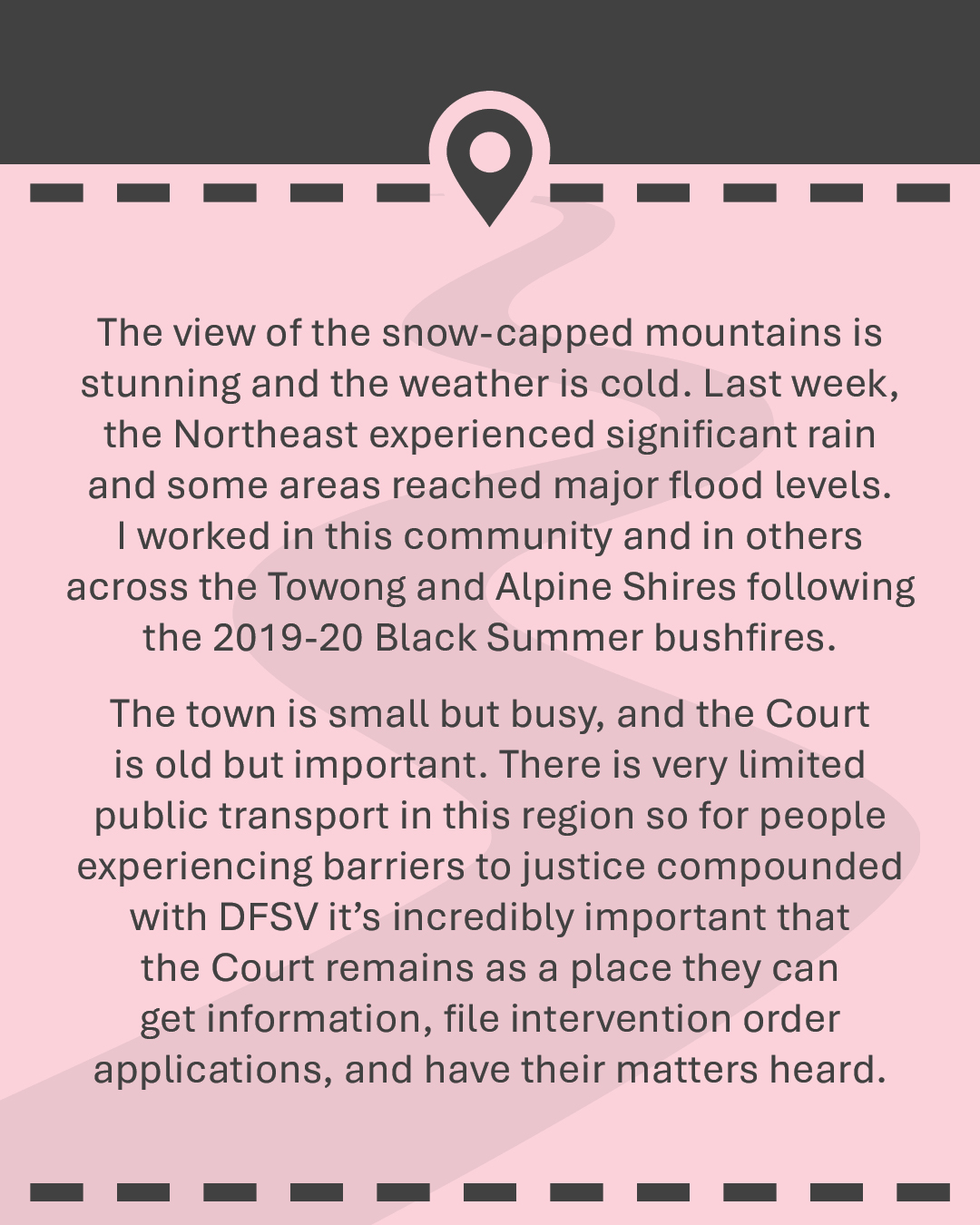
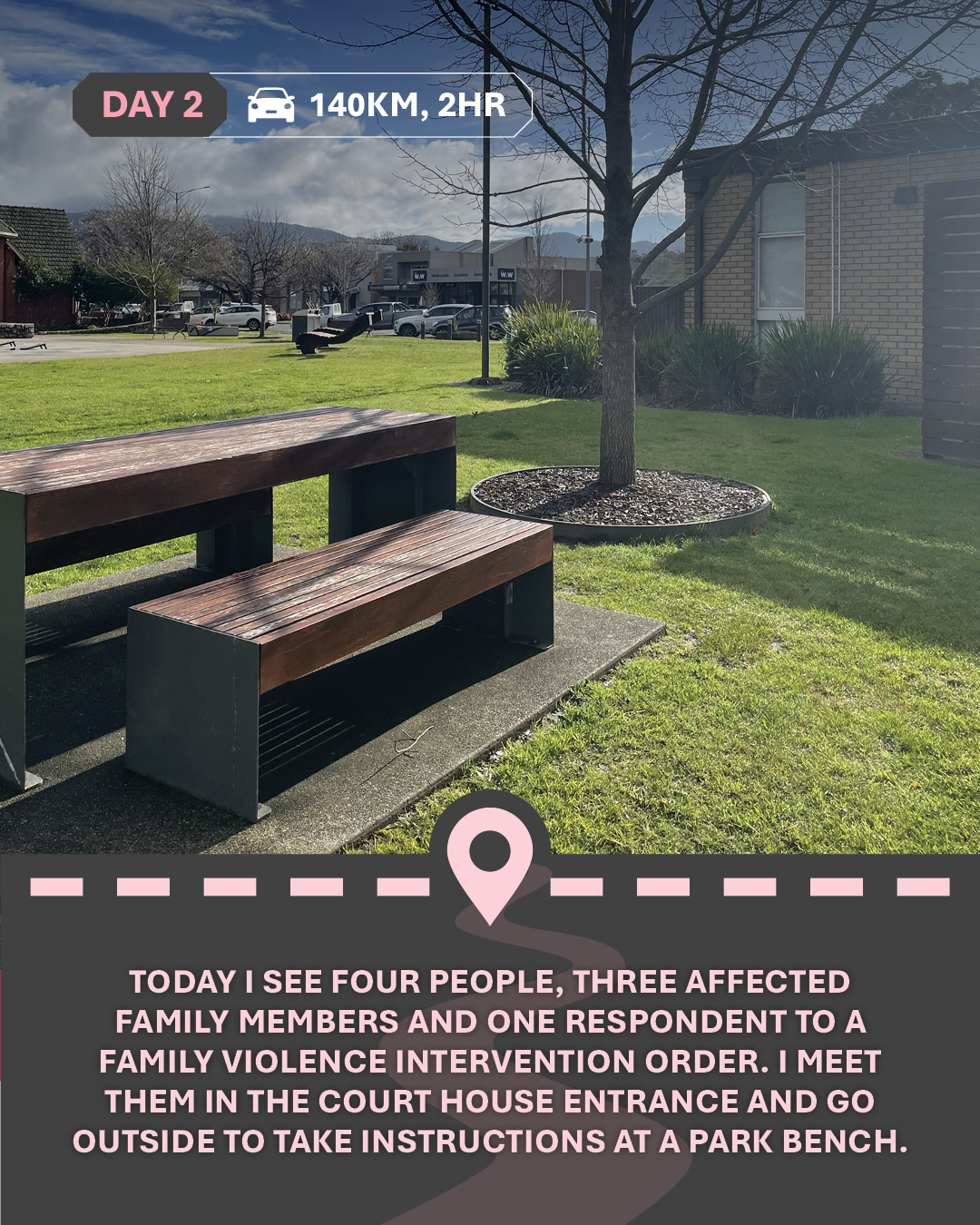
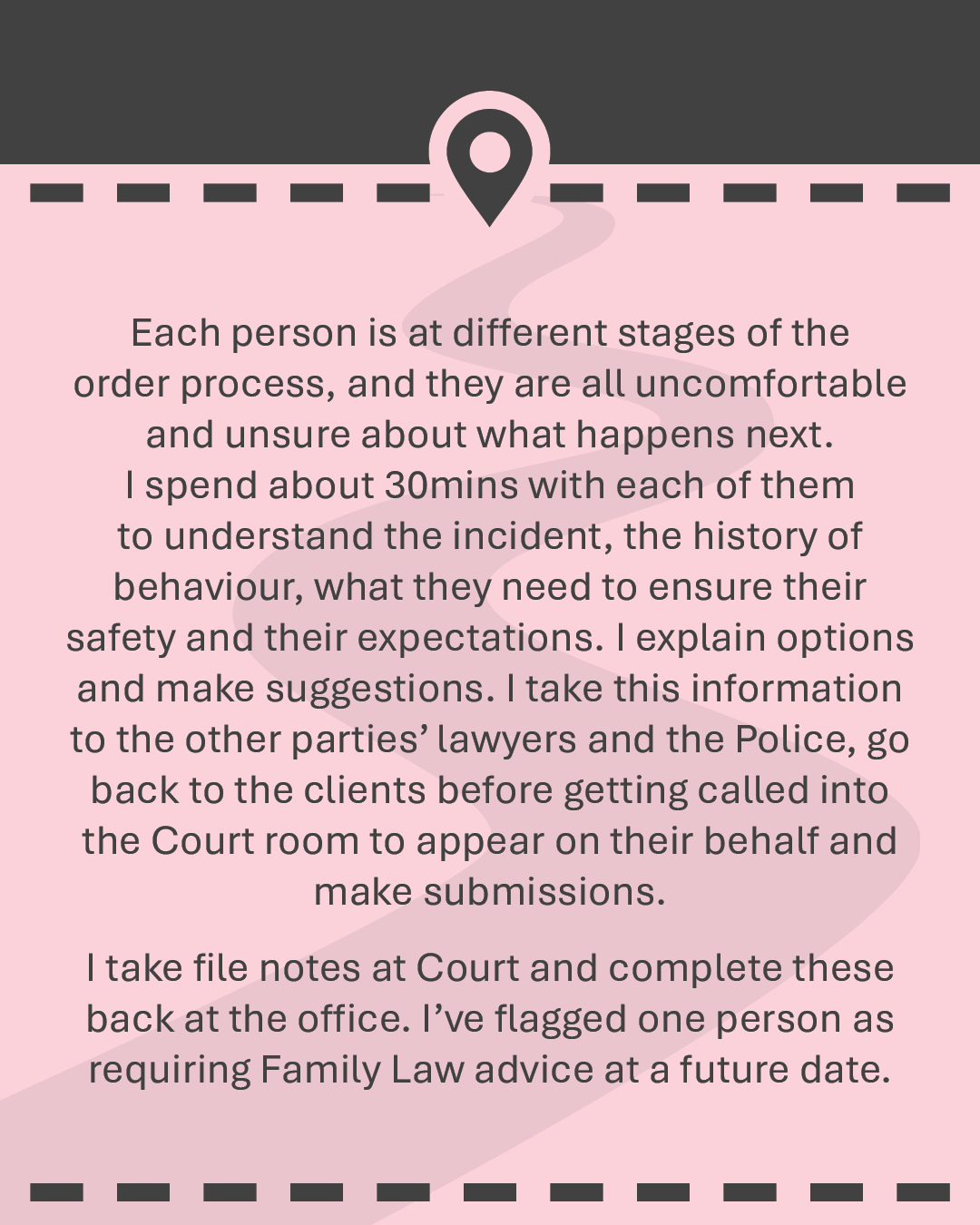
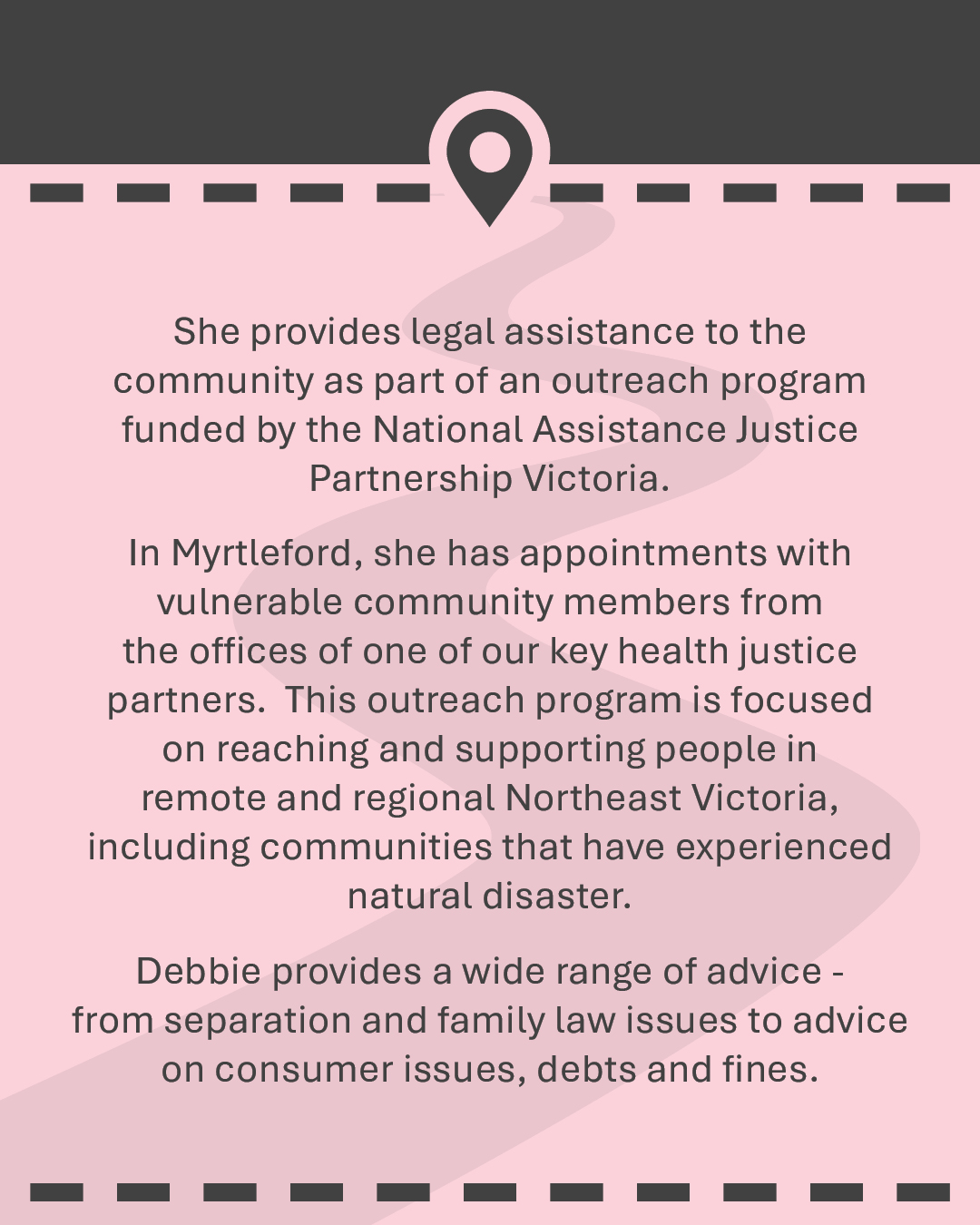
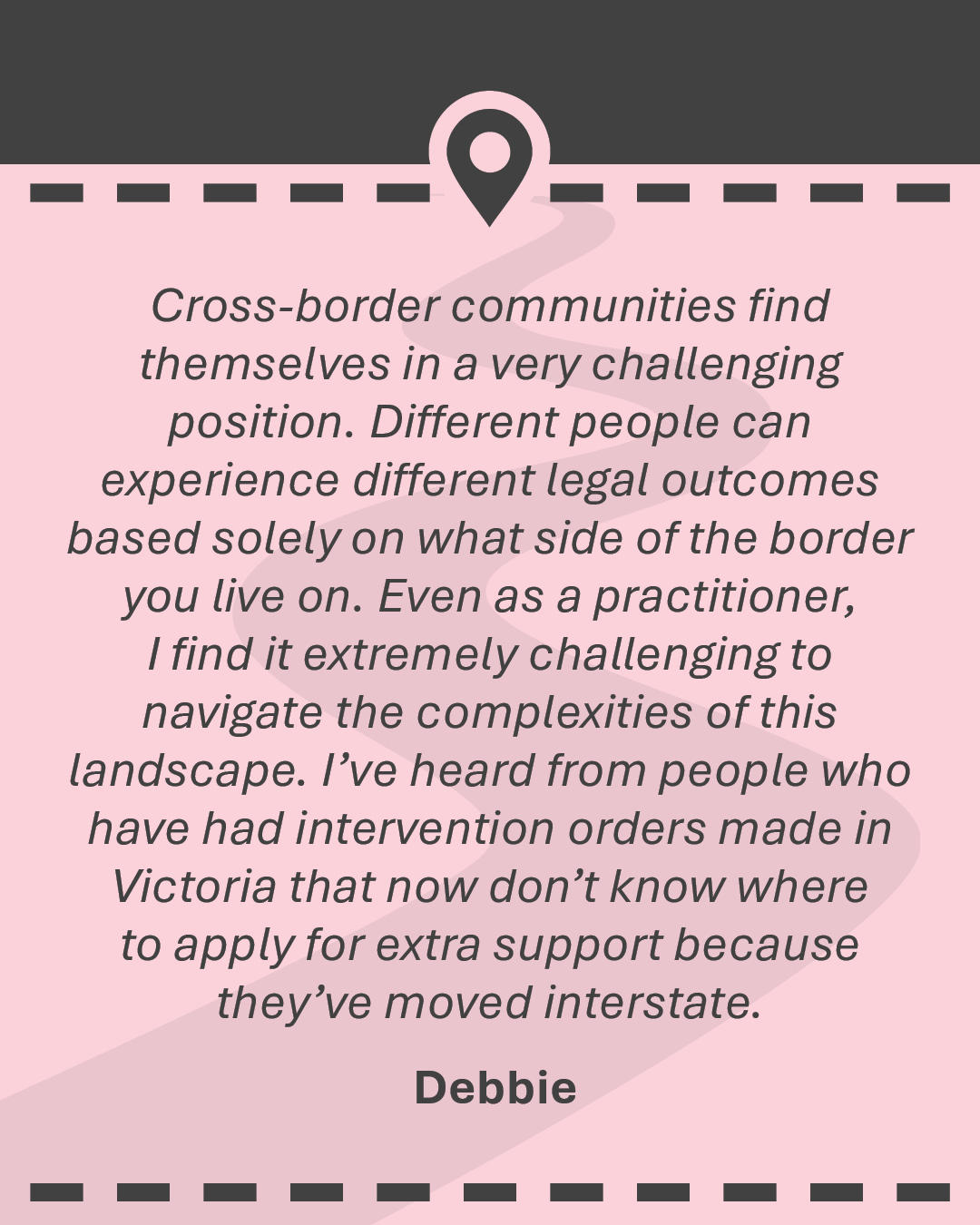
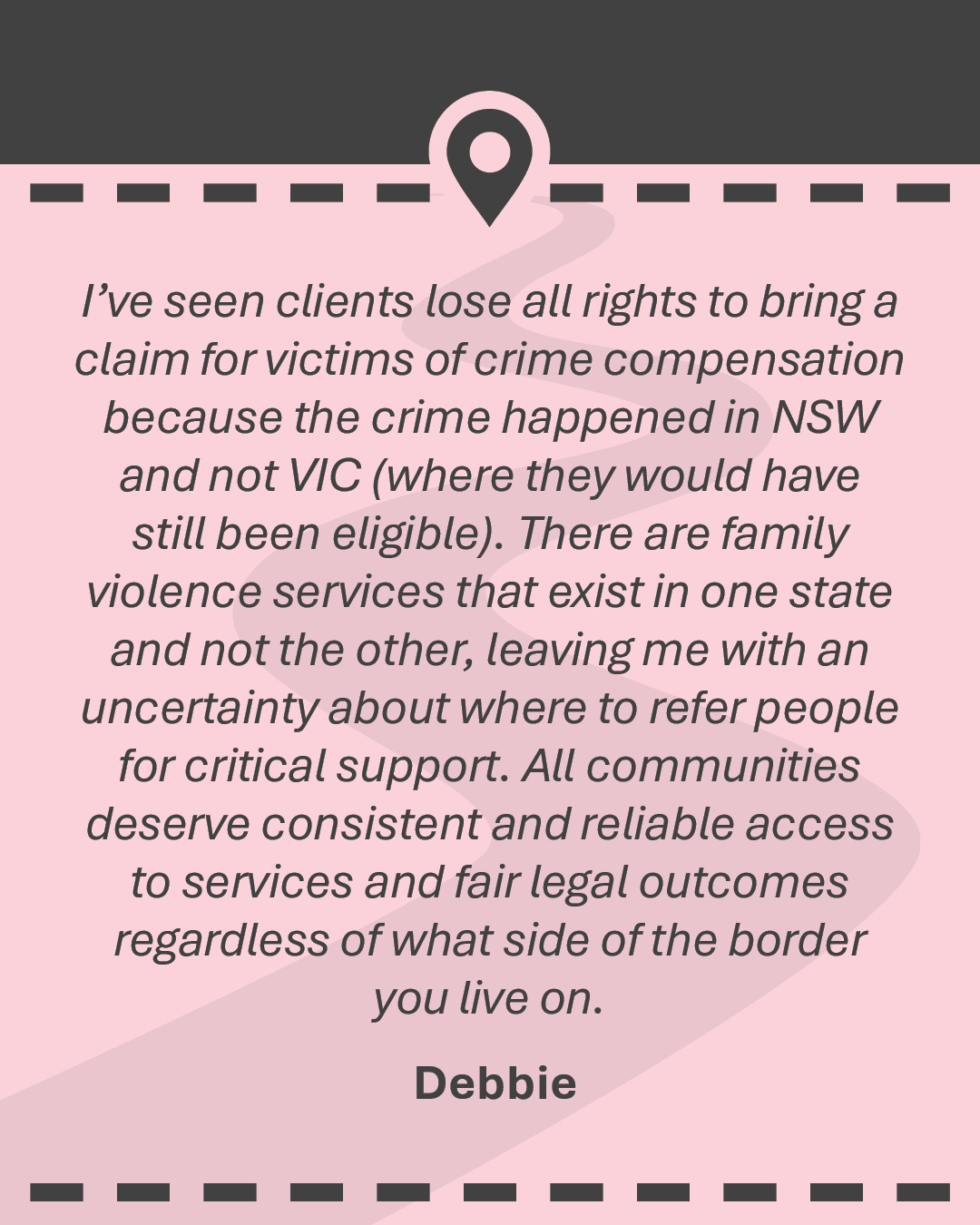
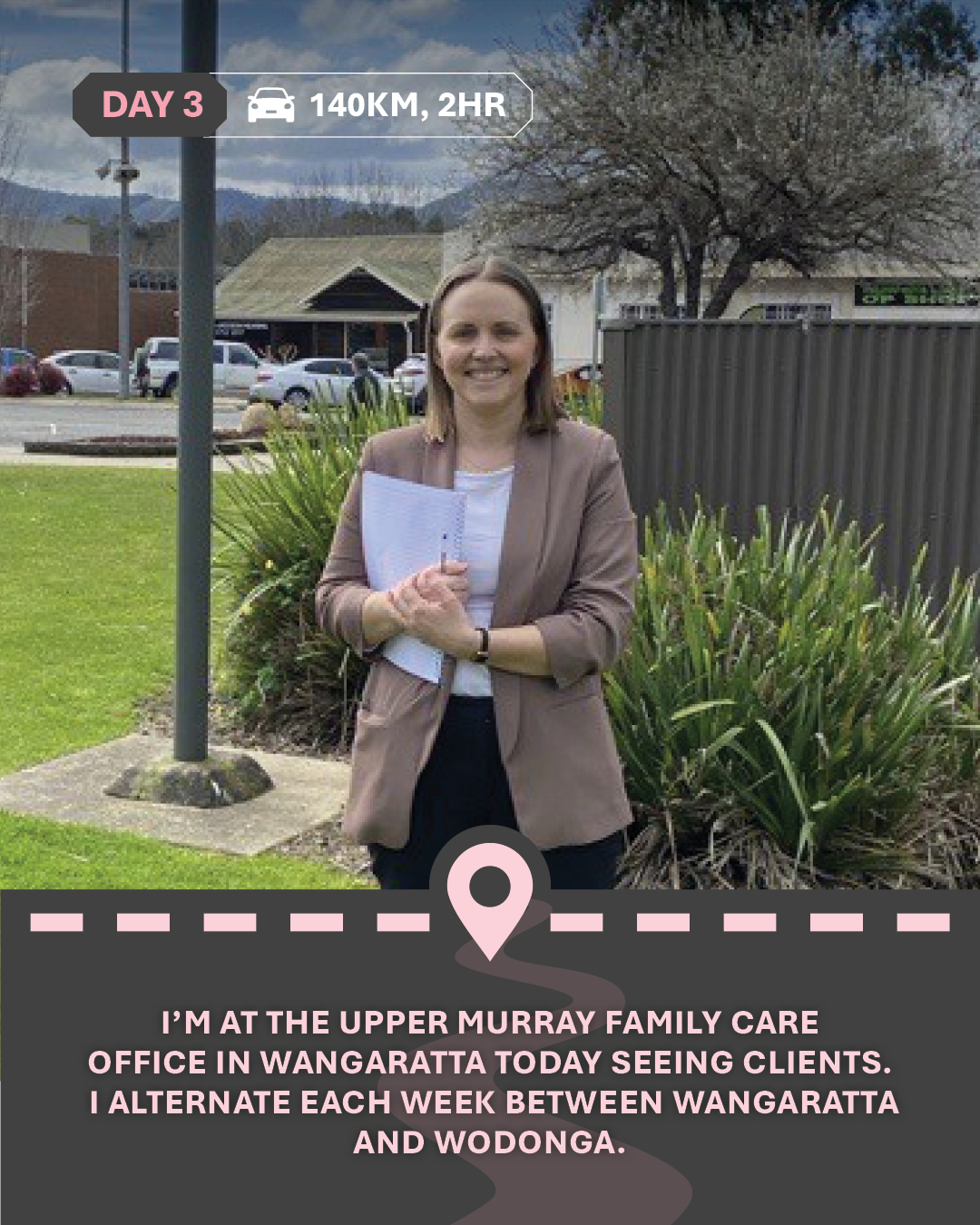
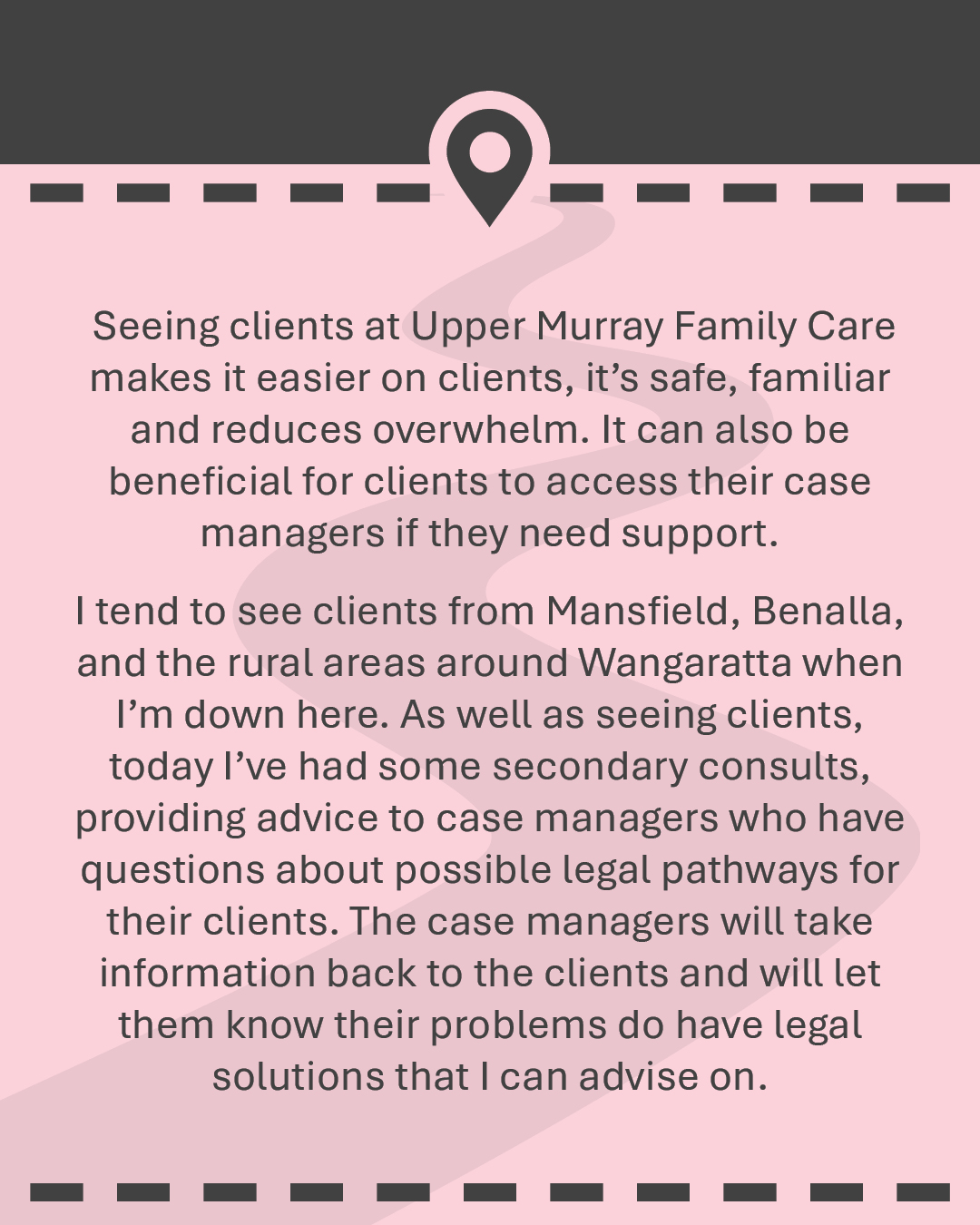
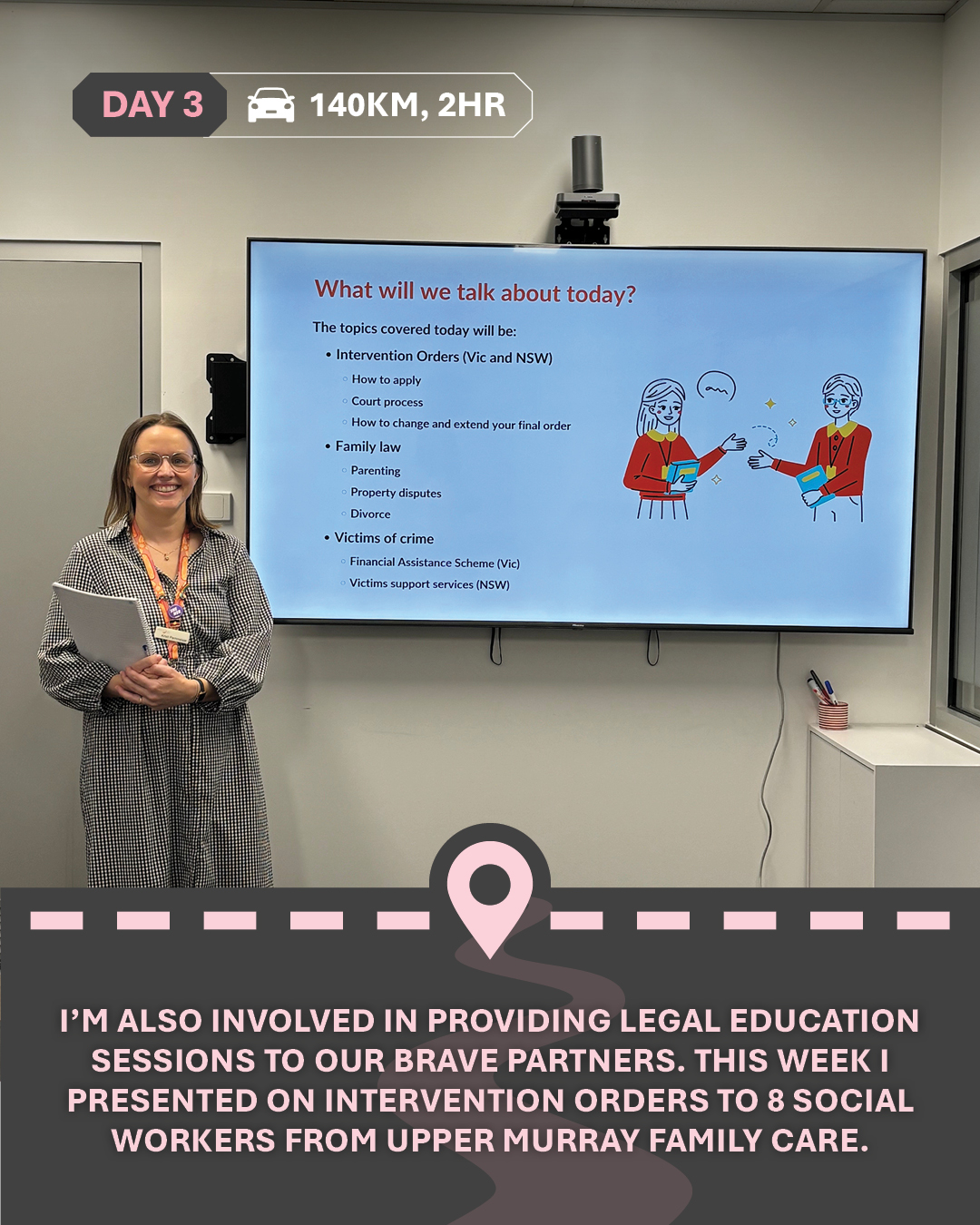
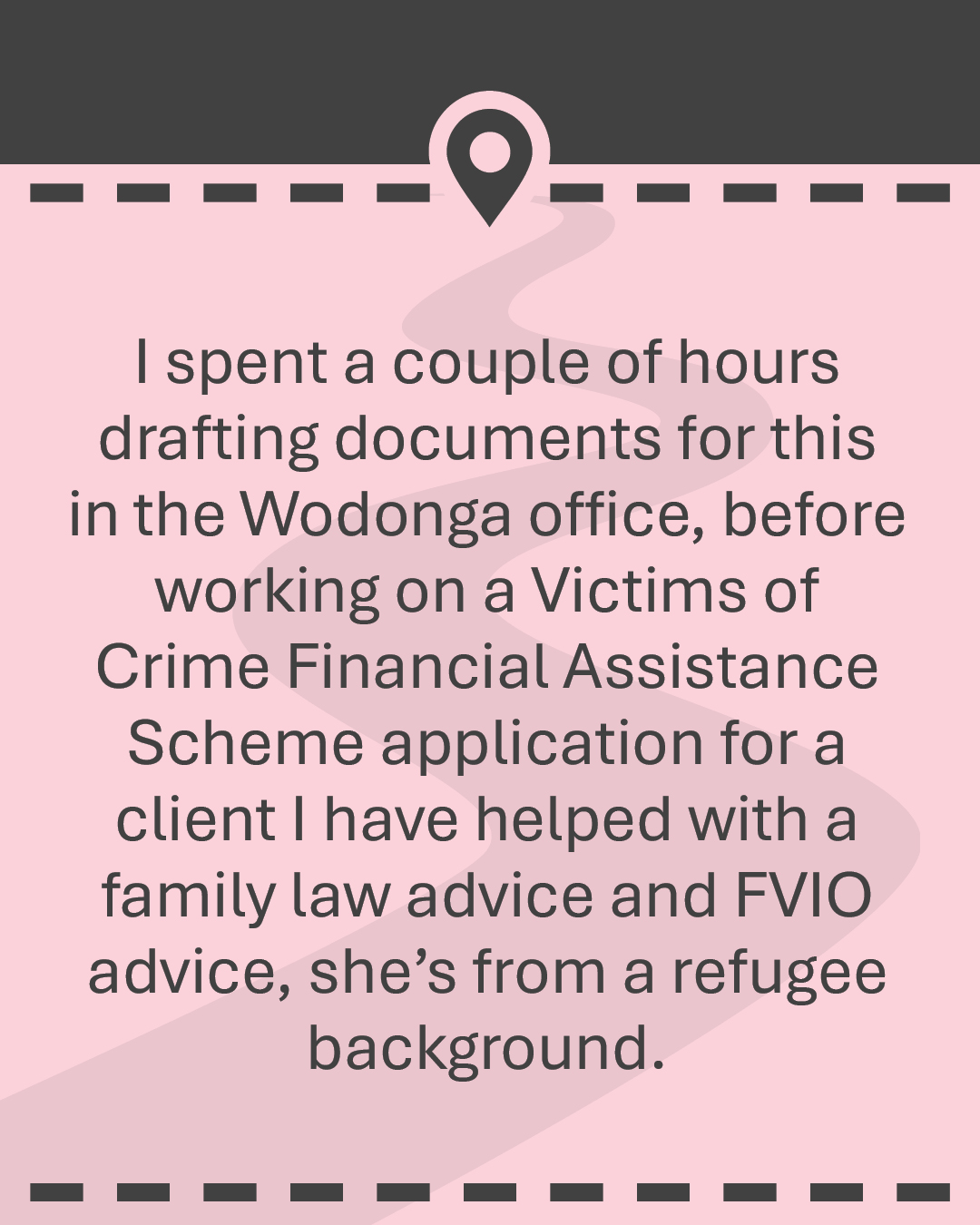
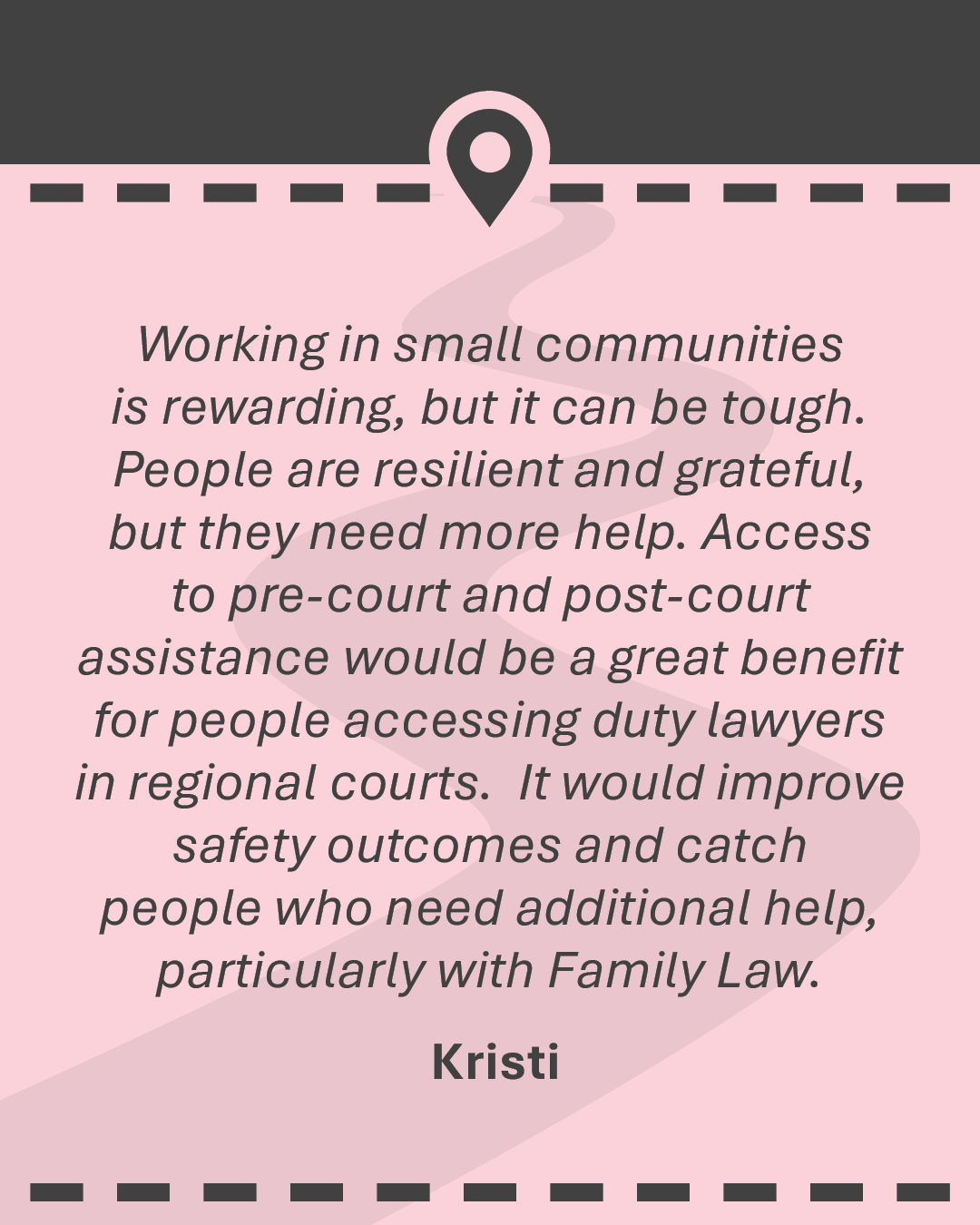
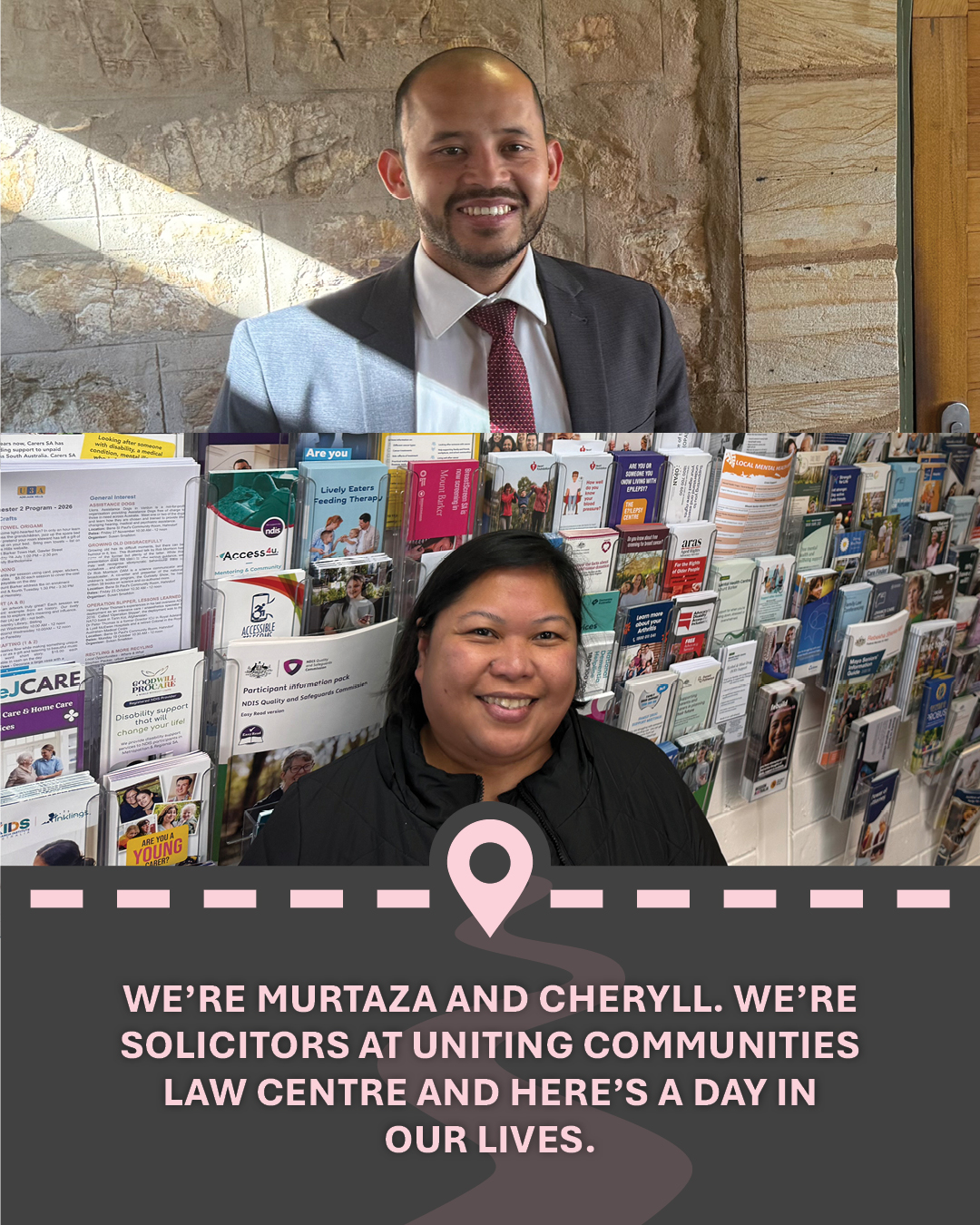
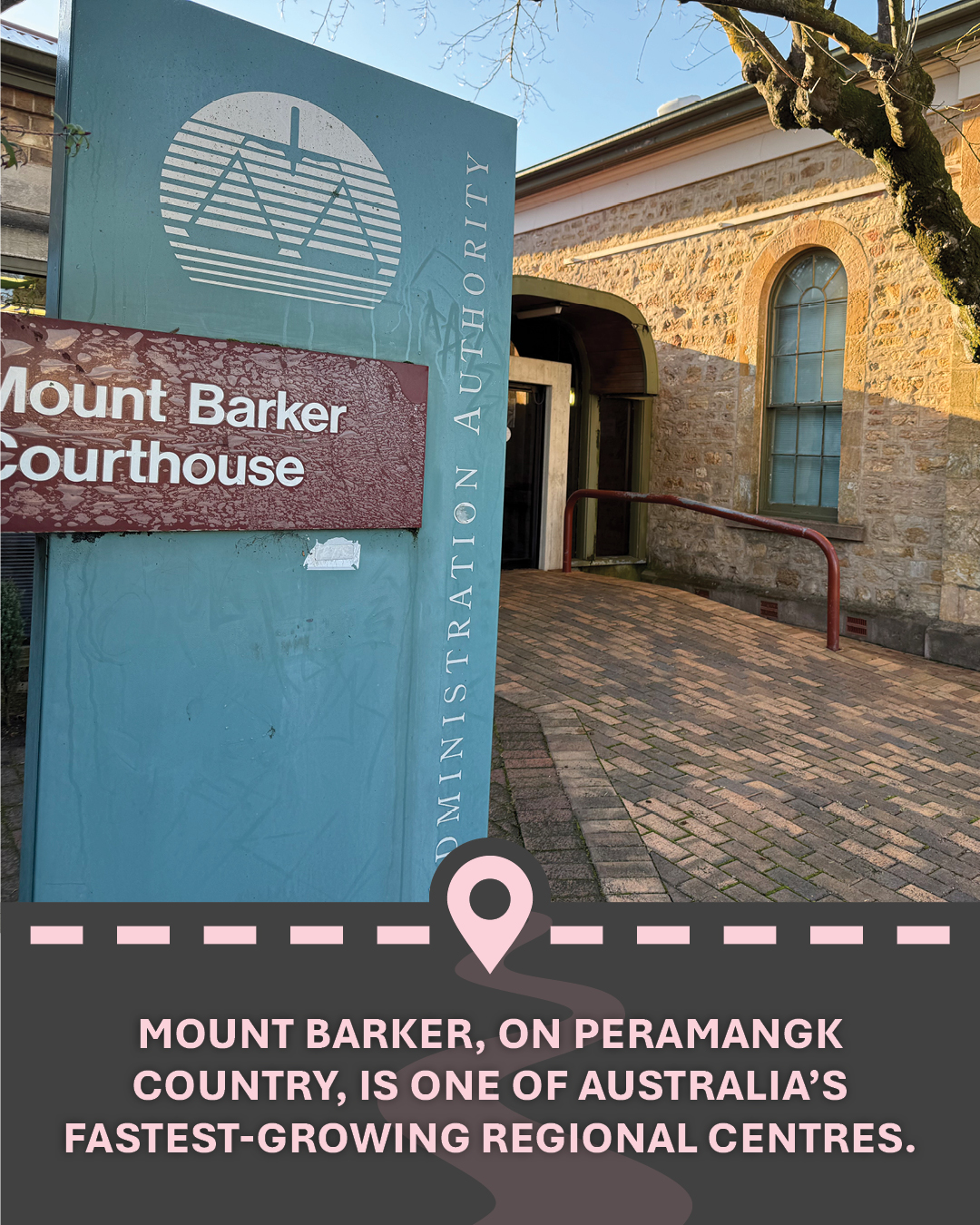
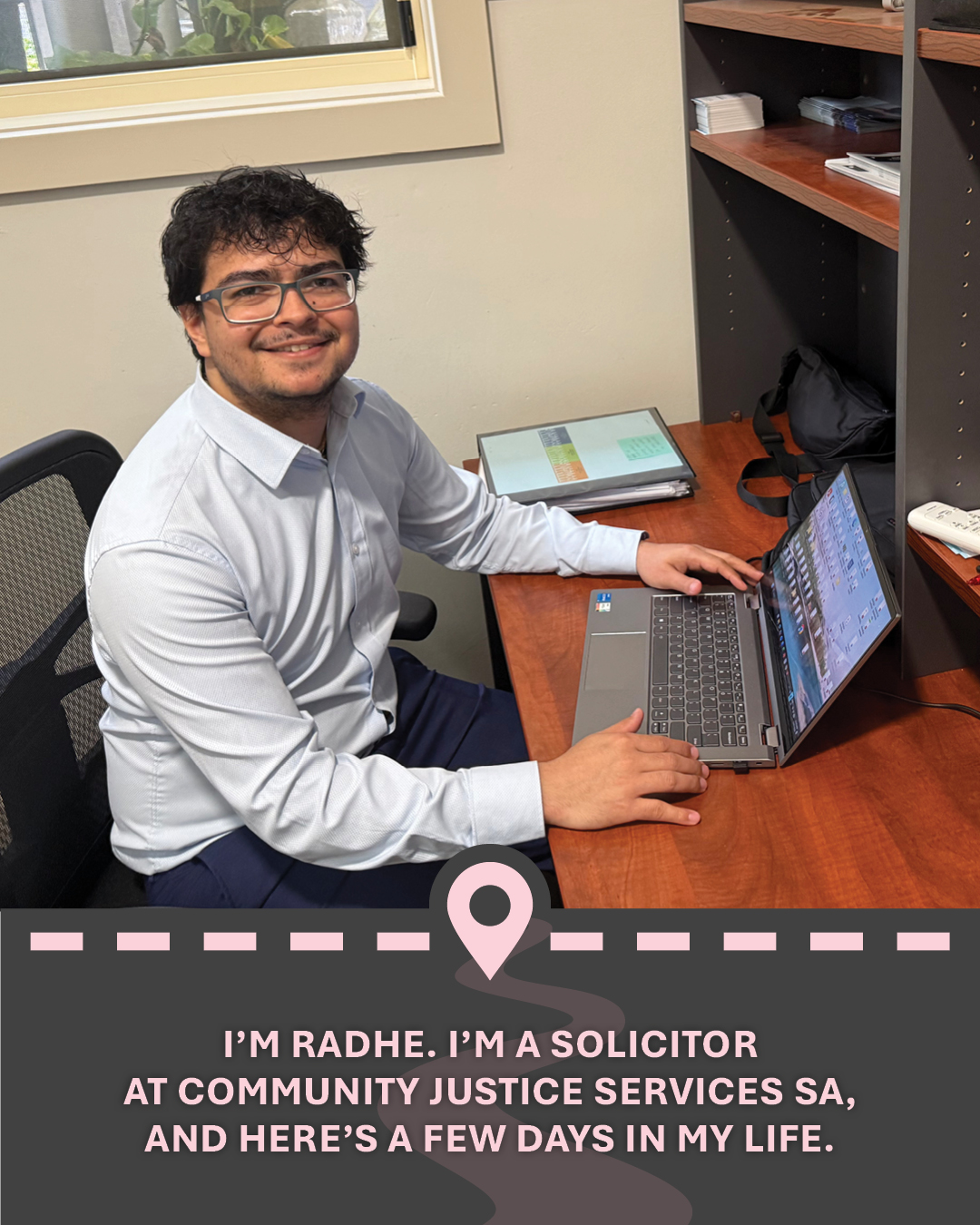
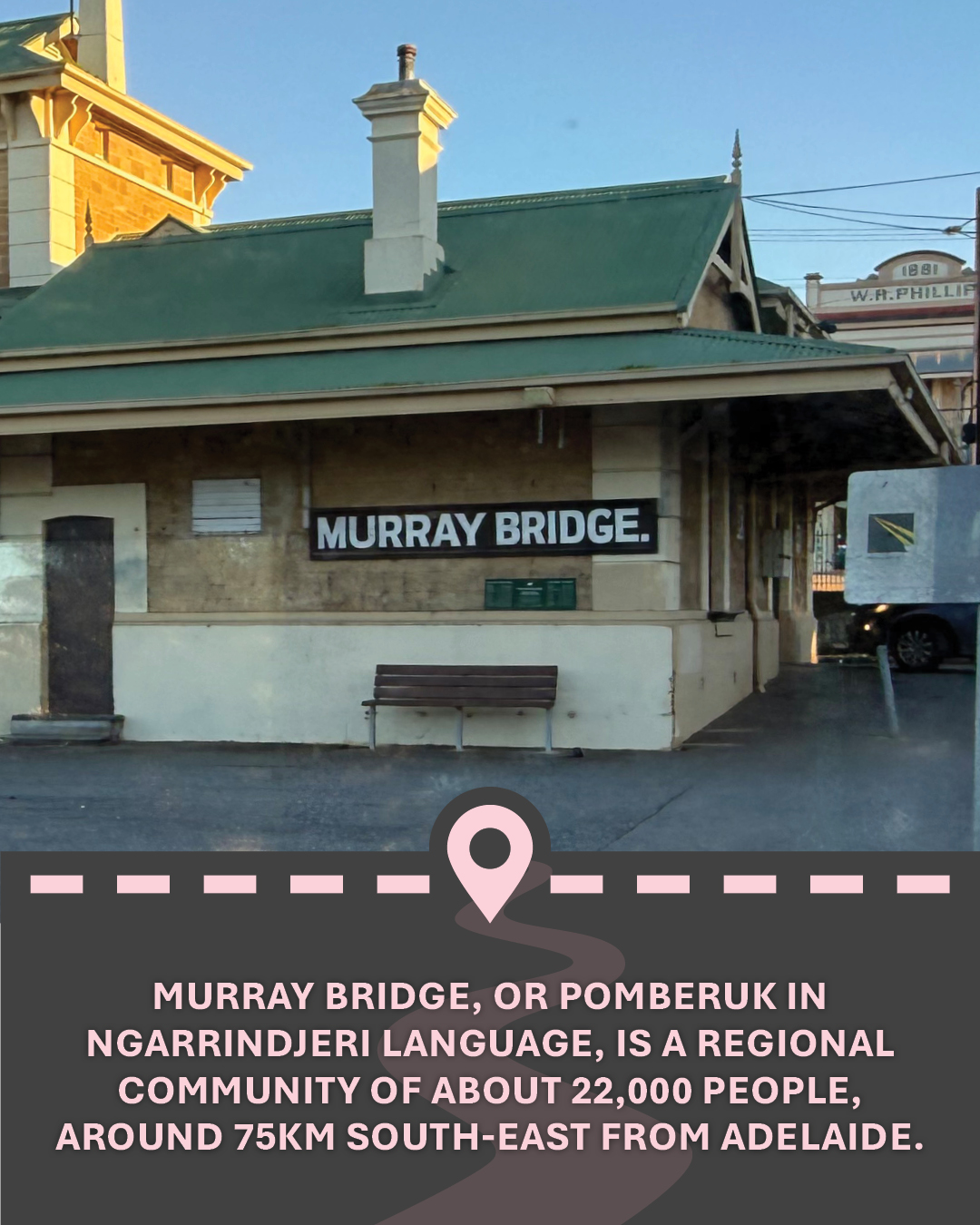
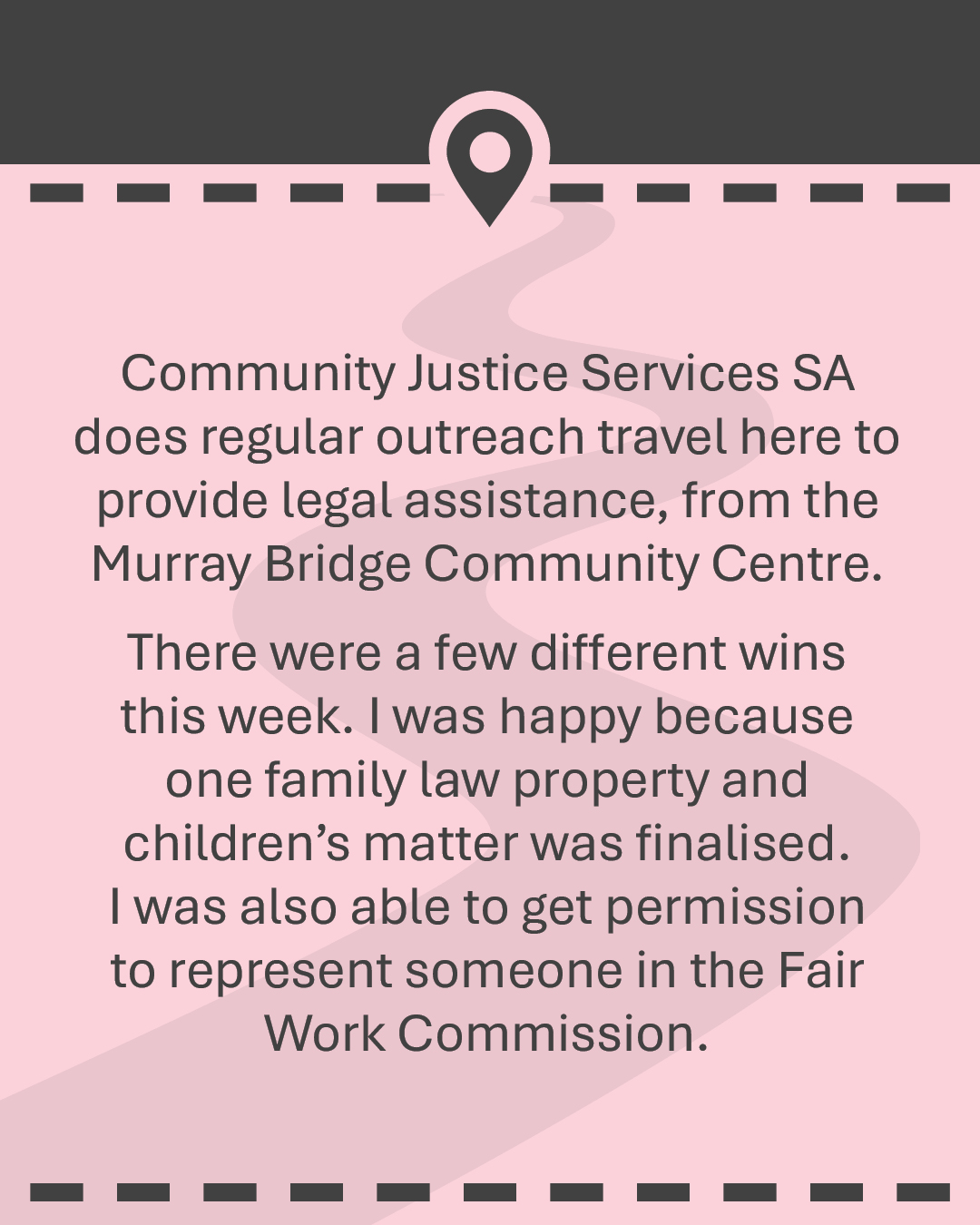
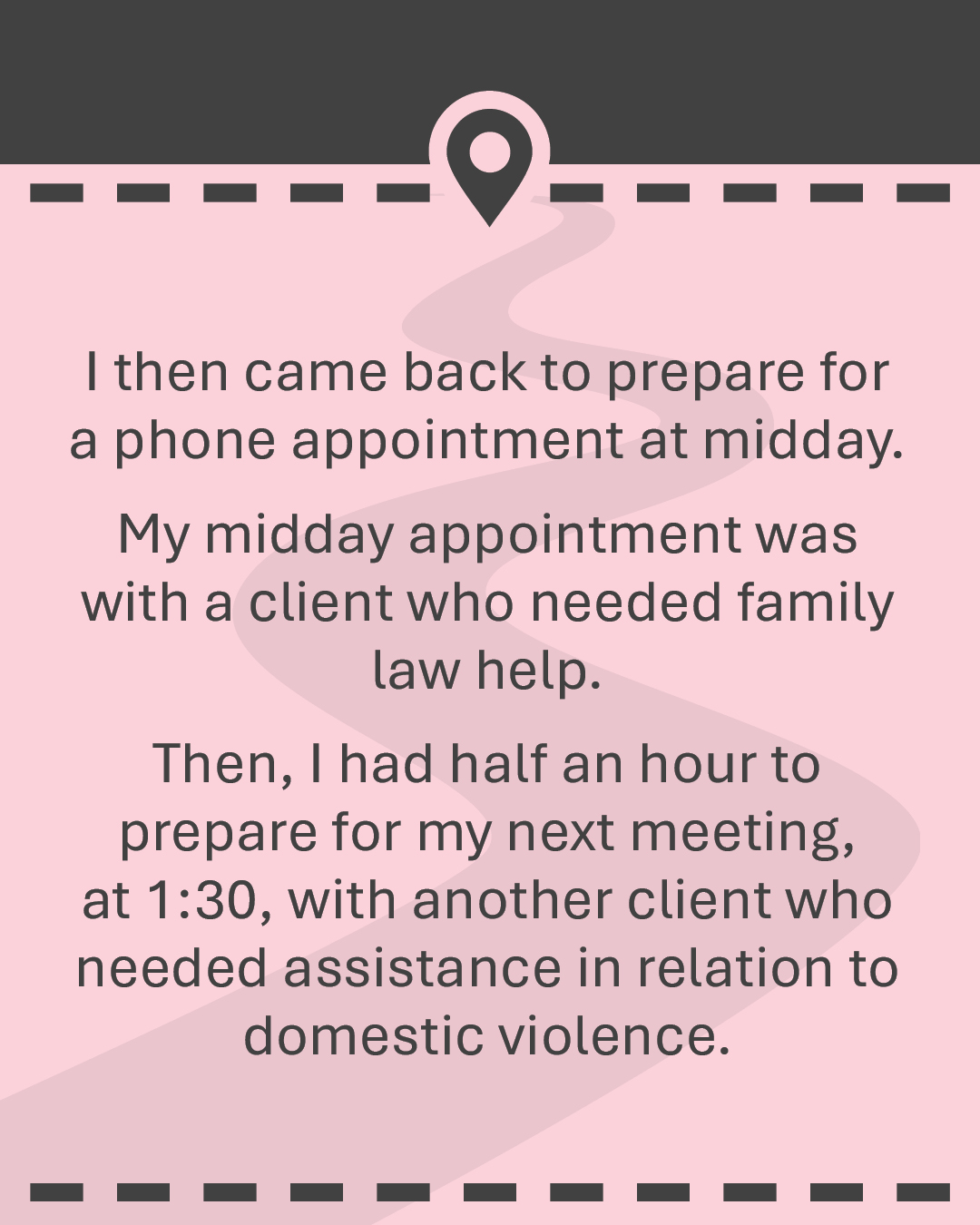
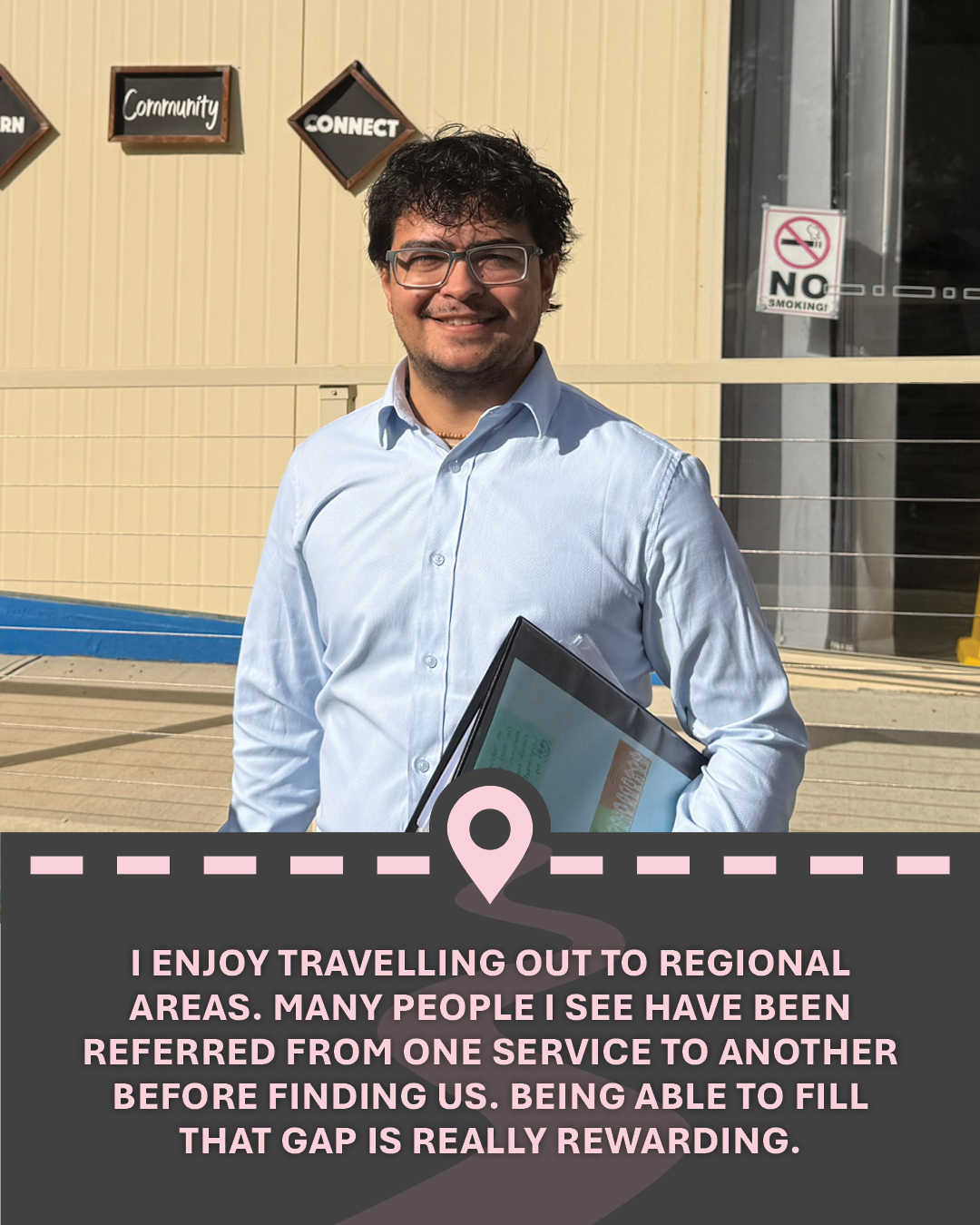
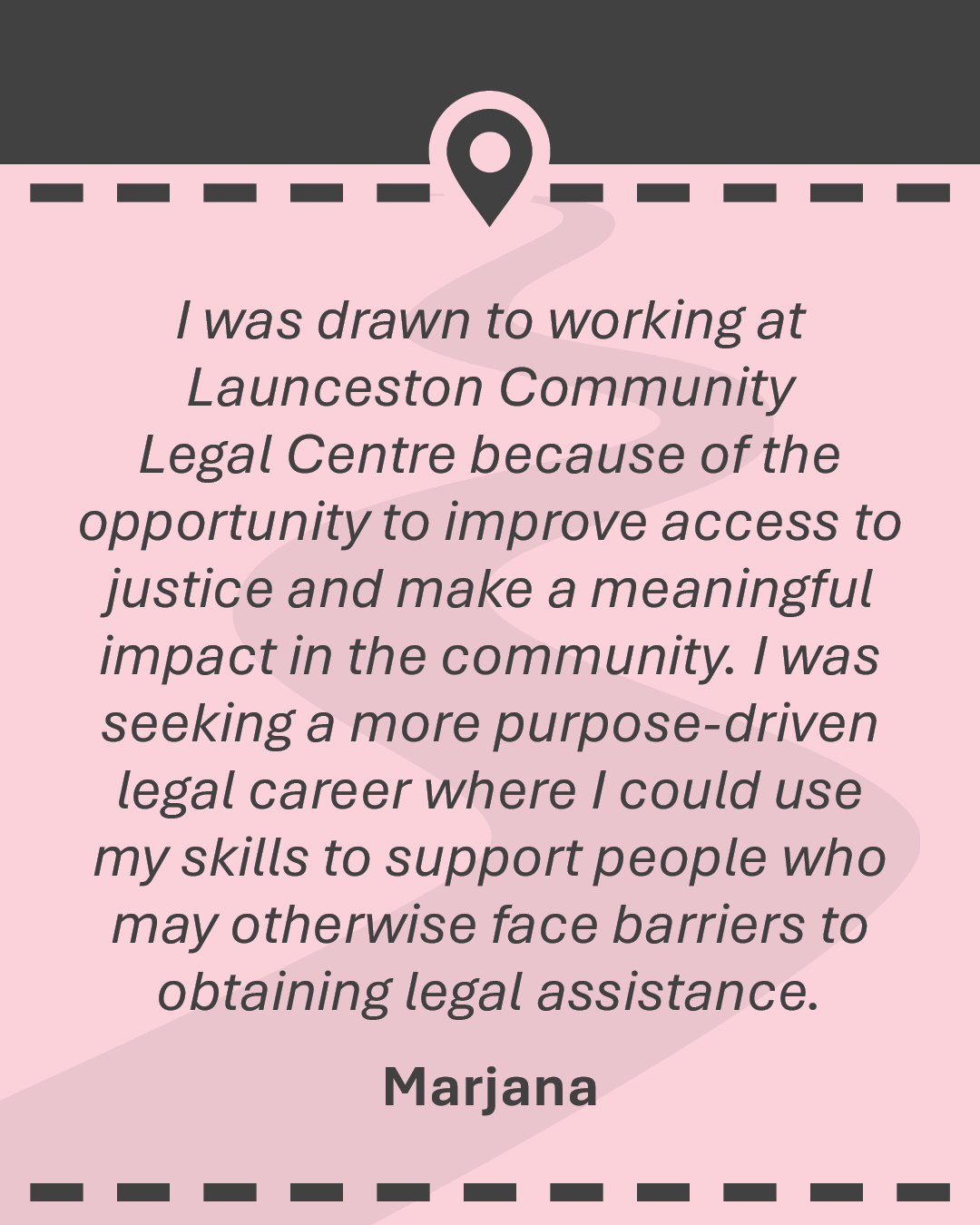
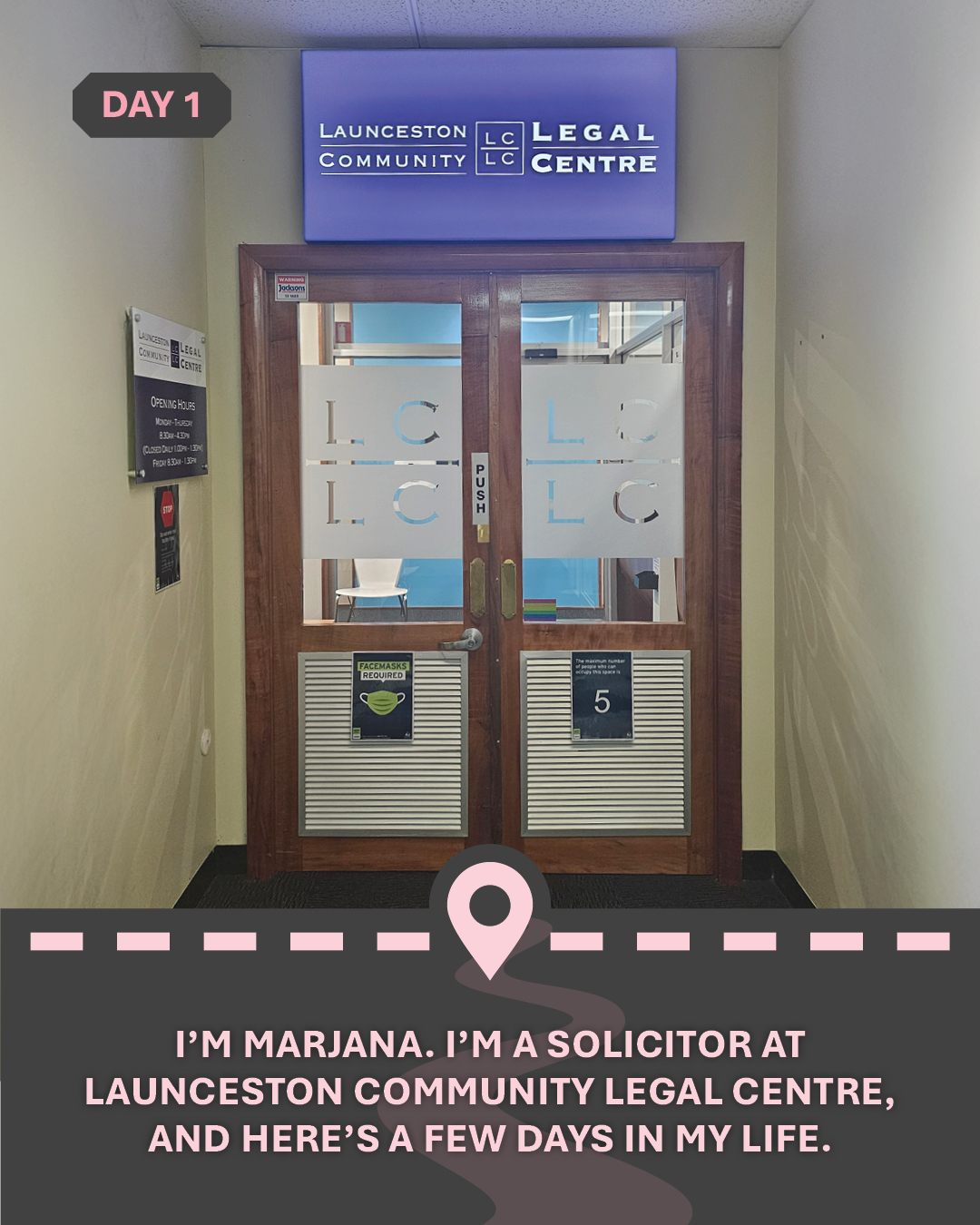
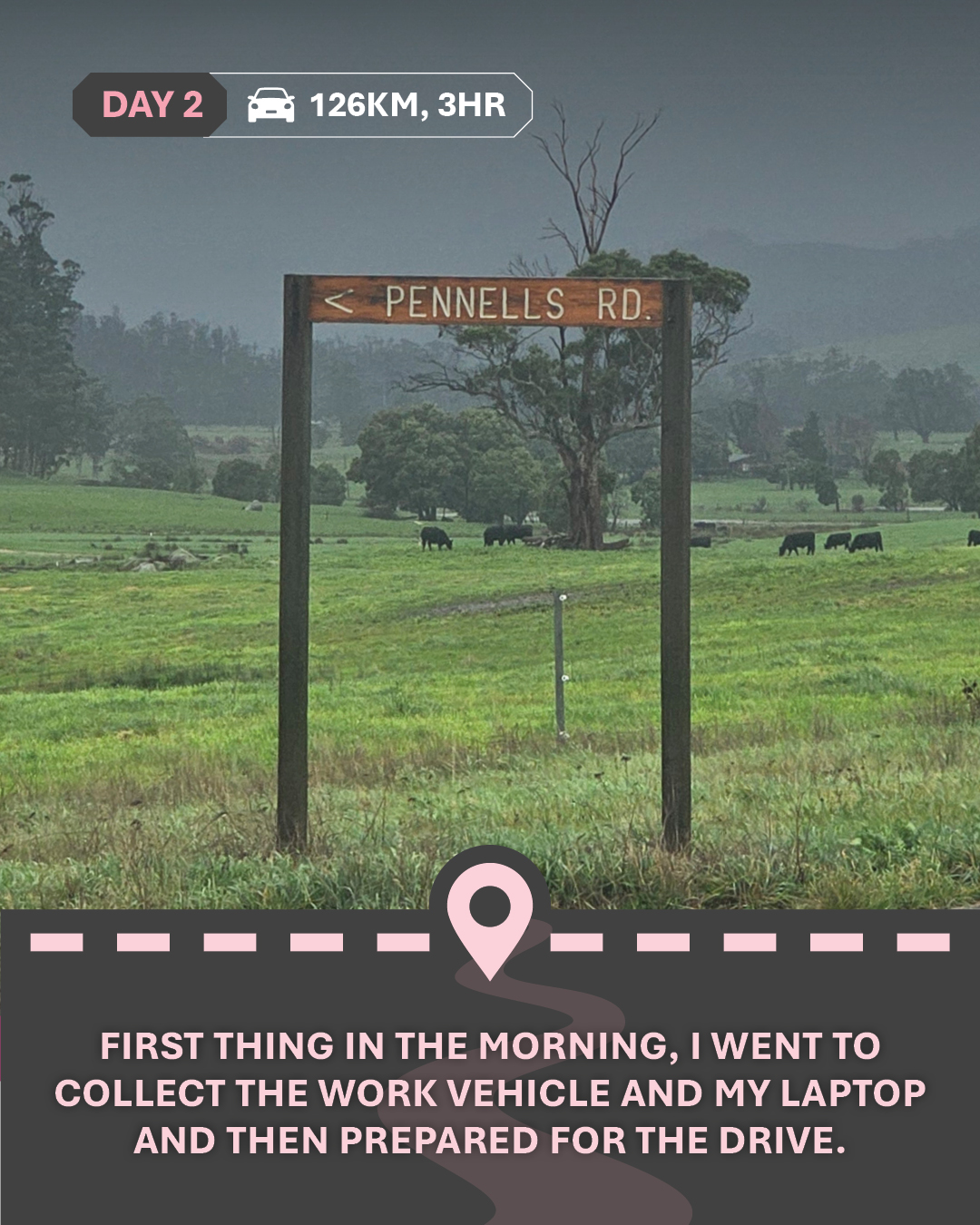
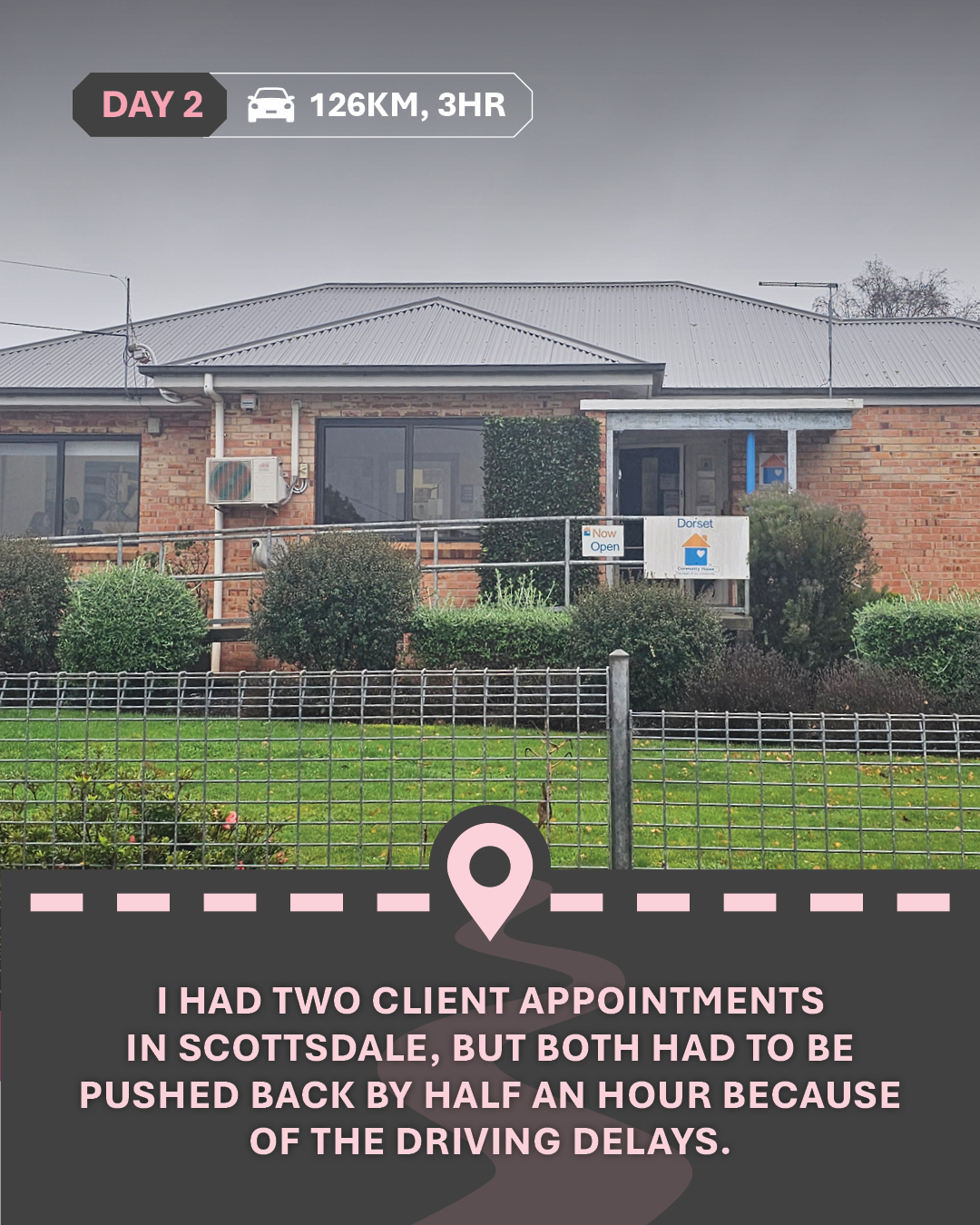
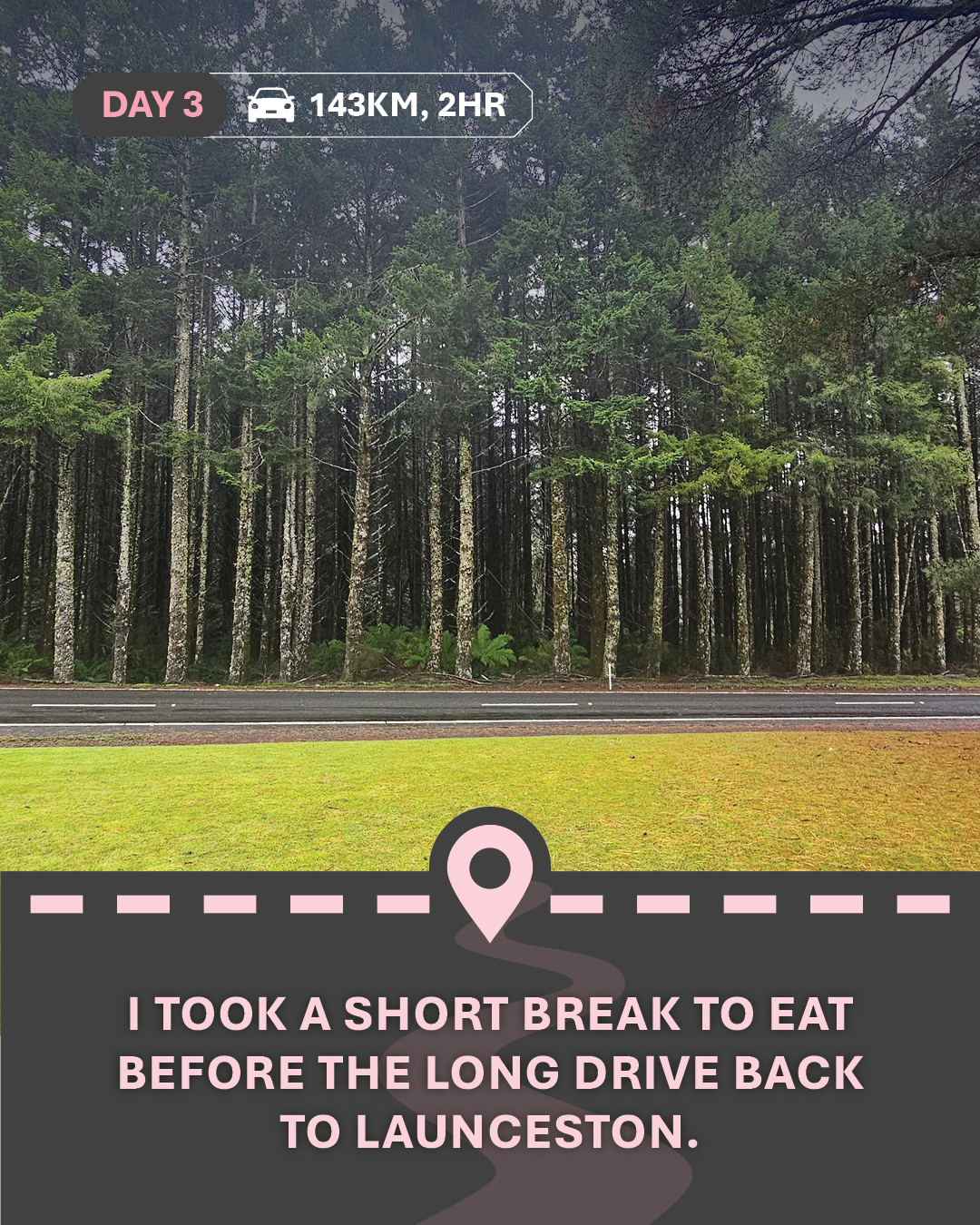
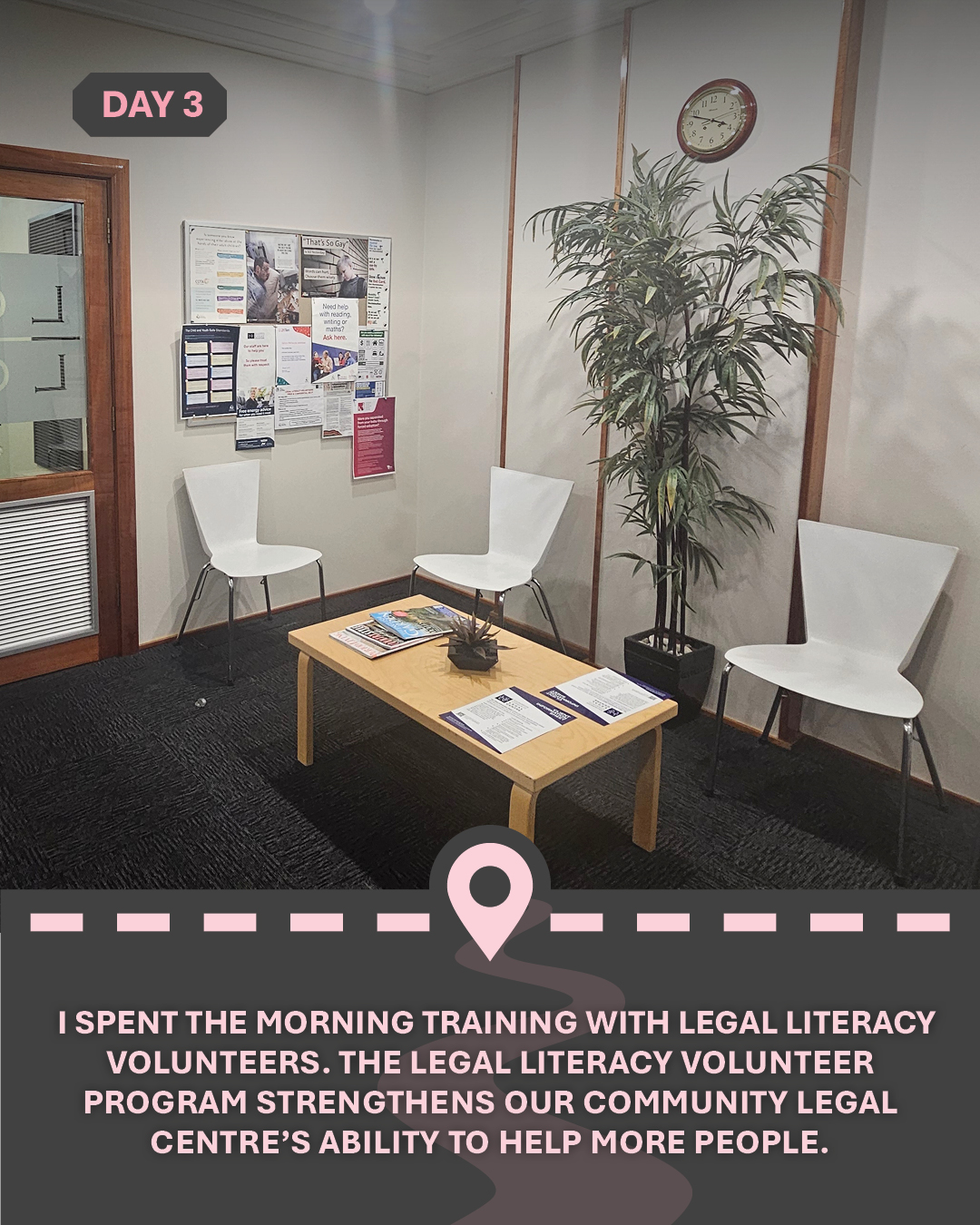
A few days in the life of a frontline community legal centre worker.

A client’s journey to access justice and safety with support from their community legal centre.
The centres and workers featured here are just a fraction of the regional and remote community legal sector. There are dozens more centres and hundreds more workers doing similar important work across the continent every day. Some identifying details have been changed to protect privacy and safety for clients and workers.
Note: for best functionality, view the interactive map tool on computer or tablet screen, on full-screen mode. If you want to view pop-up content larger, you can open each in a new window.




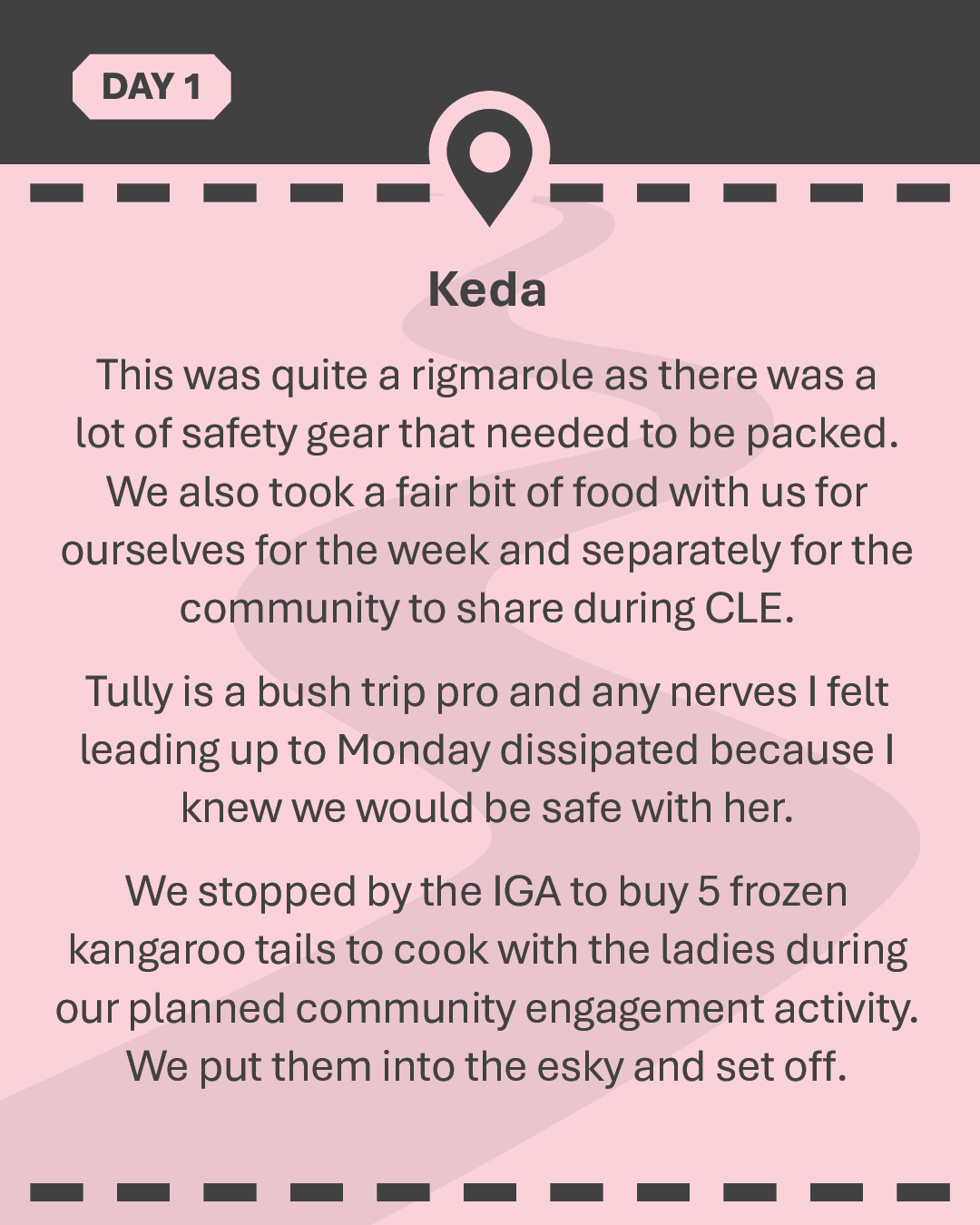
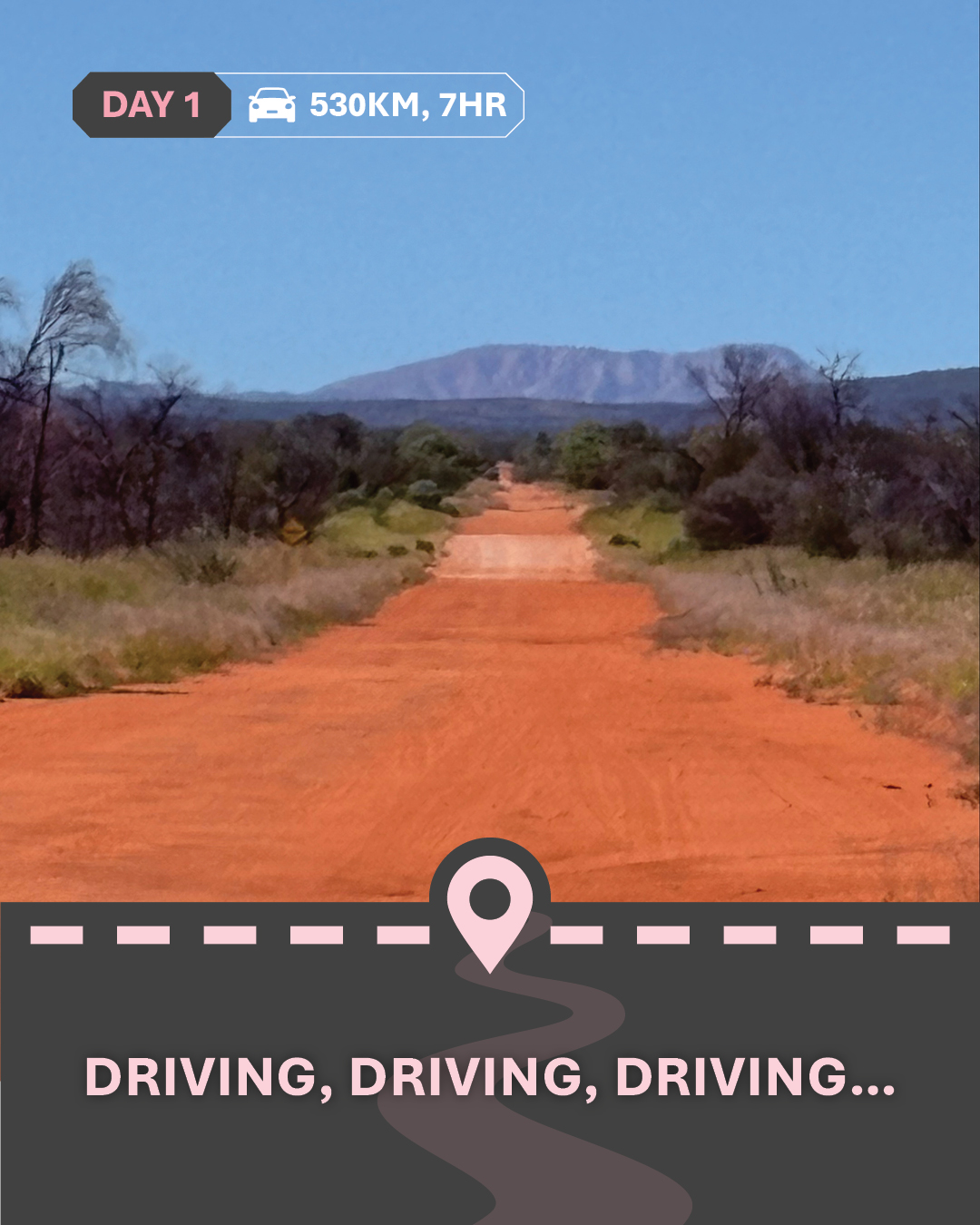
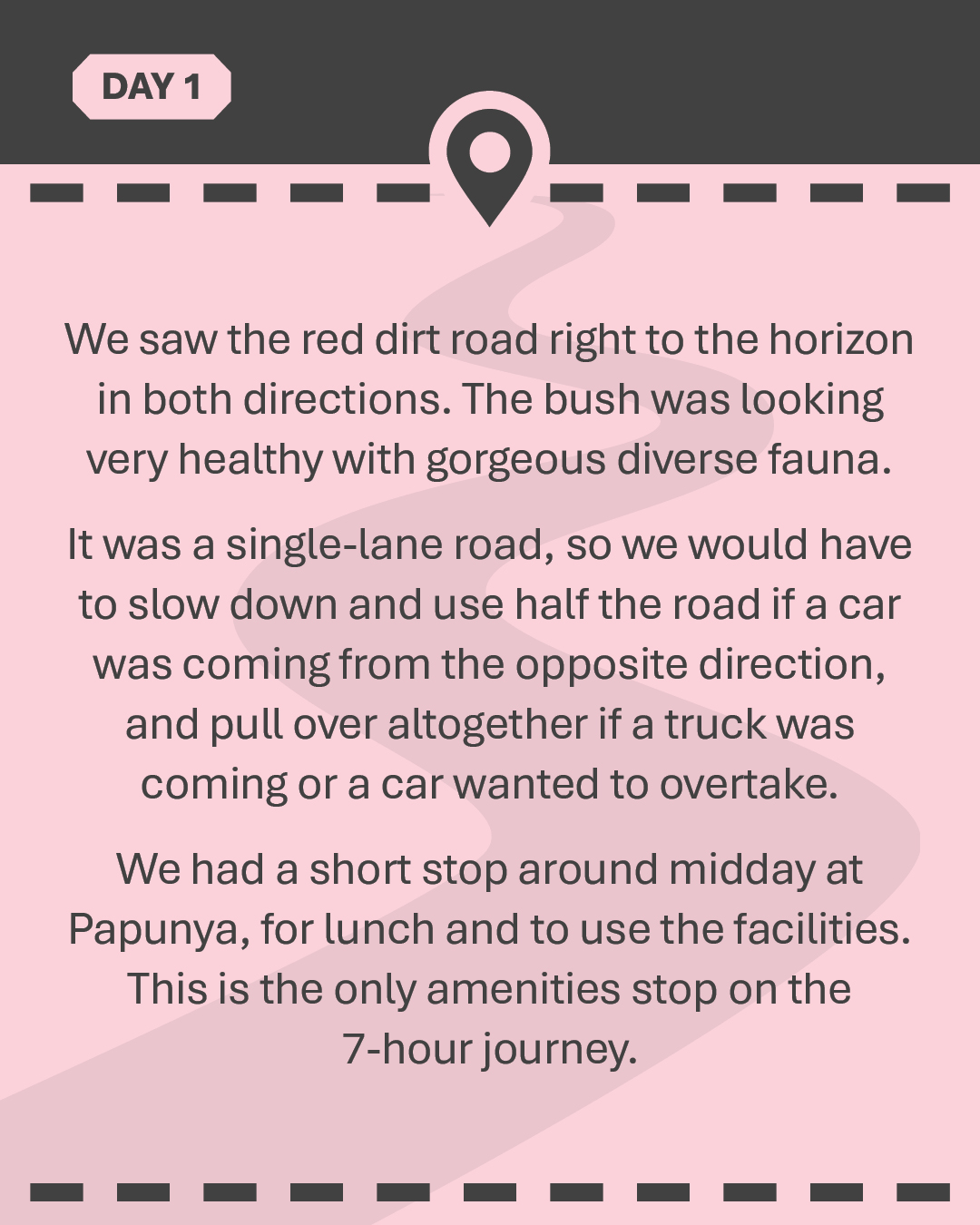
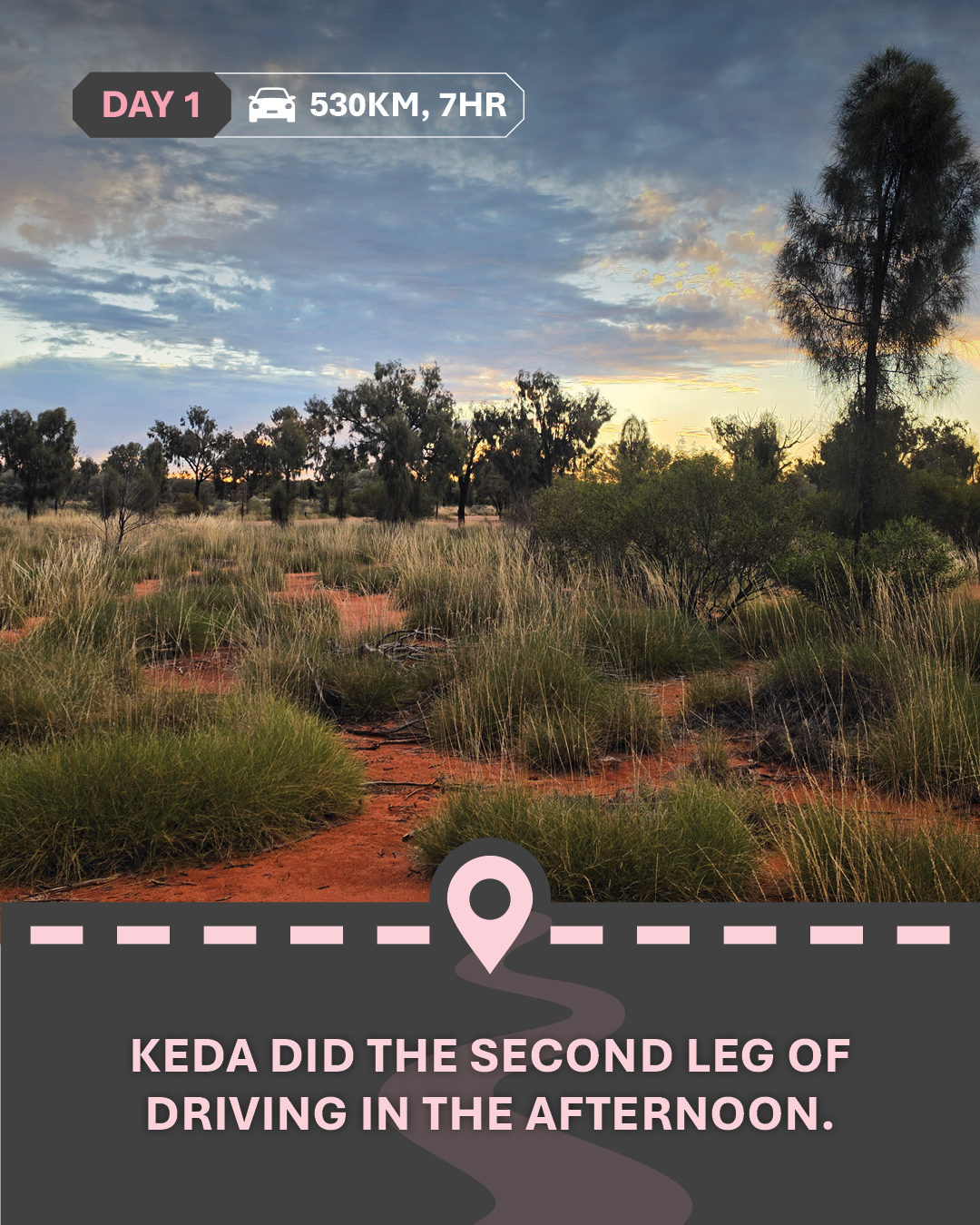















Part 1: Introduction — Why Ms Tracey needed community legal support
Part 2: Ms Tracey preparing for the hearing with support from her community lawyer
Part 3: The hearing

The numbers
People in regional and remote communities
7 million people, or 27% of the population in Australia, live in regional and remote areas.
A greater proportion of people living in regional and remote areas report having a disability than people living in cities.
People living in very remote areas are hospitalised at almost twice the rate of people living in major cities. People living in remote areas are hospitalised at 1.3 times the rate. For preventable hospitalisations, the rates are 2.8 times as high for people in very remote areas, and 1.8 times as high for people in remote areas, as compared to people in major cities.
The rate of family and domestic violence hospitalisations for people living in very remote areas is 41 times higher than for people living in major cities. 23% of women living outside major cities have experienced partner violence compared to 15% of women living in major cities.
Community legal centres in regional and remote communities
According to our most recent State of the Sector survey…
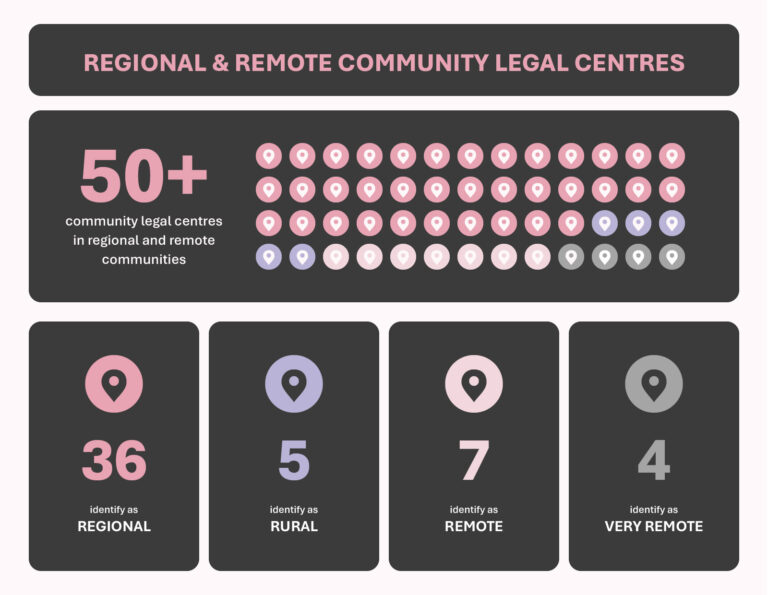
About 80% of the regional and remote centres in our membership are ‘generalist’ centres, assisting people in their local area with a broad range of legal and related problems.
About 20% are specialist centres, which help people in a particular area of law, or help people from a particular demographic group.
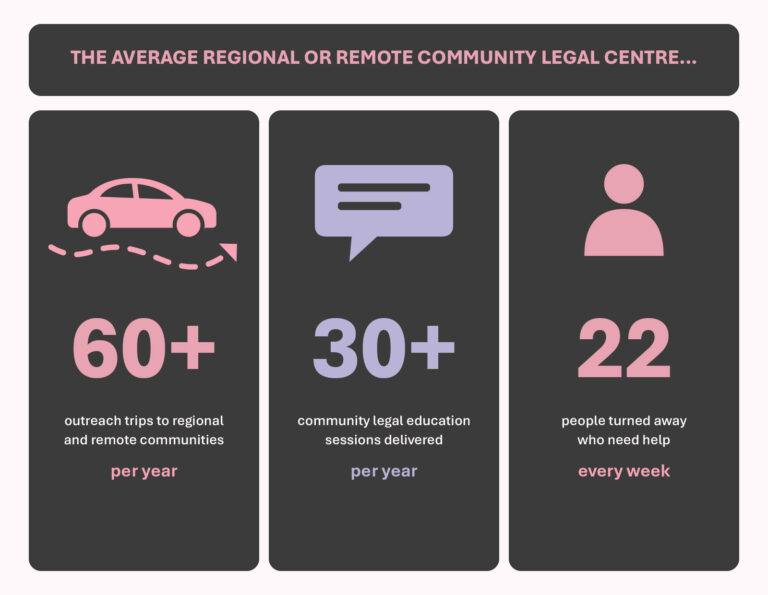
Collectively, community legal centres travel 1.26 million km a year to reach people in regional and remote communities.
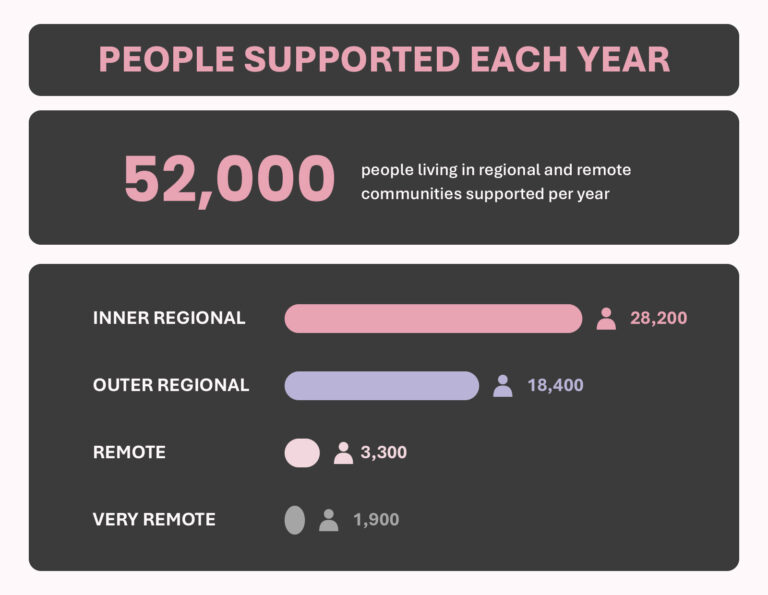
People we support
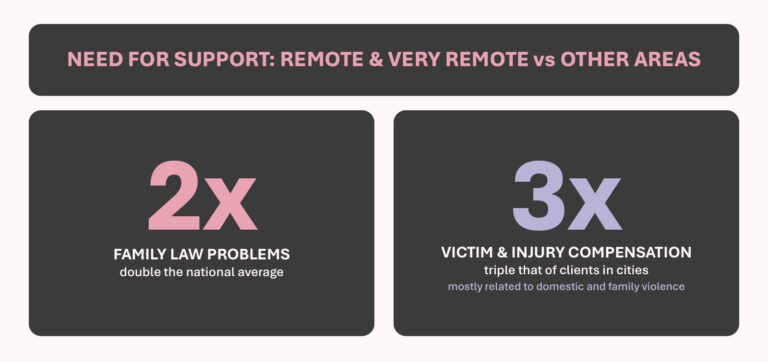
The top five most common things community legal centres help people living in regional and remote communities with are:
- Domestic and family violence and domestic violence protection orders
- Parenting arrangements
- Other civil law problems
- Housing
- Victim and injury compensation.
Our workforce
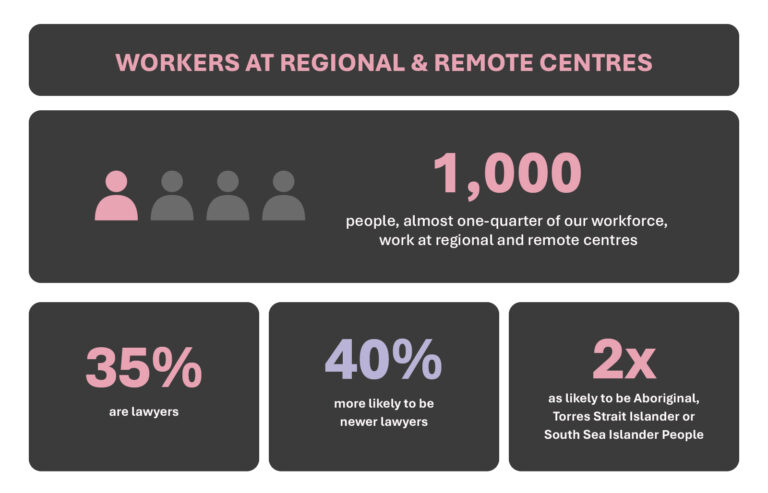
Around 1,000 people work at regional and remote community legal centres.
Over 4 in 5 are women and nonbinary people.
Workers at regional and remote community legal centres are almost twice as likely to be Aboriginal, Torres Strait Islander or South Sea Islander people than workers at metropolitan centres.
Over half of regional and remote community legal workers hold a Legal Practising Certificate. Lawyers make up 35% of the regional and remote community legal centre workforce. Most other Legal Practising Certificate holders are in leadership roles, like Principal Solicitor or CEO.
1 in 11 are allied professional workers, like social workers, financial counsellors and tenant advocates. Another 1 in 11 are in legal support roles, like paralegals.
Workers at regional and remote centres who hold a Legal Practising Certificate are over 40% more likely than those at metropolitan centres to have held their certificate for under two years.
Outreach
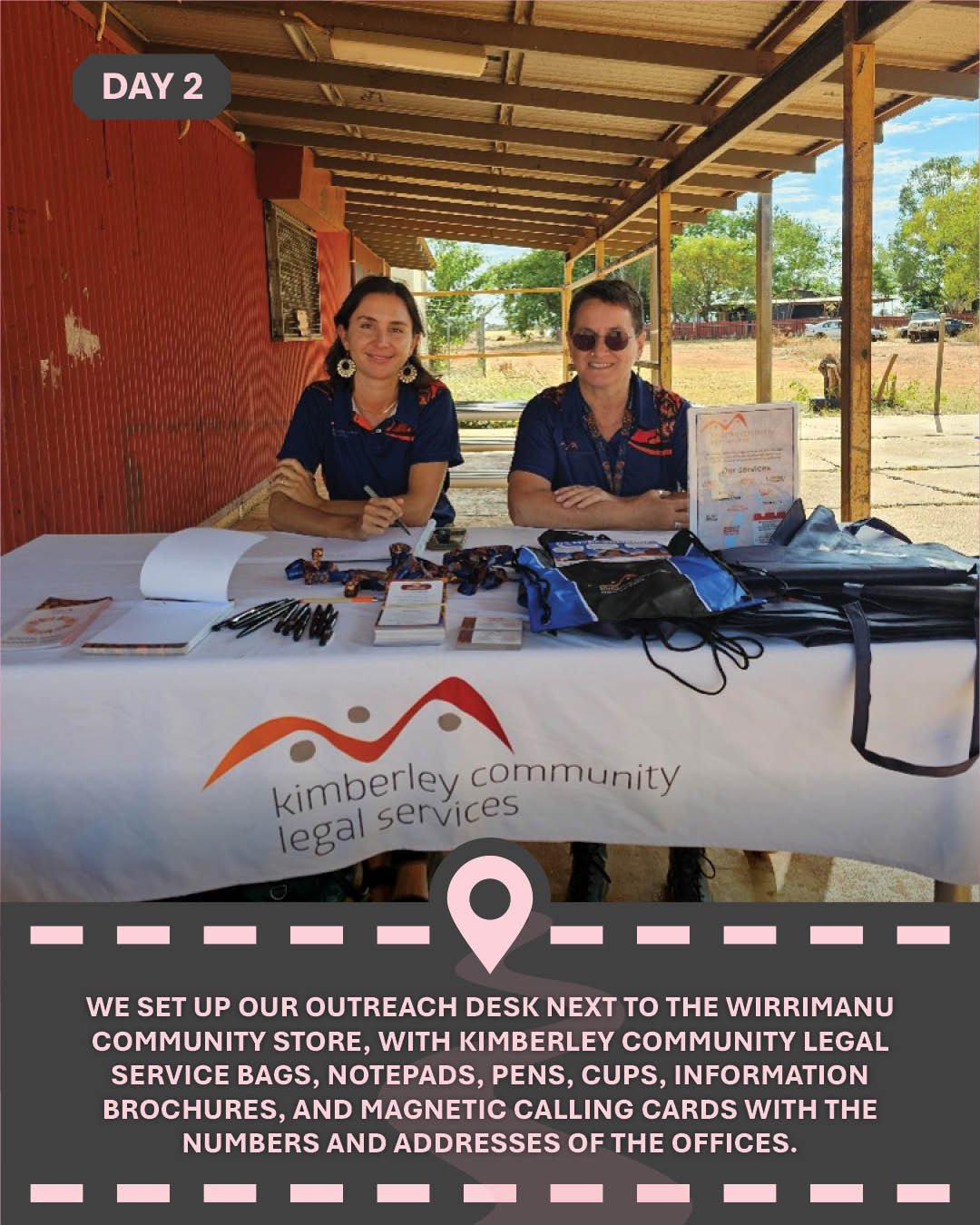
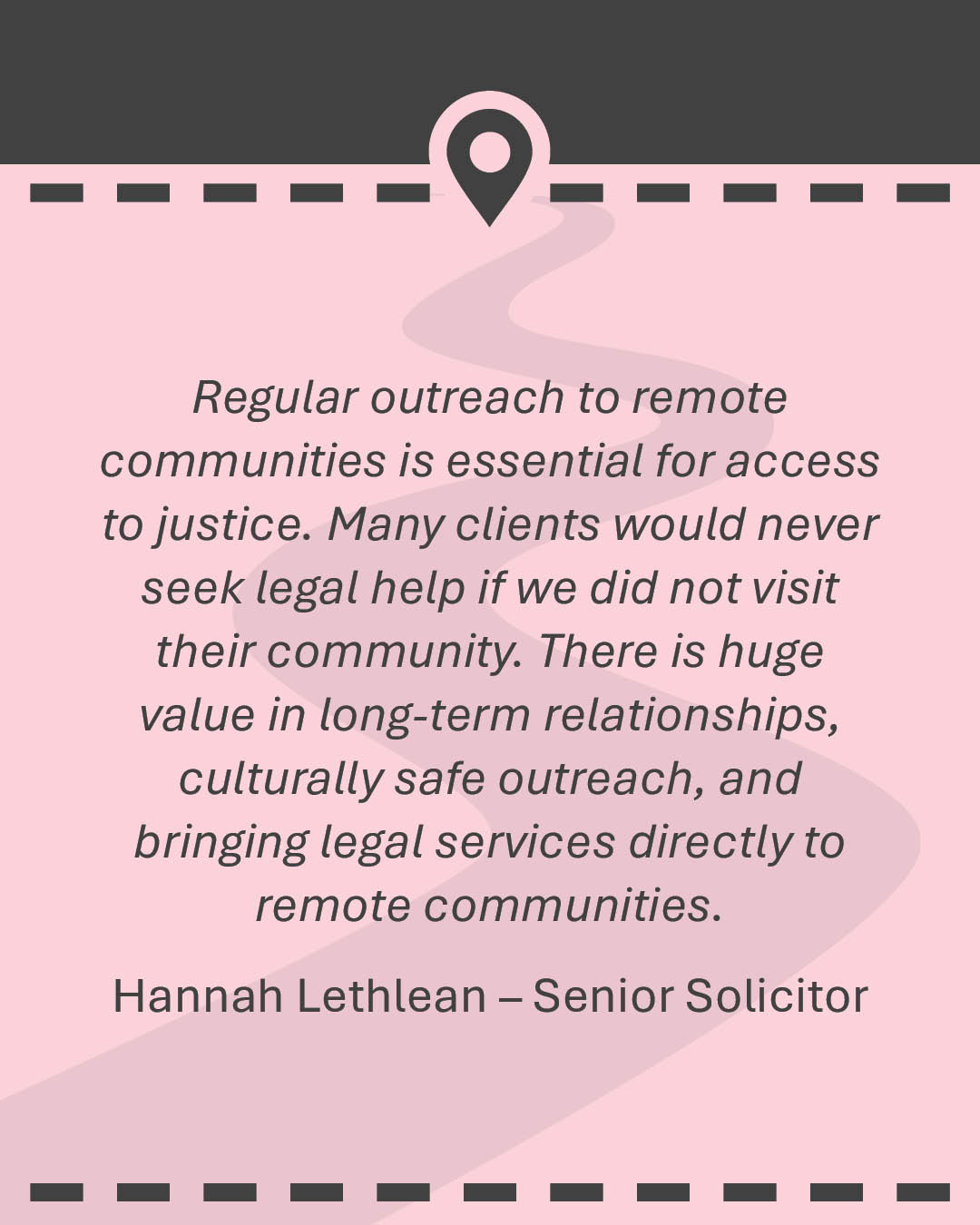
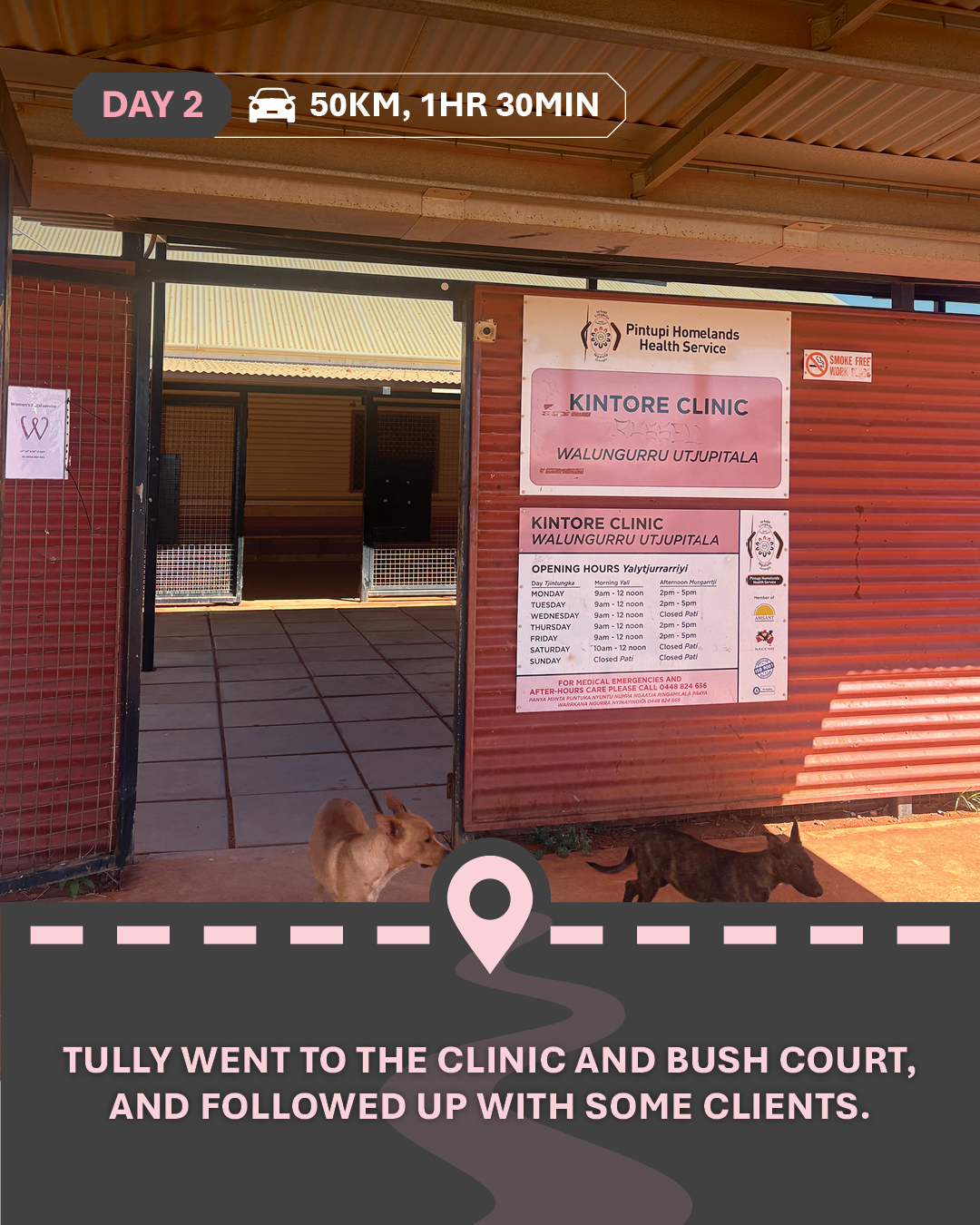
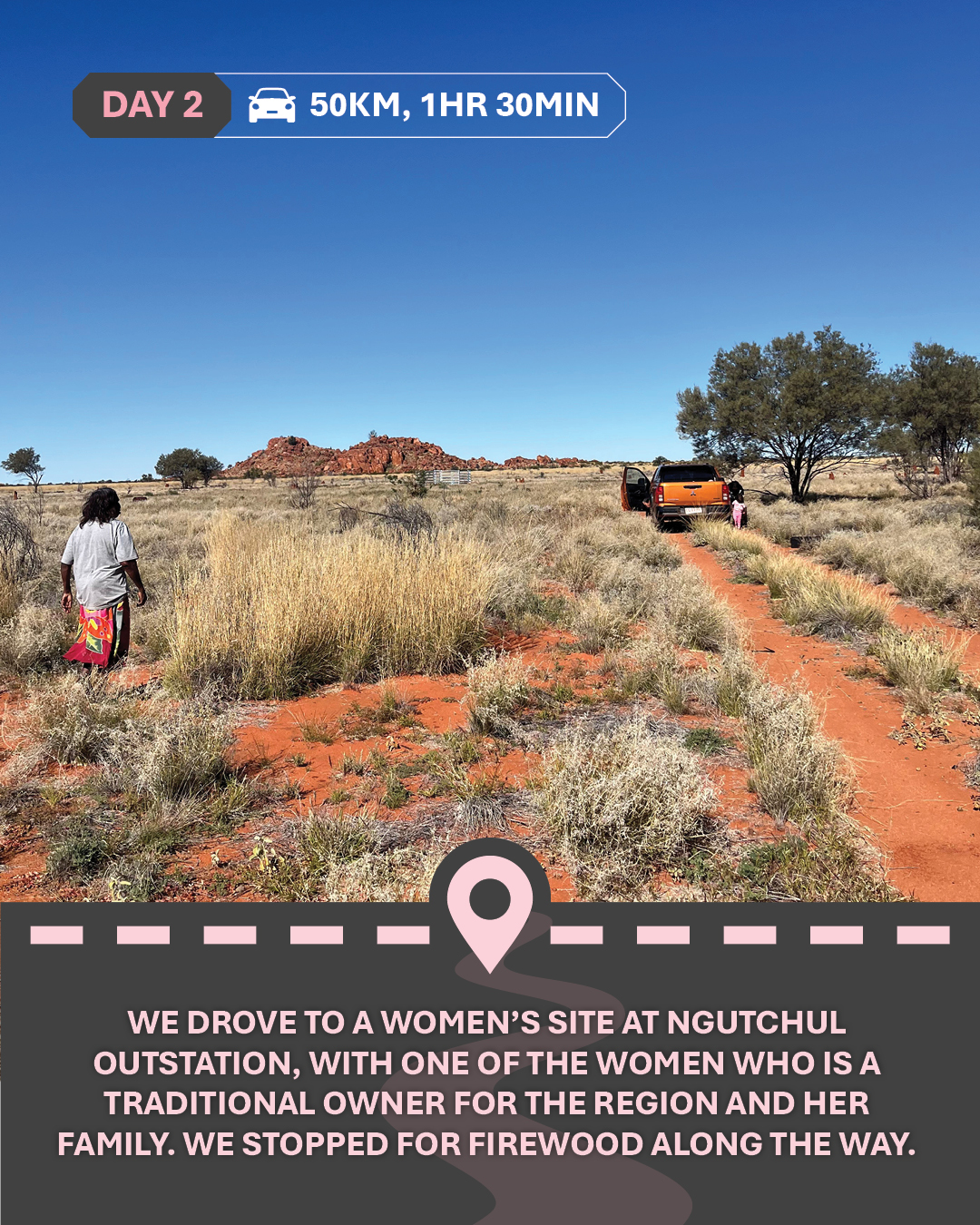
For many people, the only way they can access the help they need is by community lawyers and social workers driving hours to their remote communities to see them face-to-face.
A lot of time on the road
Many clients of regional and remote community legal centres don’t have reliable access to a car, or even a mobile phone. Often, the only way people access support is by community lawyers and social workers driving hours to their remote communities to see them face-to-face.
Most community legal centres provide services across a very large geographic catchment area, with some making regular road trips of hundreds of kilometres to provide outreach services to the most remote communities, including remote Aboriginal and Torres Strait Islander communities.
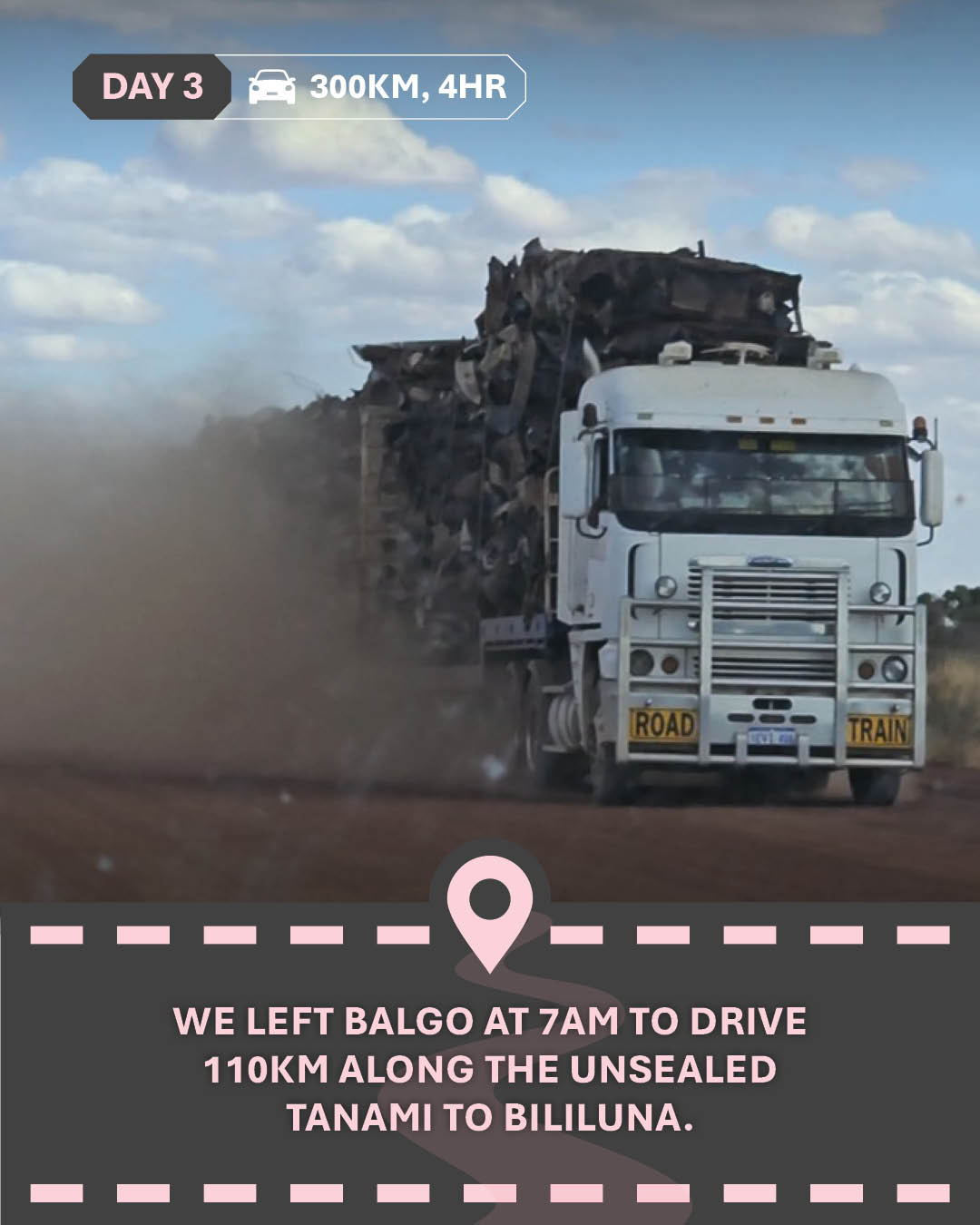
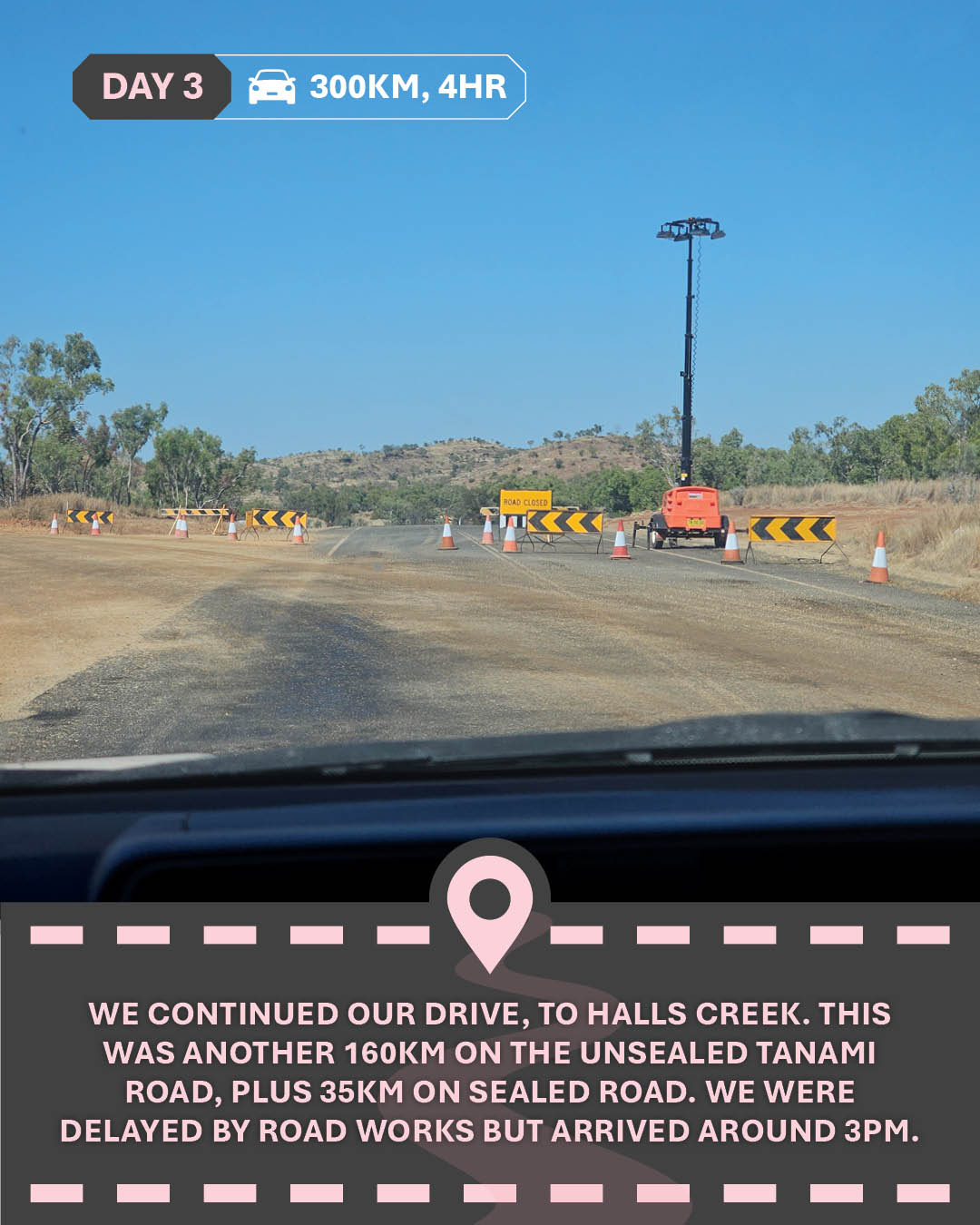
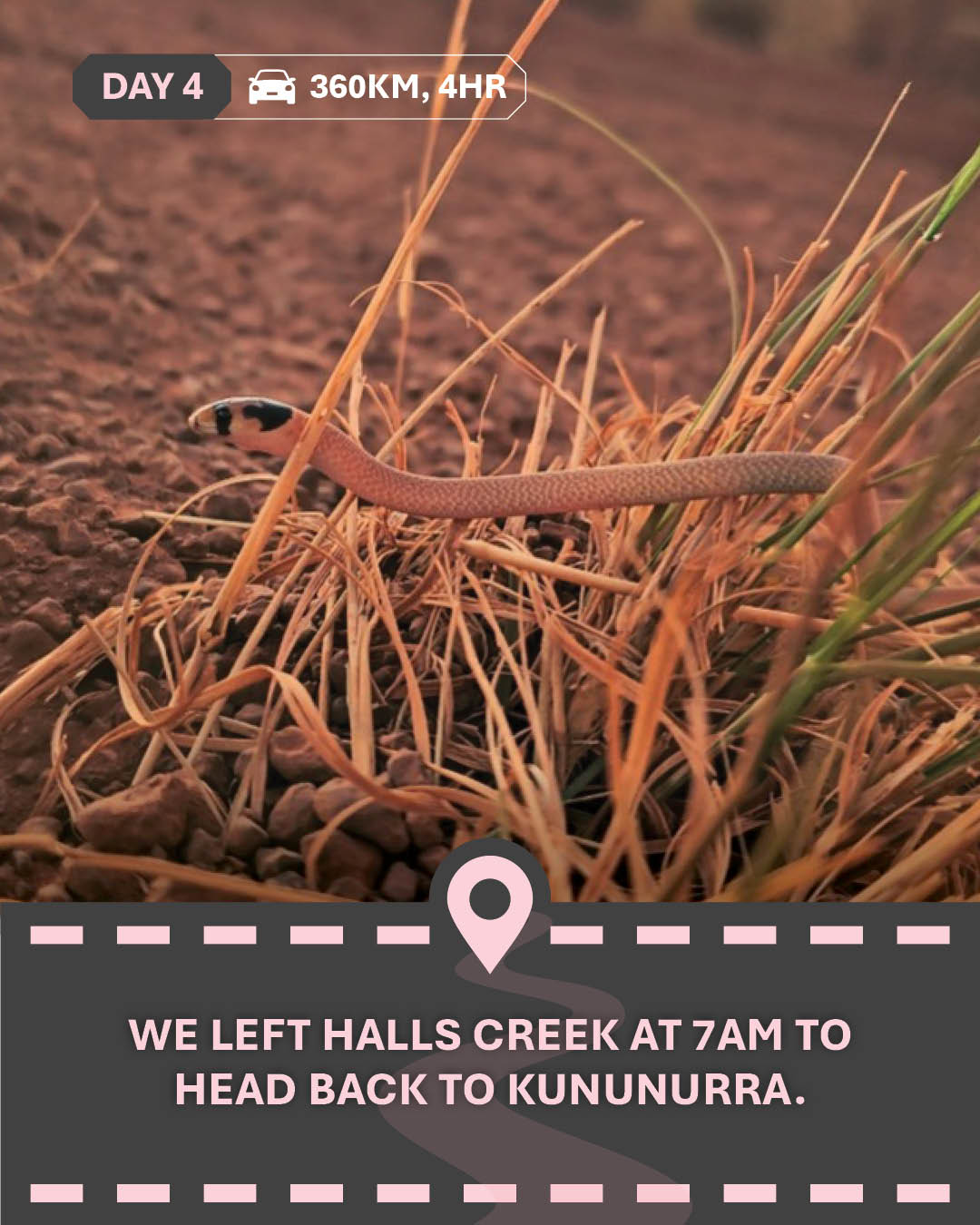
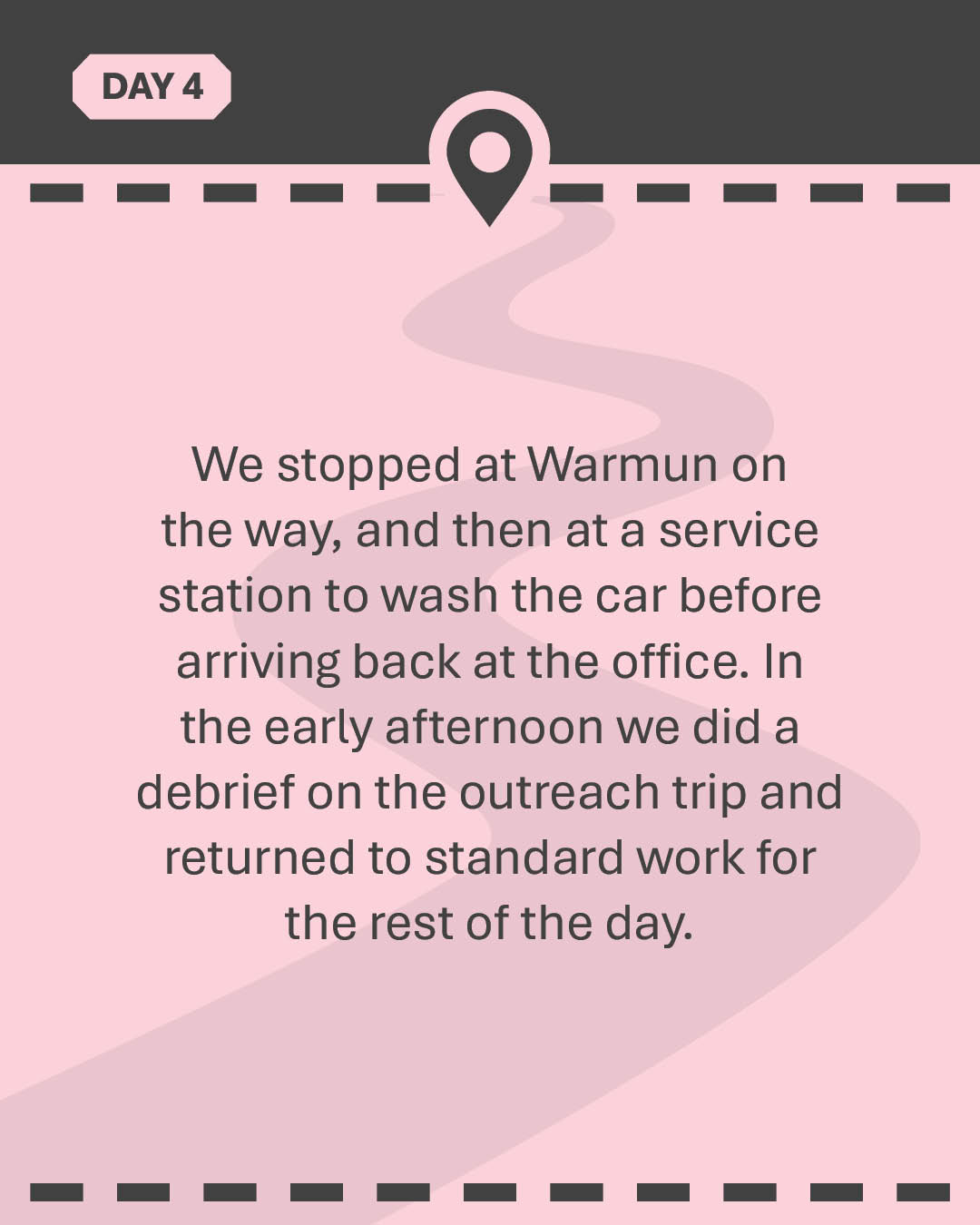
Workers can spend six or more hours driving to, carrying out, and travelling home from, a single client meeting. For outreach to communities more than a few hours away, community legal workers have to stay overnight, or for several nights, away from home.
Long distances between remote communities can be exacerbated by poor road maintenance, making journeys more difficult than they need to be. Many regional and remote community legal centres need to have and maintain four-wheel-drive cars.
At some centres, all lawyers, social workers, community education workers and others that go on outreach have to do special off-road driving training because the communities they serve are only accessible via unfinished roads.
Building trust in remote communities
Working with people in remote communities requires time to build trust. It’s unfortunately all too common for organisations, including government agencies, to visit a remote community once or twice, making promises to help, but then not come back again.
Community legal centres serving these communities know they might need to spend months demonstrating regular on-the-ground presence, showing up when and where they say they will, before people will start trusting them with their problems.
When a centre first starts providing outreach to a community they haven’t been to before, workers might do several outreach trips in a row with very few people coming to speak with them. These repeated, reliable outreaches are crucially important to building the trust that will make people feel safe seeking help in future.
Funding models aren't fit for purpose
Community legal centres travel a combined 1.26 million kilometres a year to provide services to people in regional and remote communities. That’s far enough to travel between Earth and the moon 3.3 times.
Centres often have to budget for four-wheel-drives, petrol, off-road driving and bush first aid training, accommodation, and sometimes flights for workers to travel to very remote communities in their catchment area. Communications infrastructure can be patchy in regional and remote areas, so some centres have to invest in satellite phones. This is all part of necessary spending to deliver effective services to people in regional and remote areas.
Centres have to budget significantly more staff time to account for the extra time needed to build trust and provide effective services to people in regional and remote communities. It’s often unsafe to send one worker alone on long drives in the bush, so centres will generally send at least two workers on every outreach, which also increases the time-cost to the centre.
The National Access to Justice Partnership (NAJP), the main funding source for the community legal sector, does not reflect the significantly higher costs of delivering services, or heightened legal and related need, in regional and remote communities.
Housing and childcare
The shortage of housing and childcare in regional and remote communities undermines safety, wellbeing and access to justice, and contributes to the community legal sector workforce crisis.
Regional and remote housing crisis
Regional and remote communities are facing a worsening housing crisis.
Rental vacancy rates are hitting record-lows while rent prices are rapidly increasing. Public housing is limited or non-existent in regional and remote areas, and in remote and very remote communities is often very poorly maintained.
Housing diversity is lacking, with a dominance of detached housing, which limits options for households on single- or lower incomes.
Government approaches to housing are city-centric and generally fail to address the needs of regional and remote people and communities.
For people who live in regional and remote areas, this means that it can be hard – or even impossible – to find a home to live in, let alone one that is affordable.
The appalling housing conditions in remote communities are confronting and, frankly, a national disgrace.
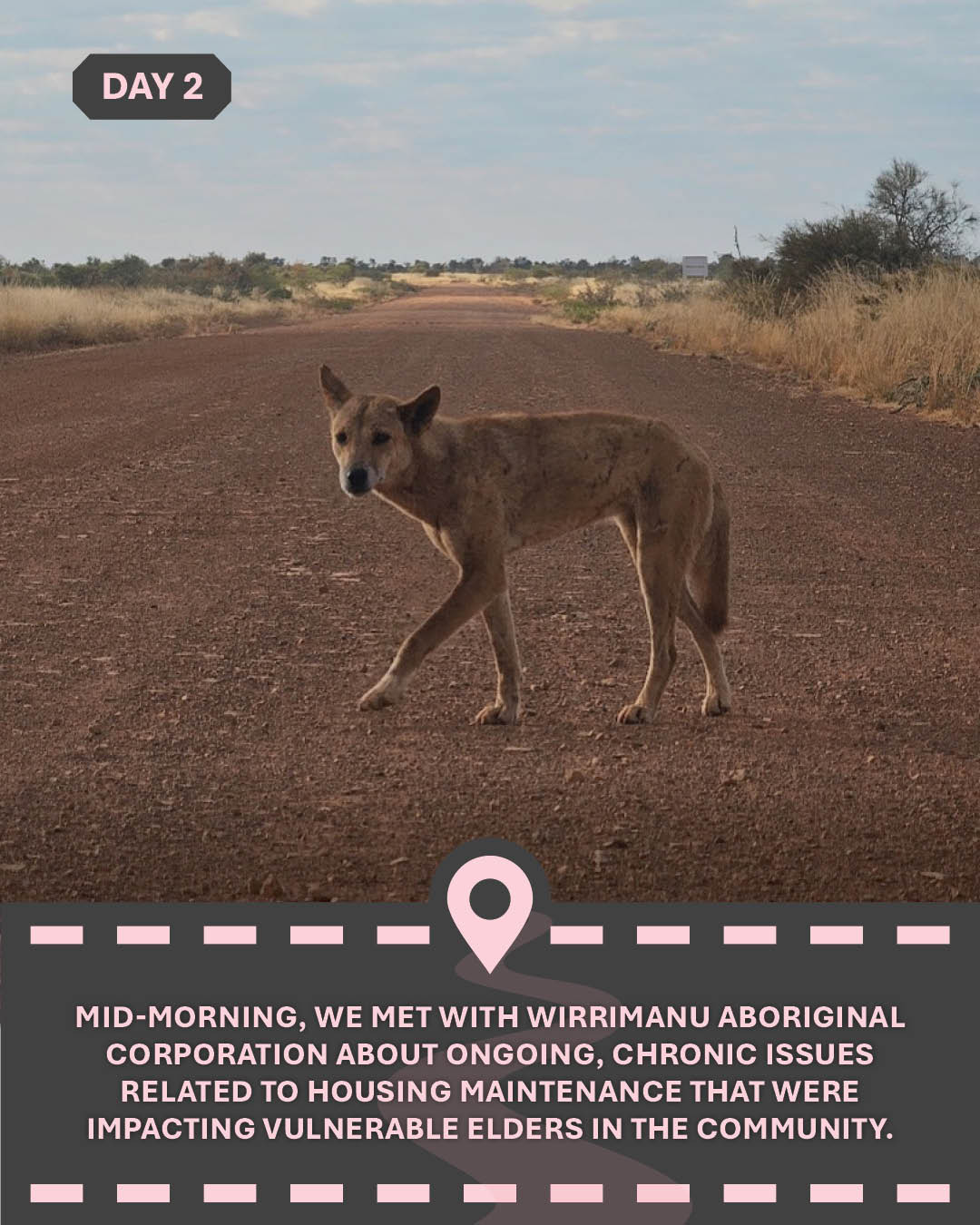
Respected Elders who are frail and have limited mobility are being forced from their homes because severe plumbing and electrical faults have made them unsafe to live in. Despite repeated reports, repairs are delayed or poorly completed, with little accountability for substandard work.
One Elder we spoke to had moved out of her home for five months, waiting for works to be completed and during that time was still paying rent (we will open a file to pursue compensation).
Community members are understandably frustrated and have lost confidence in the current maintenance system. Meaningful reform is urgently needed to ensure repairs are timely, of an acceptable standard, and genuinely improve living conditions.
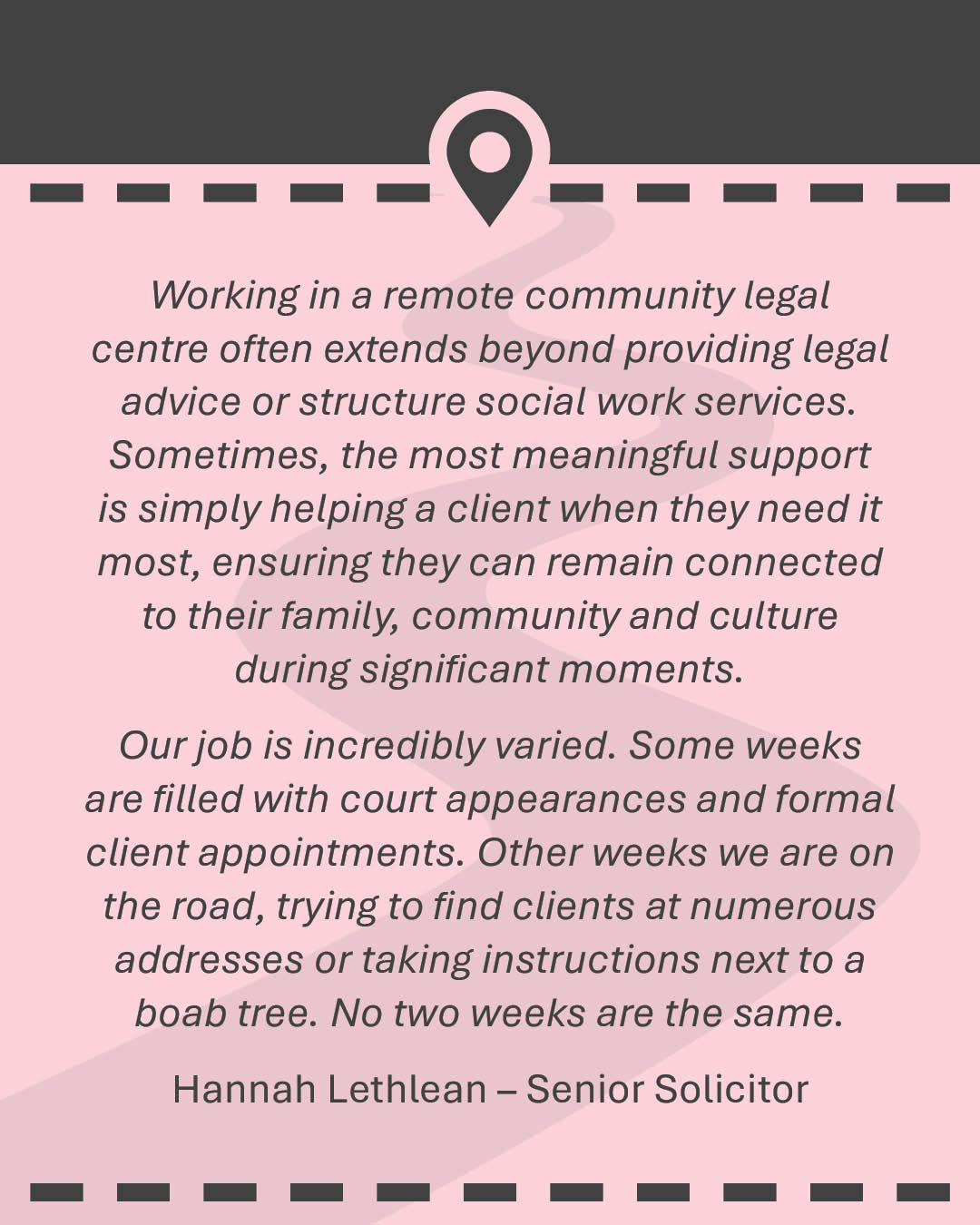
Hannah Lethlean, Senior Solicitor, Kimberley Community Legal Service
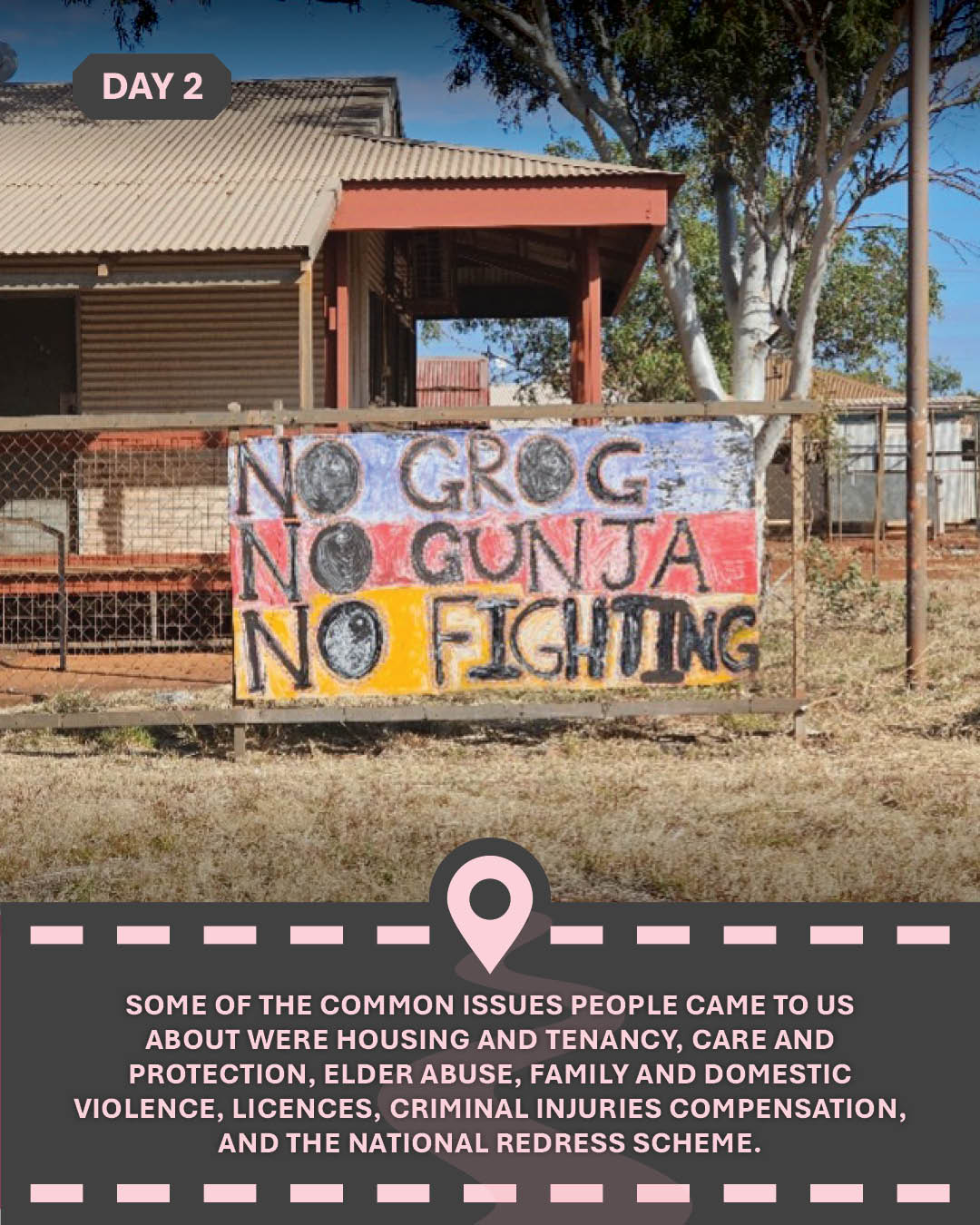
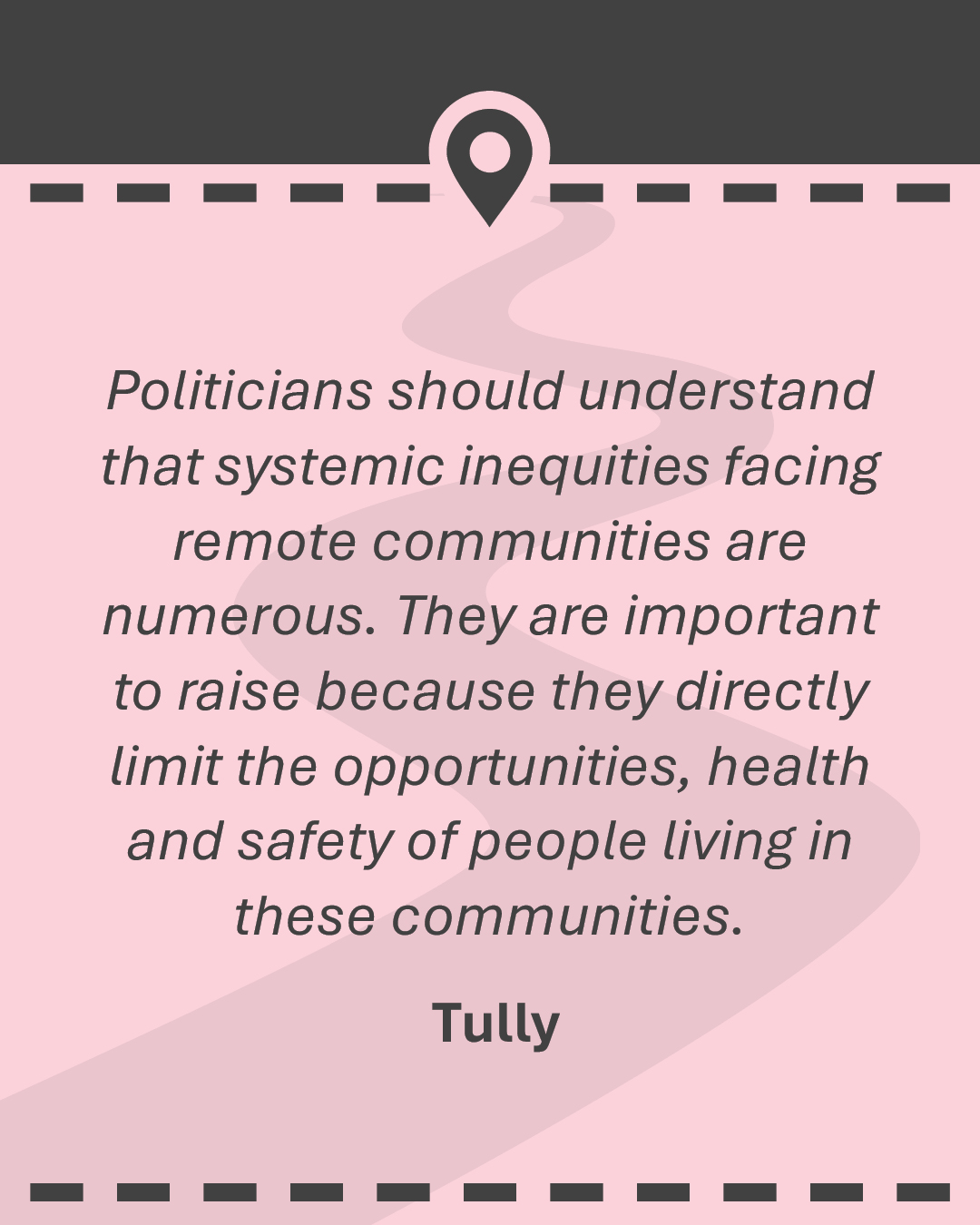
Housing overcrowding in remote NT communities remains among the worst in the country. As at September 2021, 54 per cent of houses in remote Indigenous communities in the NT were considered overcrowded, and more recent figures show over half of all remote community homes remain overcrowded today, with 97.6 per cent of people living in severely overcrowded dwellings being Aboriginal. While government investment has increased housing supply in recent years, the scale of the shortfall means overcrowding continues to directly undermine health, safety and wellbeing in these communities.
Research into family violence and housing has found regional and remote locations suffer from acute shortages in crisis, transitional and long-term housing, resulting in Indigenous women and children escaping family violence being turned away from safe houses that are already at capacity. There is no safe house for women and no women’s centre in this community, services that other remote communities do have access to.
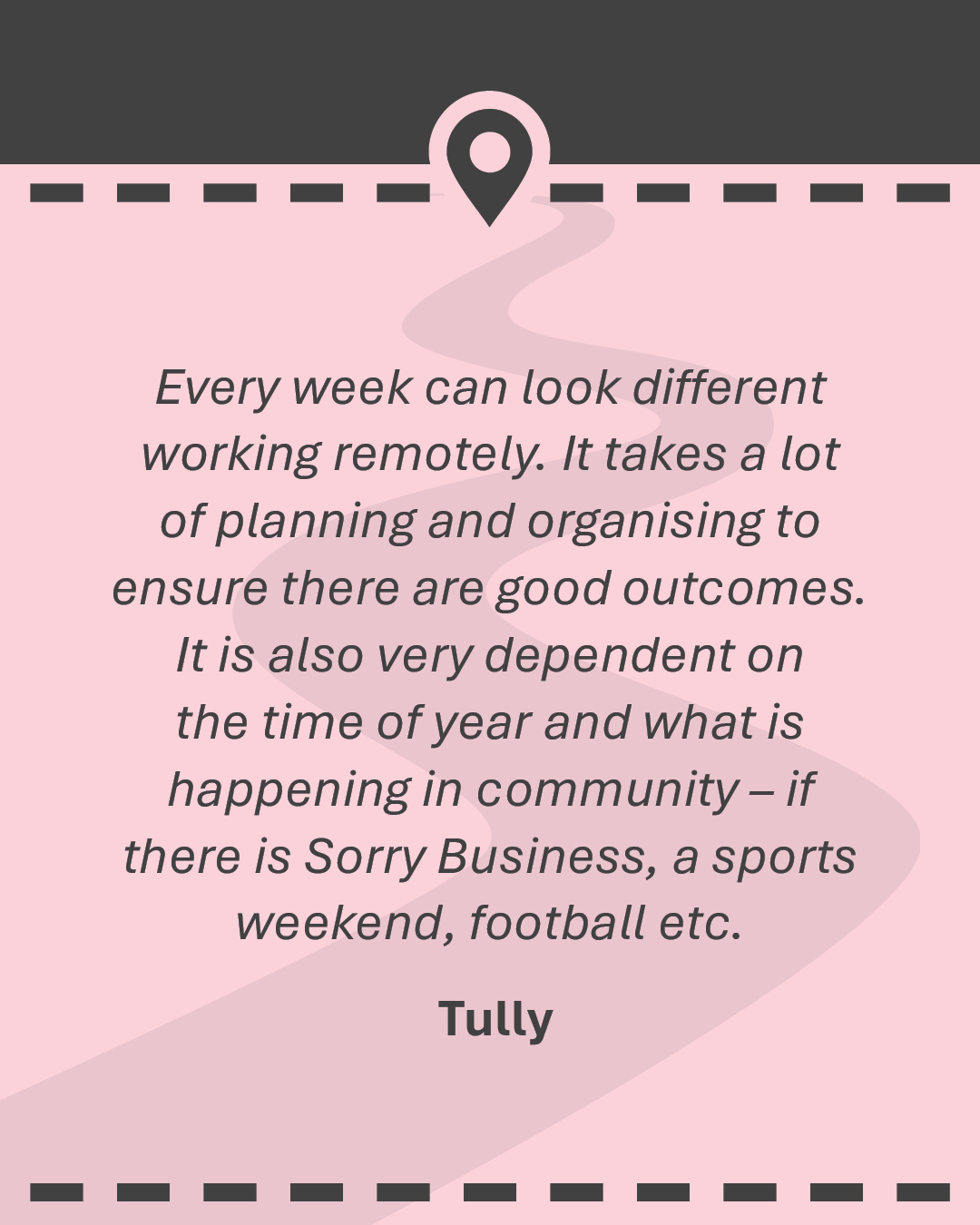
Tully McIntyre, Women’s Safety and Support Officer, Central Australian Women’s Legal Service
Shortages of early childhood education and care in regional and remote communities.
Early childhood education and care options tend to be limited and expensive in regional and remote communities.
Some of the reasons for this are high operational costs, workforce shortages, and infrastructure gaps.
In fact, regional and remote early childhood education and care providers face many of the same challenges as do regional and remote community legal centres.
A lack of available or affordable childcare contributes to the gender pay gap and can heighten risk factors for domestic and family violence through leaving victim-survivors isolated at home caring for children.
Access to early childhood education and care drops sharply with remoteness. National research has found remote and outer remote areas have the highest levels of childcare deserts, at 87.5 per cent and 79.9 per cent respectively.
More than two thirds of priority communities experiencing early childhood disadvantage in childcare deserts are in regional or remote areas, with a significantly higher representation of Aboriginal and Torres Strait Islander children among them.
This matches what is being observed locally: a childcare building exists but the service is not operating, and it is unclear whether this reflects a funding gap or an implementation failure.
Tully McIntyre, Women’s Safety and Support Officer, Central Australian Women’s Legal Service
Housing, childcare, and the community legal centres workforce crisis
The shortage of housing and childcare in regional and remote areas combine with chronic underfunding to drive an acute workforce crisis for community legal centres and other local services. Staff shortages then leave people and communities without access to the help they need and workers at risk of burnout and vicarious trauma in the face of overwhelming demand.
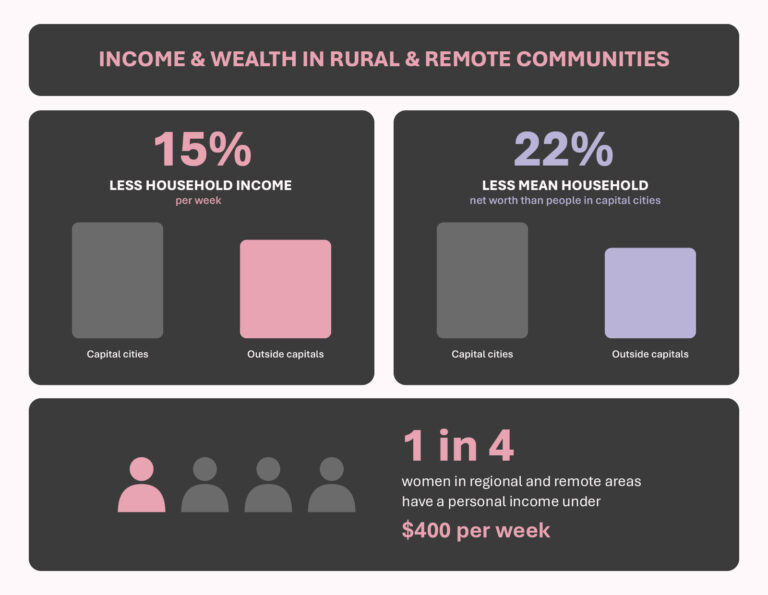
Community legal centres’ lack of resourcing to pay sufficient wages combine with low rental availability and high rent costs to leave frontline workers struggling to find a place to live. Limited childcare options can be another insurmountable barrier for regional and remote community legal sector workers who have children.
Systemic racism
Sovereignty has never been ceded. We acknowledge the hundreds of First Nations Countries and cultures that have lived on this land and beside its waters for millennia.
Australia was established based on the false claim of terra nullius, which was used to justify colonisation and genocide.
The ongoing impacts of dispossession, the Stolen Generations, and systemic racism mean that Aboriginal and Torres Strait Islander people experience much higher rates of poverty, gender-based violence, housing insecurity, physical and mental ill-health, and child removals than non-Indigenous people.
The Stolen Generations have never ended: the systematic removal of Aboriginal and Torres Strait Islander children from family, kin, Country and culture continue. This is a root cause of governments’ failure to deliver on Closing the Gap targets.
Politicians often think about youth justice in isolation from child safety in isolation from the family law system in isolation from domestic, family and sexual violence. Our clients are often impacted by all of these at the same time.
There needs to be more resourcing for services that understand these intersections, and the systems themselves need to improve their understanding of each other. Our lawyers are often asked to educate child safety workers on how the family law system works. The burden should be on those systems to properly understand the intersections themselves.
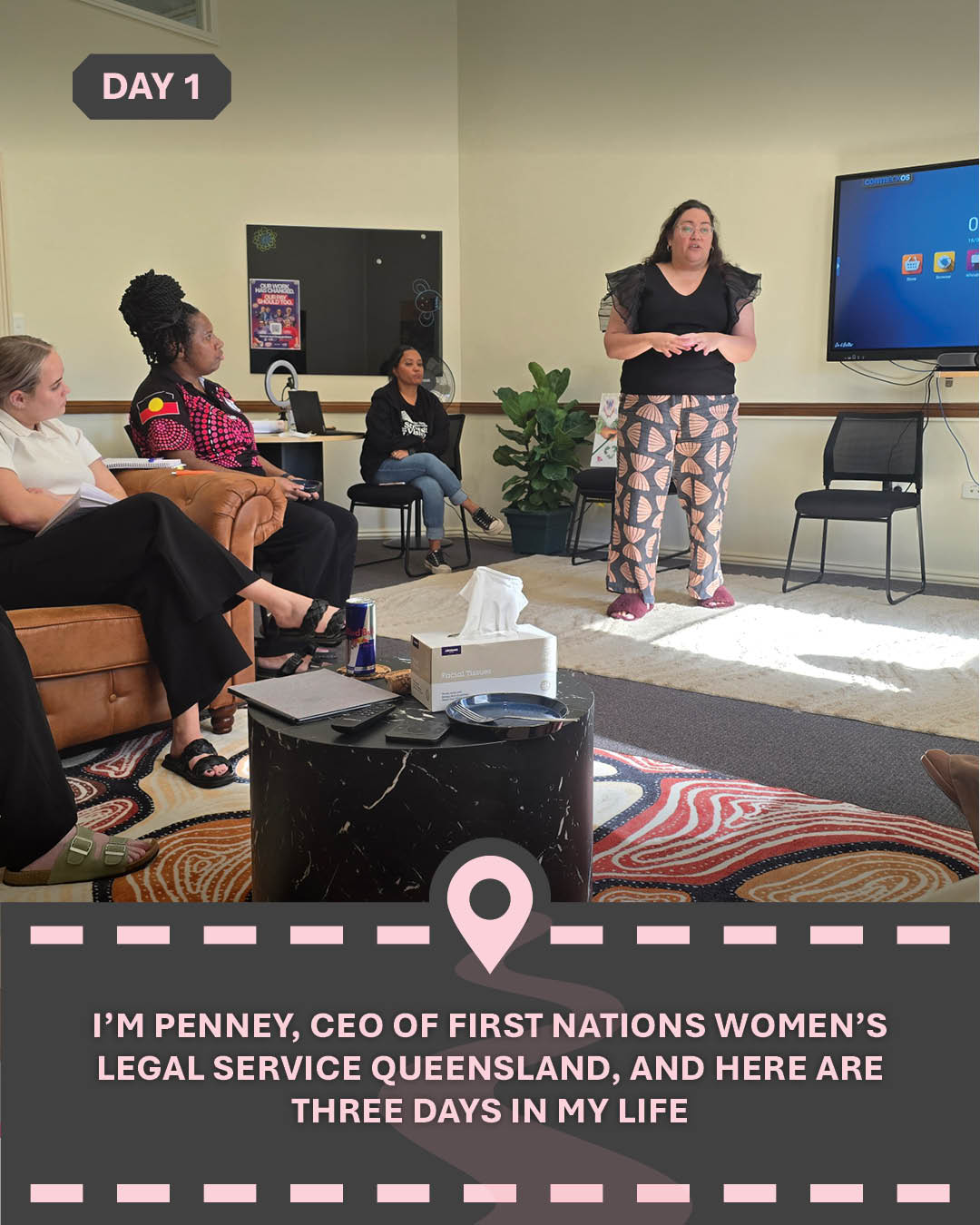
Penney Ferguson, CEO, First Nations Women’s Legal Service Qld
Aboriginal and Torres Strait Islander people face systemic racism and discrimination accessing mainstream health and mental healthcare services. The high cost of specialist healthcare and long waitlists for public services create extra barriers to accessing services. This contributes to poorer health outcomes and higher mortality rates for First Nations people. Culturally appropriate support to access healthcare, including mental healthcare, is lacking for First Nations people of all ages. Aboriginal and Torres Strait Islander community-controlled services are underfunded to stem the tide of poor health outcomes for First Nations peoples.
Aboriginal and Torres Strait Islander peoples experience harsher policing and far higher rates of imprisonment and deaths in custody than non-Indigenous people. Governments spend huge sums of money policing and jailing Aboriginal and Torres Strait Islander peoples, while underfunding evidence-based community-led solutions to justice problems.
Aboriginal and Torres Strait Islander people have provided governments with hundreds of recommendations over many decades to narrow the gap. Governments have too often ignored them.
Systemic racism drives legal need
The impacts of systemic racism against Aboriginal and Torres Strait Islander people can cause or worsen legal problems.
Racism in child removals systems means First Nations people are more likely to need legal support for child protection matters.
Racism in policing and prison systems means First Nations people are more likely to need criminal law assistance.
Racism that drives economic and health inequity means First Nations people are more likely to need legal and related support across a whole range of areas, like housing, employment, social security, and more.
Meanwhile, Aboriginal community-controlled legal assistance providers often tend to be the poorest funded and with workers paid the lowest wages.
Our centre does incredible work holding systems accountable, particularly when it comes to First Nations women, children, and families. When families have autonomy and support to create safety for themselves, we see better outcomes across family law, child safety, and domestic violence.
Our communities need to have a say and a share in the decision-making, when decisions directly affect us. The people living here care far more about the state of our community than any person whose job it is to make decisions from afar about our lives.
Penney Ferguson, CEO, First Nations Women’s Legal Service Qld
Systemic racism drives geographic discrimination in remote communities
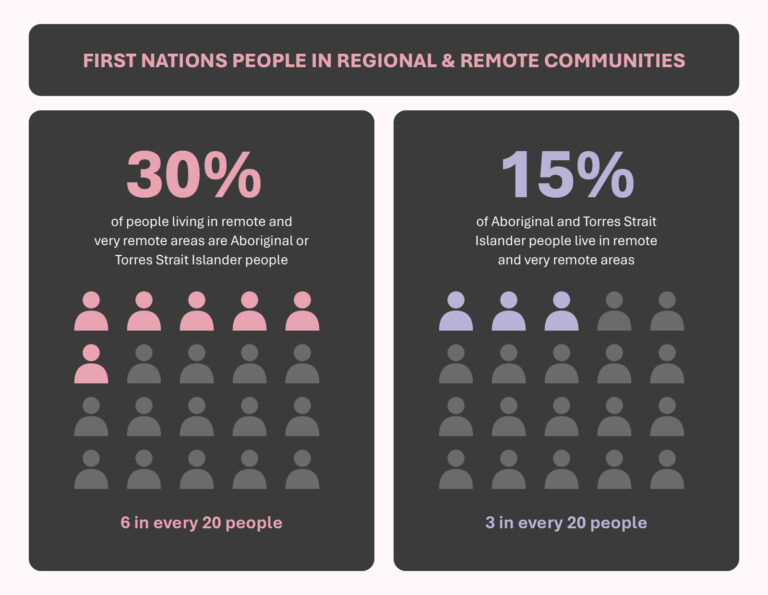
The proportion of First Nations people within the population increases with distance away from metropolitan areas. Government decisions that harm people in remote communities disproportionately harm First Nations people. This means geographic discrimination can be a proxy for racism.
The lack of funding for services that are meant for all people in Australia impacts those who live in regional and remote areas. Aboriginal people in these areas experience racism and discrimination based on their postcodes. Torres Strait Islander communities also face discrimination around food prices, fuel and flights. For example, a packet a biscuits that costs $3 in a city can cost upwards of $7 in a remote community.
Challenges are not due to a lack of willingness by community members, but rather a lack of essential infrastructure and service flexibility of government and non-government agencies. Clients are sent letters from various government departments asking them to log-in to portals, witness documents, or provide written responses. For many clients, English is their second language, and many communities lack the support and infrastructure for clients to complete these tasks. Seeing these systemic barriers continue to affect remote communities in this era is frustrating.
Hannah Lethlean, Senior Solicitor, Kimberley Community Legal Service
The decision to live in remote, regional, rural or very remote communities is multi-layered. Proximity to traditional Country ensures that cultural and ceremonial customs and traditions can continue. Older generations can teach and pass on these practices to younger people.
In living on and caring for Country, First Nations peoples continue traditions and culture that address environmental, water management, animal and land care practices. The way in which First Nations peoples honour care for, and connection to, Country, builds intercultural understanding, respect and pride. It provides vast opportunity to educate all people — migrants, new citizens, settler folk and visitors — about the deep benefits of looking after and connecting to place.
Geographic location, including living on Country, can be a crucial part of identity for Aboriginal and Torres Strait Islander peoples. Government decisions often treat where a person lives as ‘just a choice’ and therefore a reasonable ground for unequal access to services, justice, wellbeing and safety. This undermines the right of all people, and particularly First Nations people, to live in their home communities.
Climate and disasters
Climate change is a justice issue, and it disproportionately impacts people in regional and remote communities.
Regional and remote community legal centres adapt to weather and climate conditions
Regional and remote community legal centres adapt their service delivery in response to climate and weather patterns. Some of this is not necessarily attributable to climate change: centres plan outreaches around wet and dry season. Weather conditions and a lack of appropriate infrastructure can limit people’s access to justice if a centre is unable to do a planned outreach.
Climate change drives increasing severity and unpredictability of weather patterns, which can exacerbate these challenges.
Climate disasters create and worsen legal problems
Climate change is already driving more frequent and worsening climate disasters like fires, droughts, heatwaves, cyclones and floods. As governments continue to expand the fossil fuel industry and sideline climate mitigation measures, its impacts are set to worsen.
Disasters create and worsen legal problems related to people’s housing and tenancies, social security, debts, insurance, experience of domestic, family and sexual violence, and child protection. These problems can impact people’s lives, and entire communities, over many years.
Climate change compounds structural barriers. Disasters and the harshest extremes of day-to-day weather conditions most severely impact people who experience social and economic barriers to equality, and who are most often failed by our laws, policies, and justice systems. This includes people experiencing poverty, people living in regional and remote communities, and Aboriginal and Torres Strait Islander people, for whom climate change can impact cultural and spiritual connections to land and waterways, as well as physical wellbeing.
Legal help for people impacted by climate disasters
Empowering communities to avoid legal problems
Community legal centres deliver community education on disaster-related legal issues to support people to prepare for disasters. This risk reduction education includes topics like housing and tenancy laws, social security, financial literacy, preparing important documents, and insurance. This kind of education helps to insulate communities from the ripple effects of disasters.
Supporting people to recover after a disaster
Need for community legal help skyrockets after a disaster. People need community legal centres to help them in areas like housing and tenancy, insurance, social security, domestic and family violence, child protection, and more. People need help immediately, as well as throughout the ‘long tail’ of the disaster, in the months and years following.
Community legal centres have been a critical part of disaster response following disasters like the Black Saturday bushfires in 2009, Black Summer bushfires in 2019-20, and unprecedented flooding disasters across NSW, Victoria, South Australia, Western Australia and Queensland in 2021 and 2022 — just to name a few.
Many centres are in communities that have been hit by multiple disasters over the years. For example, Townsville Community Law has responded to monsoonal and flooding events in 1998, 2010-11, 2012 and 2019, and tropical cyclones in 1997, 2000, 2006 and 2011.
In many instances, community legal centres and staff are directly impacted by climate disasters, as well as contributing to response and recovery efforts.
This experience has taught us that communities value place-based services, from local organisations they already know and trust to be around long-term. People impacted by disasters benefit from the holistic, integrated, trauma-informed model we provide. Our support helps people manage the full range of legal and related needs impacting their lives during and following disasters.
Solutions to deliver justice where we live
There are several straightforward solutions that the Federal Government can immediately implement to improve access to justice for people and communities in regional and remote areas.
Our sector is very highly educated. Over half (55%) of the workers in our sector hold a graduate degree, master’s degree, or higher. However, university is expensive. People are graduating carrying large and growing debts.
To help incentivise people to choose to work at a regional or remote community legal centre, the Federal Government should establish a university debt forgiveness scheme.
The independent review of the National Legal Assistance Partnership (NLAP) recommended a HECS-HELP Forgiveness Scheme for remote and regional lawyers who work in the community legal sector:
“Existing literature suggests financial incentives, such as loan forgiveness schemes, can be effective tools for attracting new entrants to the workforce in regional and remote areas (Yong, J, et al. 2018). This is not a new proposition for bolstering key workforces in regional and remote Australia. The Commonwealth currently supports two similar initiatives: HELP for Rural Doctors and Nurse Practitioners, and Reduction of HELP debts for teachers in very remote areas.
“These two initiatives provide assistance for eligible recipients through two mechanisms. The first is a waiver of indexation on accumulated HELP debt, and the second is a reduction of accumulated HELP debt. The aim of the schemes is to increase the number of people in these roles living and working in rural, regional and remote Australia.”
The recommended scheme has not been implemented. This is a straightforward step the Federal Government should take to improve access to justice in regional and remote communities.
To further strengthen this initiative, the Federal Government should seek to support universities to formally partner with regional and remote community legal centres to provide paid placement opportunities for students to support future recruitment.
Students on placement can provide valuable contributions to regional and remote community legal centres. Beyond this, the experience of doing a placement at a regional or remote community legal centre can be life-changing for young people, opening their eyes to the kinds of work these centres do and in many cases causing them to seriously consider long-term careers working at regional or remote community legal centres.
Service delivery regional loading
Funding models for community legal centres don’t reflect the significantly higher costs of delivering services, or heightened legal and related need, in regional and remote communities.
Governments should do the work required to map legal needs and develop a funding model that reflects the true cost of delivering high quality, trauma-informed and culturally safe services to regional and remote communities.
In the meantime, the Federal Government should provide regional loading payments of at least 20% of total current funding to every regional and remote community legal centre.
Some examples of the kinds of things centres may spend the payment on include petrol and staff time for outreach trips, development of a new program or service, establishing a new collaboration or partnership, or making insecurely funded programs or services permanent.
Workforce regional loading
Community legal centres in regional and remote areas are experiencing a workforce crisis exacerbated by the cost-of-living and rental crises, sector under-resourcing, growing volume and complexity of legal need, a shortage of services in regional and remote areas, and more.
In 2024, the Queensland Government provided a $12.4 million funding uplift to improve wages and conditions for community legal centre workers. Community Legal Centres Queensland data from 2025 demonstrates that in the wake of the payment, worker retention, worker wellbeing, and sector capacity have all improved.
To address the acute workforce crisis the Federal Government should invest an additional $17 million to improve wages and conditions for community legal centre staff working in regional and remote communities.
Some examples of the kinds of things centres may spend the payment on include a wages uplift for all staff, relocation payments, additional professional development opportunities for staff, providing or contributing to housing or childcare for staff, and increasing the leave available to staff, like study leave, parental leave or cultural leave.
The Federal Circuit and Family Court of Australia consistently reports that around 80% of family law matters it deals with involve family violence. Rates are similarly high in the Family Court of Western Australia. However, too many victims-survivors, especially in regional and remote areas, face the family law system without the community legal help they need.
The family law system itself is chronically under-resourced, which can heighten the risk of harm and systems abuse. Community legal centres that provide free, specialised family law advice and representation services in regional and remote areas remain significantly under-funded to meet need.
Improving access to safety and justice for victims-survivors of family violence in the Family Court requires increasing investment in the family law system itself, and in regional and remote centres’ family law and family violence service capacity.
The Federal Government should increase resourcing for the Federal Circuit and Family Court of Australia and the Family Court of WA to address backlogs, implement trauma-informed processes, and improve cultural safety for Aboriginal and Torres Strait Islander people.
The Federal Government should also invest an additional $15.8m a year for regional and remote community legal centres to deliver family law assistance.